 Skip to content
Matching antique furniture is the hardest thing we do, and it is the reason a great many clients ring us. This page explains how it is done and where it stops.
On this page
We can match furniture that is 100 years old to new reproduction purchases made the year before.
That is the hardest thing we do, and the reason a great many clients ring us. It describes two different problems solved at once.
The first is matching a genuine antique: a hundred years of light, wax, handling and oxidation, with all the unevenness that comes with it. The second is matching a reproduction piece bought recently — often a factory finish, applied uniformly, which is in its own way harder because there is nowhere for a discrepancy to hide.
Most clients need both at once. A new piece has to sit in a room that has grown over decades without announcing itself as the newcomer.
Colour matching to a sample
We match to a sample. That is the method, and it is worth being precise about it.
You send us something that carries the colour: ideally the piece itself, or a drawer out of it, or a small offcut. Our polishers work in the finishing shop against that physical object, building the colour in stages and checking it in daylight until the two read as one piece rather than two.
That is why colour matching is priced on application rather than carried on the standard price list. The cost is polishing time — several more passes, with drying and assessment between each, and the willingness to strip back and start again if the third pass has gone a shade warm.
A photograph will not do it on its own. Screens and cameras both lie about wood, and they lie differently on every device. Photographs are useful for form, proportion, mouldings and handles. For colour we need the object.
Timber selection comes first
Colour is applied at the end, but the match begins with the board.
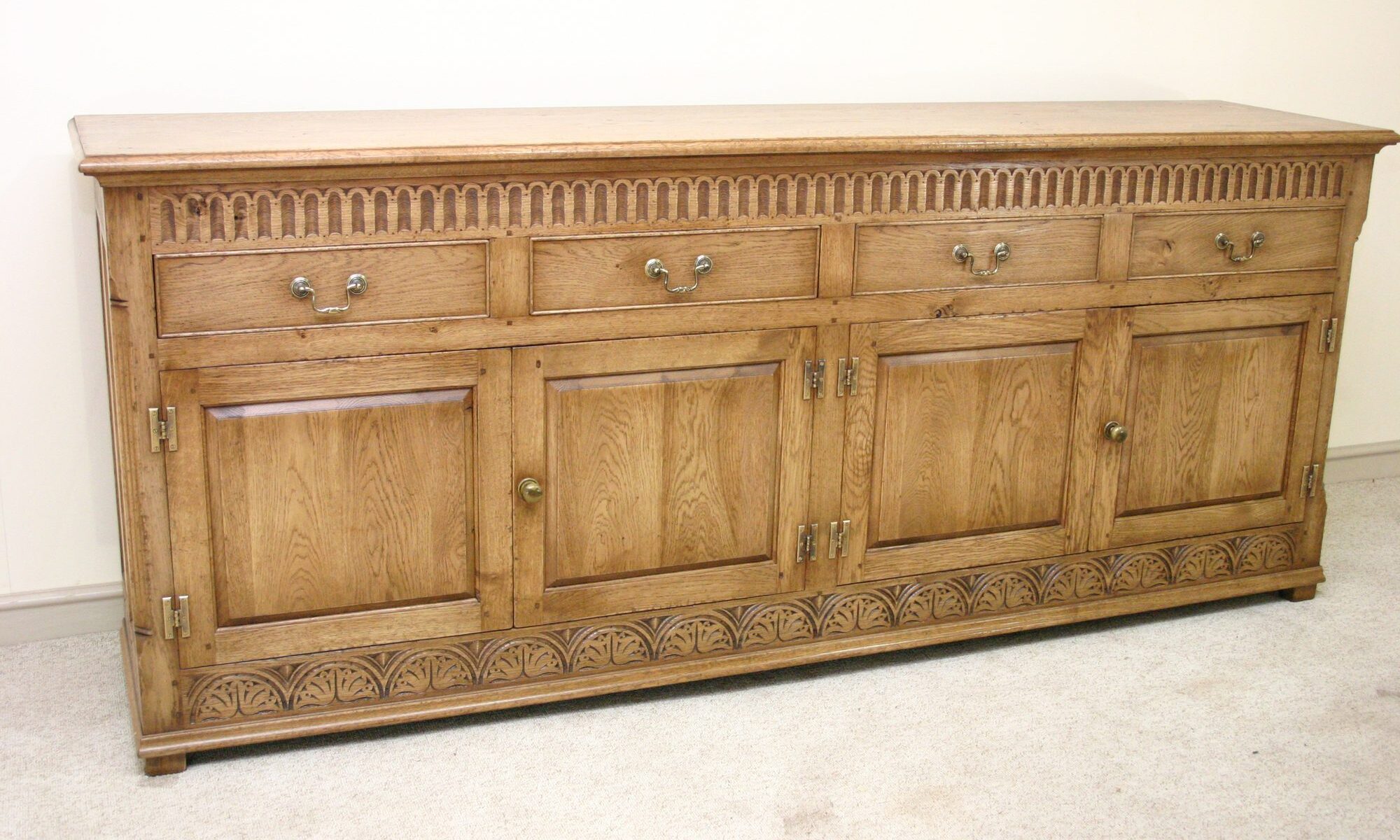
Oak, cherry, mahogany and walnut each take colour differently and each age differently, so we start by identifying what your existing piece is made from and matching the species where we sensibly can. Beyond species, the grain matters: an old piece cut from quarter-sawn oak, showing the silver flash of the medullary ray, will never be matched by a plain-sawn board, however good the polishing.
So we select for figure as well as species — clean timber with no knots where the original is clean, character oak where the original has movement and knots in it, and boards chosen for ray where the original shows ray. That selection happens before machining, on the boards themselves.
Where the original is veneered or cross-banded, we reproduce it the same way. More on timbers.
Much of our matching work is in mahogany, against Georgian and Victorian pieces. See mahogany furniture.
What to send us
The more of this we have, the closer the result.
Photographs. Front, side and a close-up of any moulding, handle or carved detail. One taken in daylight, without flash, near a window. Include something for scale.
Dimensions. Height, width and depth of the existing piece, and the space the new piece has to occupy.
The piece itself, or a part of it. A drawer is ideal. It carries the timber, the colour, the drawer front detail, the handle and usually the original construction, and it travels easily. A cupboard door works too. If the piece cannot be moved, tell us and we will discuss looking at it.
Anything you know about it. Roughly when it was made, whether it has been refinished, whether it stands in direct sun.
We send our own samples back, free, so you can hold our timbers and finishes against the original before anything is decided. Order samples.
The honest limits
We would rather set expectations properly than oversell this.
We match to a sample, not to a memory. Without the physical reference in the finishing shop, we are guessing, and a guess on a dining table is an expensive guess.
Timber is a natural material and it keeps moving. A new piece matched perfectly today will continue to mellow. Oak darkens and warms. Cherry darkens considerably and quite quickly, particularly in light. Walnut tends to lighten and lose some of its contrast. The old piece is largely settled; the new one has that ahead of it.
This works in your favour. We match to where the old piece is now, and the new one walks towards it over the following years. What we cannot do is freeze either piece.
Light and position matter. A piece in a south-facing bay moves faster than the same piece in a hall. If the two will live in very different light, tell us at the outset.
Some finishes cannot be honestly matched. A modern high-build lacquer has a surface quality a traditional polish does not imitate. We will tell you when the closest honest result is a good relationship rather than an identical twin.
Matching, extending and completing a set
Colour matching is usually part of a larger job: bedside chests to go with an inherited bed, a server to stand alongside a family dresser, two more chairs added to a set of six, a table made to a length the original maker never offered. All of it is commissioned in the ordinary way, at any of the three levels on the bespoke page, in any of the finishes we offer.
Send us a photograph
Start with a picture and a rough size. We will tell you honestly what we think is achievable before you commit to anything.
How long it takes. Matching work is quoted individually, because the answer depends on what we are matching. As a guide, a standard design is normally twelve weeks from order to delivery, up to sixteen when we are busy, and a genuine one-off usually adds around four weeks. Colour matching adds polishing time on top of that, and we will give you a realistic date once we have seen the piece. See how commissioning works.
Order timber and finish samples · Send us a photograph · 01449 710500
The same matching is done in fitted work: panelling and built-in furniture by Reeve & Co Interiors, kitchens by Square & True, made to sit alongside what is already in the house.
What matching antique furniture actually involves
Matching antique furniture is a finishing problem before it is a making problem. The carcass work is the straightforward part. Colour, sheen and wear are what decide whether a new piece looks like a member of the family or a visitor.
We work in a fixed order. Timber selection first, because no amount of staining will rescue a board with the wrong figure. Then the raw piece is toned to the base colour of the antique, which is almost never the colour people expect — most old oak has gone a good deal warmer and greyer than a new board. Then the grain is filled, or deliberately left open, to match. Then colour is built in thin coats and checked against the sample in daylight rather than under workshop lights. Then the sheen is cut back, usually well below what a new piece would normally carry.
Where matching antique furniture stops
Two things cannot be reproduced, and it is fairer to say so at the start.
The first is a century of uneven wear: the polish on the arms of a chair where hands have rested, the bloom around a handle, the dull patch where a lamp has always stood. We can suggest it, and we do, but suggestion is what it is.
The second is the movement of timber over a hundred years. An old top has cupped, settled and been re-flattened, sometimes more than once. A new top will do that over the coming decades in your house, not in our workshop.
What matching antique furniture can do reliably is get a new piece close enough that nobody looks twice, and leave time to close the last of the gap.
Frequently asked questions
Can you really match a 100-year-old piece?
Yes, and we do it regularly. We match to a physical sample in the finishing shop, building the colour in stages until the two read as one piece. We match new work both to genuine antiques and to recent reproduction furniture.
Do you need my original piece, or will photographs do?
Photographs are enough for form, proportion and detail. For colour we need something physical: the piece, a drawer, a door or an offcut. Cameras and screens misrepresent wood, and they do it differently on every device.
Will the new piece stay the same colour?
No, and neither will the old one. Timber continues to mellow. Oak darkens, cherry darkens quickly in light, walnut tends to lighten. We match to where your piece is now, and the new piece moves towards it over time.
How long does a matching commission take?
It is quoted individually, because it depends on the piece. As a guide, a standard design is normally twelve weeks from order to delivery, up to sixteen when we are busy, and a genuine one-off usually adds around four weeks. Colour matching adds polishing time on top, and we will give you a realistic date once we have seen your piece.
How much does colour matching cost?
It is priced on application, because the cost is polishing time rather than a fixed item. Tell us the piece and send a sample and we will quote it properly.