 Skip to content
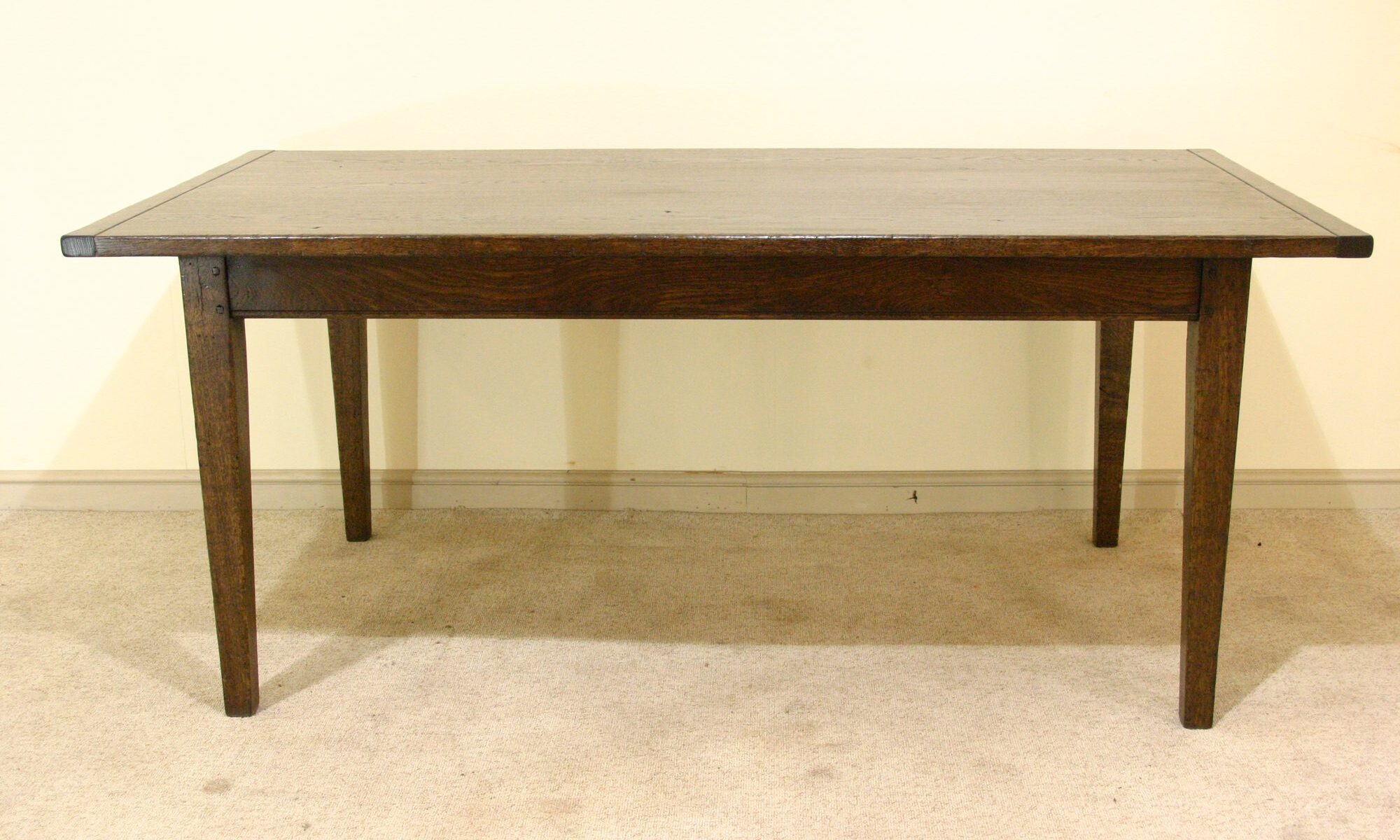
A farmhouse table made to order in solid oak, cherry, walnut or mahogany, to whatever length your kitchen actually is. Plain, useful, and made to take the marks.
On this page
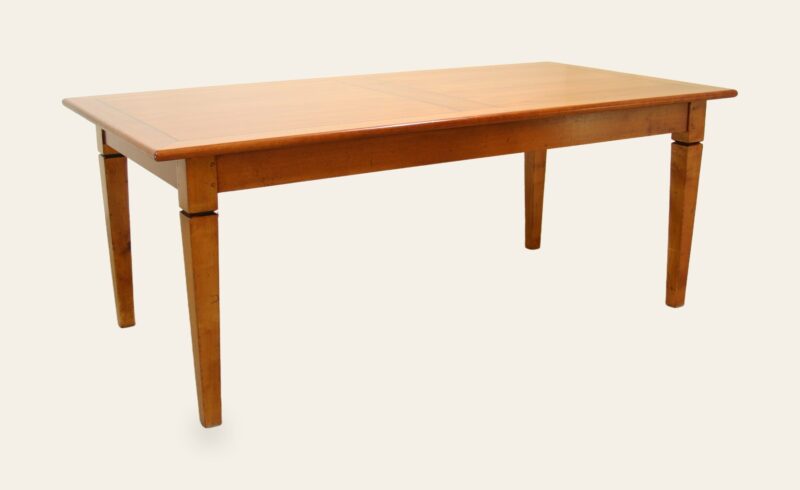
A farmhouse table is a frame table: four legs at the corners, a frieze rail between them, and a solid top sitting on the frame. It is the plainest useful table in English furniture, and it has never gone out of use because it does everything. You eat at it, work at it, and it takes the marks.
Ours are made to order in solid oak, cherry, mahogany or walnut, to whatever length your kitchen actually is.
The Pendleton range
Our farmhouse tables are the Pendleton range. Pendleton is simple rustic country furniture with no decoration to speak of — the interest is in the timber and the proportion.
The confirmed signature details of the range:
- Quintessential farmhouse tapered legs — square at the top, tapering to a smaller section at the floor, which is why a big table does not feel heavy.
- The optional Pendleton turned leg — a softer, more traditional country look than the taper gives.
- A large top suitable for dining or kitchen use — the Pendleton top is designed to be worked on, not just eaten off.
- Various drawer options — from none, to one in the end, to two in the frieze.
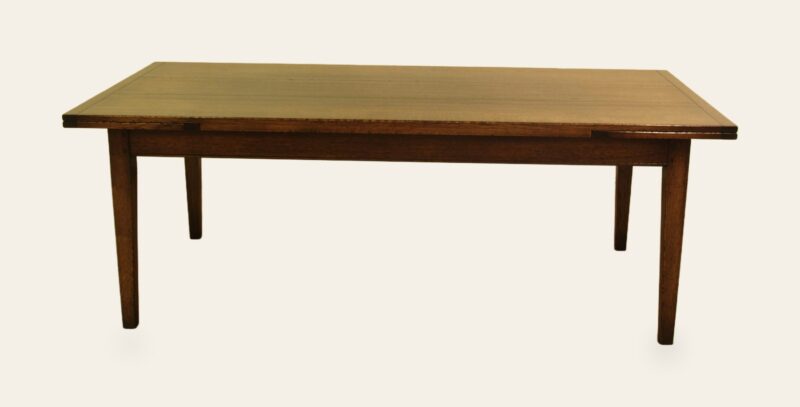
- Draw-leaves, frequently specified, so clients can seat more guests without losing space day to day.
Painted bases with a pippy or standard oak top are a signature Pendleton treatment, and the most requested combination in the range.
The forms we make
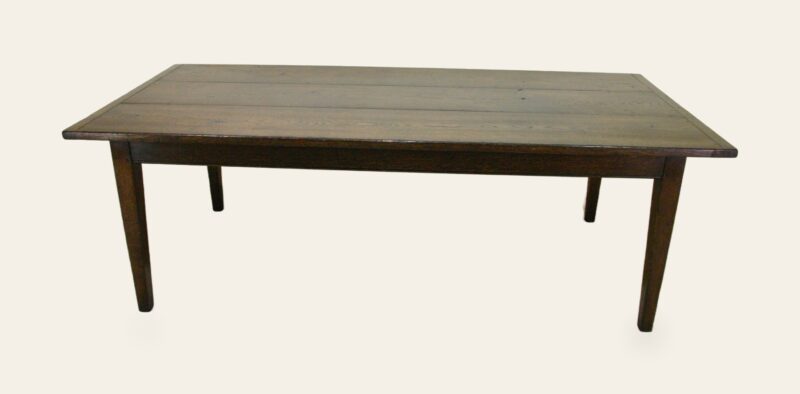
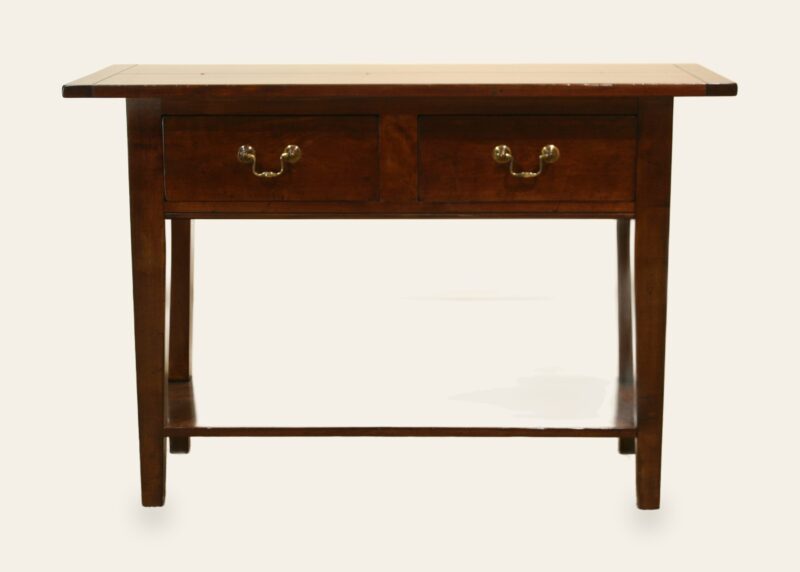
Farmhouse table with two drawers, straight legs. The standard: tapered legs, two drawers in the frieze, a solid top.
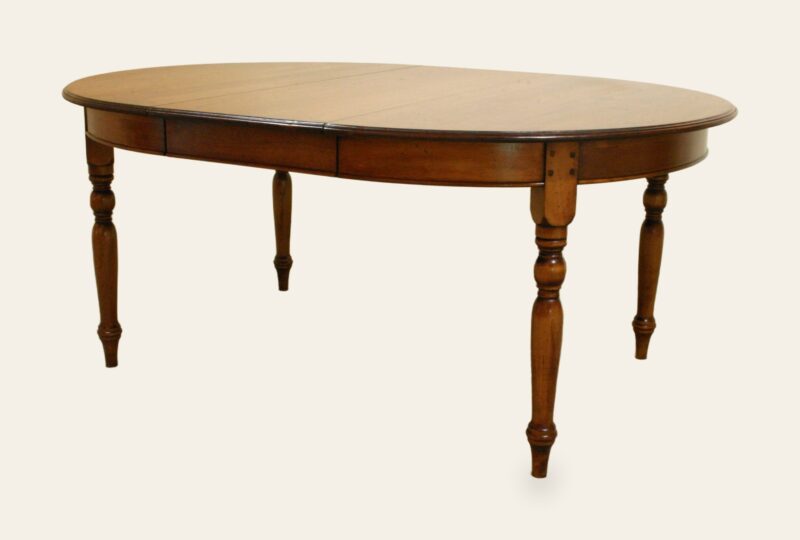
Farmhouse table with two drawers, turned legs. The same table on the Pendleton turned leg.
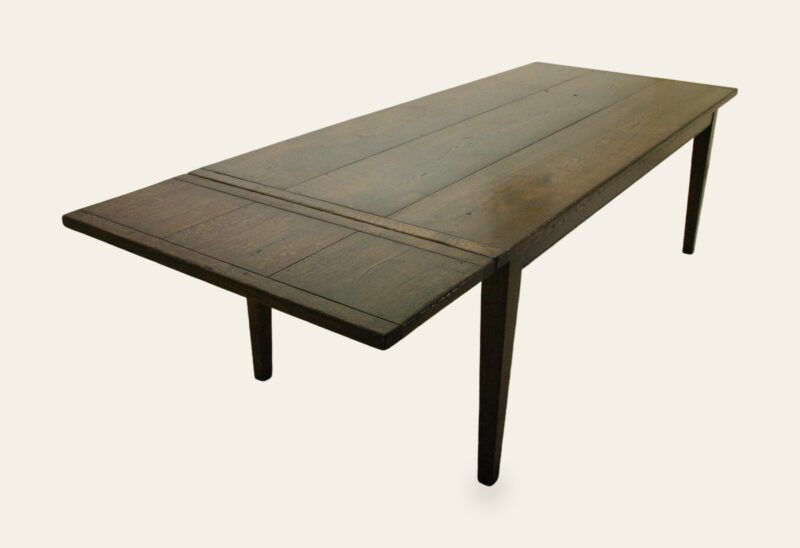
Farmhouse with drawleaf. Two leaves stored under the main top, drawn out level at either end. See drawleaf tables.
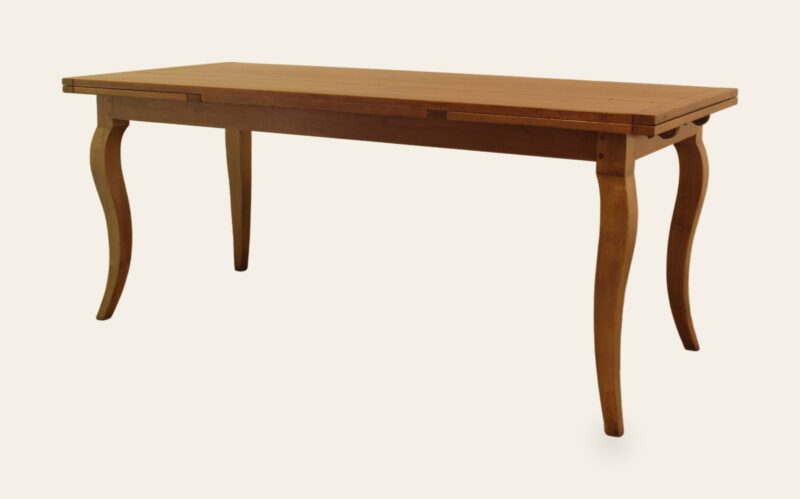
Farmhouse drawleaf with cabriole legs. The cabriole — the S-curved leg that sweeps out at the knee and in at the ankle — dresses the form up without changing what it does.
Round farmhouse with one leaf. A round top on turned or tapered legs, with one leaf that takes it out to an oval.
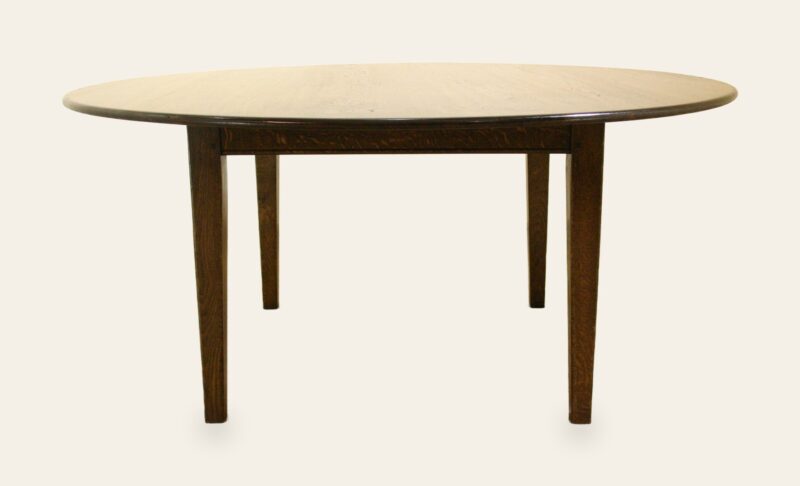
Round farmhouse, fixed top. The same without the leaf. Good in a square kitchen.
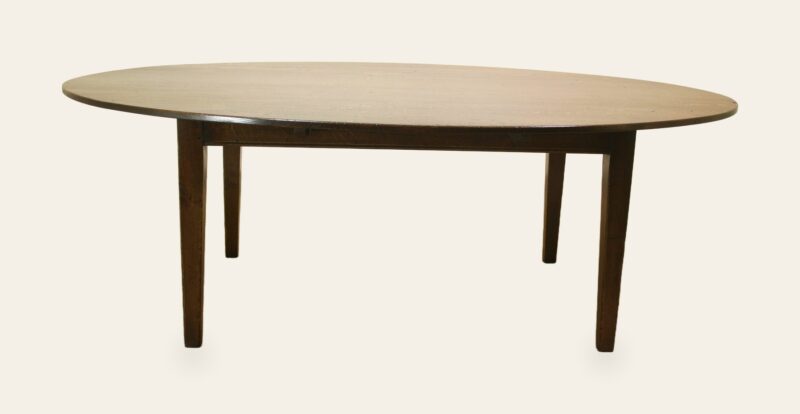
Oval farmhouse extending. The oval seats more than a round of the same width, and is kinder in a narrow room.
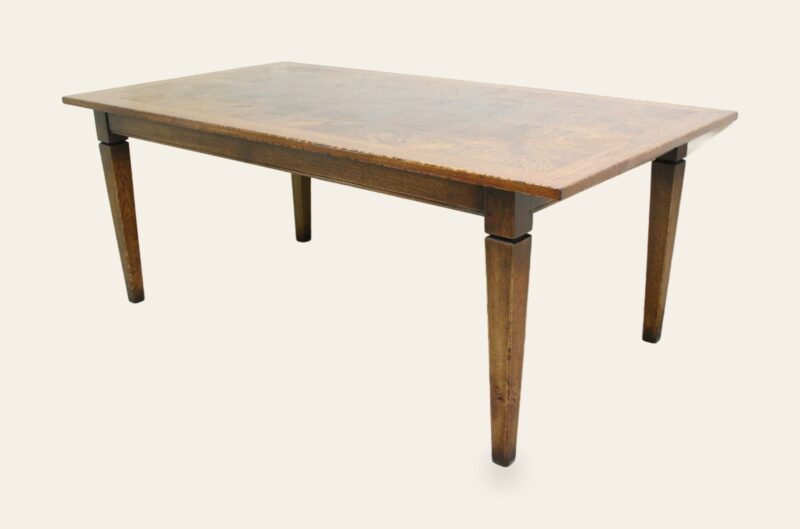
Square-legged with painted legs and a pippy or standard oak top. The painted-base treatment on the plainest frame. We also make a parquet-top farmhouse and the Thailand fixed-top table.
For the chunkier, timber-led alternative, see the Oakamoor range, which also offers drawleaf and fixed-top tables.
Sizes
Made to your length. Allow about 24in of table edge per person and about 36in of clearance behind the chairs.
Round tops work from about 48in for four. Any size is possible — these are the sizes we make most often, not a menu.
Farmhouse table
With 2 drawers, straight legs
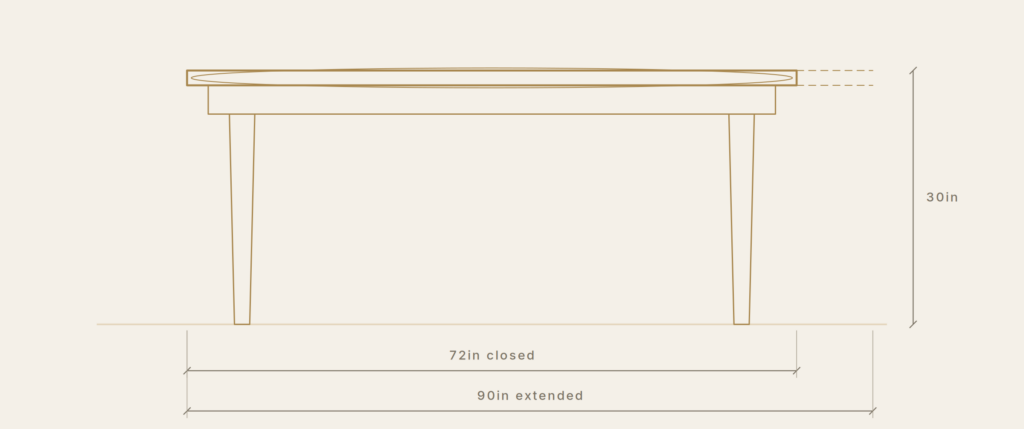
Width 66, 72, 78 or 84″ (168–213cm)5ft 6in, 6ft, 6ft 6in or 7ft168, 183, 198 or 213cm1680, 1830, 1980 or 2130mmDepth 35″ (90cm)2ft 11in90cm900mmHeight 30″ (76cm)2ft 6in76cm760mm
Farmhouse table
With drawleaf, straight legs
Width 60, 72, 84 or 90″ (152–228cm)5ft, 6ft, 7ft or 7ft 6in152, 183, 213 or 228cm1520, 1830, 2130 or 2280mmDepth 35″ (90cm)2ft 11in90cm900mmHeight 30″ (76cm)2ft 6in76cm760mm
Farmhouse kitchen table
With 2 drawers, turned legs
Width 66, 72, 78 or 84″ (168–213cm)5ft 6in, 6ft, 6ft 6in or 7ft168, 183, 198 or 213cm1680, 1830, 1980 or 2130mmDepth 35″ (90cm)2ft 11in90cm900mmHeight 30″ (76cm)2ft 6in76cm760mm
Farmhouse kitchen table
With 2 leaves, 45 cm (18″) each, turned leg
Width 60, 72, 84 or 90″ (152–228cm)5ft, 6ft, 7ft or 7ft 6in152, 183, 213 or 228cm1520, 1830, 2130 or 2280mmDepth 35″ (90cm)2ft 11in90cm900mmHeight 30″ (76cm)2ft 6in76cm760mm
Round farmhouse table
With one leaf of 45 cm (18″). Tapered leg
Width 54″ (137cm)4ft 6in137cm1370mmDepth 54″ (137cm)4ft 6in137cm1370mmHeight 30″ (76cm)2ft 6in76cm760mm
Round farmhouse table
With one leaf of 45 cm (18″). Turned leg
Width 54″ (137cm)4ft 6in137cm1370mmDepth 54″ (137cm)4ft 6in137cm1370mmHeight 30″ (76cm)2ft 6in76cm760mm
Oval farmhouse extending table
Width 66″ (168cm)5ft 6in168cm1680mmDepth 57″ (145cm)4ft 9in145cm1450mmHeight 30″ (76cm)2ft 6in76cm760mm
Made in oak, cherry, mahogany or walnut
These are the sizes we make as standard. Every piece is made to order in our own workshop, so any size between — or beyond — those listed can be made for you. Heights and depths can be altered to suit a room, and dimensions are nominal.
Timbers
Oak, cherry, mahogany and walnut are standard, and every Pendleton table is priced in all four. Oak is the usual choice.
Specials, on application: character oak, with knots and movement left in, so a new table reads as an old one; pippy oak in light, medium and heavy grades, for tops — the classic partner to a painted base; oak selected for medullary ray, within or without the timber; and clean timber with no knots at all.
Finishes: polished, painted, limed, sand-blasted, rub-through paint, natural, or colour matched to a sample. Rub-through paint on a farmhouse base — the colour worn back at the edges as chair legs would wear it — is worth seeing in person.
Order timber and finish samples before you choose a paint colour.
Made to your size
Length, depth, height, leg pattern, drawer arrangement and overhang are all yours to set. Common changes: a length cut to fit between an island and a wall to the inch; a greater overhang at the ends so a carver can pull in; drawers deepened for cutlery; legs set further in so a bench settle fits underneath; leaves added to a fixed-top design.
If it is a new design rather than a variation, our designers draw it first. See bespoke and commissioning.
Chairs to go with it
Farmhouse tables are most often specified with Windsor chairs or ladder backs, a carver at each end, and often a long stool or bench settle.
Prices
Every table is quoted to its size. Tell us the length, the depth, the leg, the timber and the finish and we will give you a guide price. Special timbers, colour matching and natural finishes are priced on application. Standard lead time is normally twelve weeks, and up to sixteen when the workshop is busy. Your date is confirmed when you order.
A farmhouse table is often one part of a larger scheme. When it is, the panelling and built-in work alongside it come from Reeve & Co Interiors, and the kitchen from Square & True — the same benches, the same hands.
Every size, timber and finish for our farmhouse tables is priced on the Farmhouse tables order page, where you can choose the options and pay the deposit online.
Choosing the size of a farmhouse table
Allow six hundred millimetres of table edge per person and nobody will be short of room. Eight hundred is generous, and is the figure to use if the chairs have arms.
Width matters more than people expect. Under about eight hundred and fifty millimetres, two people opposite one another cannot both put down a plate and a glass without negotiating. Nine hundred to a metre is the comfortable range for a farmhouse table that is also used for homework, laptops and rolling pastry.
Then leave seven hundred millimetres between the table edge and the nearest wall or unit where a chair has to pull out, and a full metre where somebody has to walk behind it. That clearance, rather than the table itself, is usually what settles the length.
How a farmhouse table ages
The top is the part that lives. We make them from wide boards, four or five across a metre of width, jointed and thicknessed to between thirty-two and forty-five millimetres depending on the length.
A farmhouse table is meant to take marks, and it will. An oil finish takes them and lets us sand and re-oil a patch without stripping the whole top. Lacquer resists them for longer and has to be dealt with as a whole surface when it eventually goes. Neither is wrong. Kitchens that cook hard usually want oil.
Breadboard ends — a cross piece at each end of the top — keep a wide top flat and are the traditional answer on a long farmhouse table. They also move seasonally against the boards, so a small step at the corner in a dry winter is correct rather than a fault.
A farmhouse table is traditionally paired with handmade ladder back chairs with rush seats.
Frequently asked questions
What is the difference between a farmhouse table and a refectory table?
A farmhouse table is a frame table, with legs at the corners and usually drawers in the frieze. A refectory table has legs set in at the ends, a low stretcher between them and generally a heavier planked top.
Can a farmhouse dining table in solid oak extend?
Yes. The Pendleton drawleaf carries two leaves under the main top, so you get the length without a loose leaf to store. Round and oval versions extend with a single leaf.
Are painted farmhouse tables as hard-wearing as polished ones?
Yes, on the base. We would not normally paint a top that is going to be worked on: a bare or polished oak top over a painted frame is the combination that lasts.
Can you match a farmhouse table to a dresser I already own?
Usually. Send photographs and, if you can, a sample of the finish. See matching antique furniture.