 Skip to content
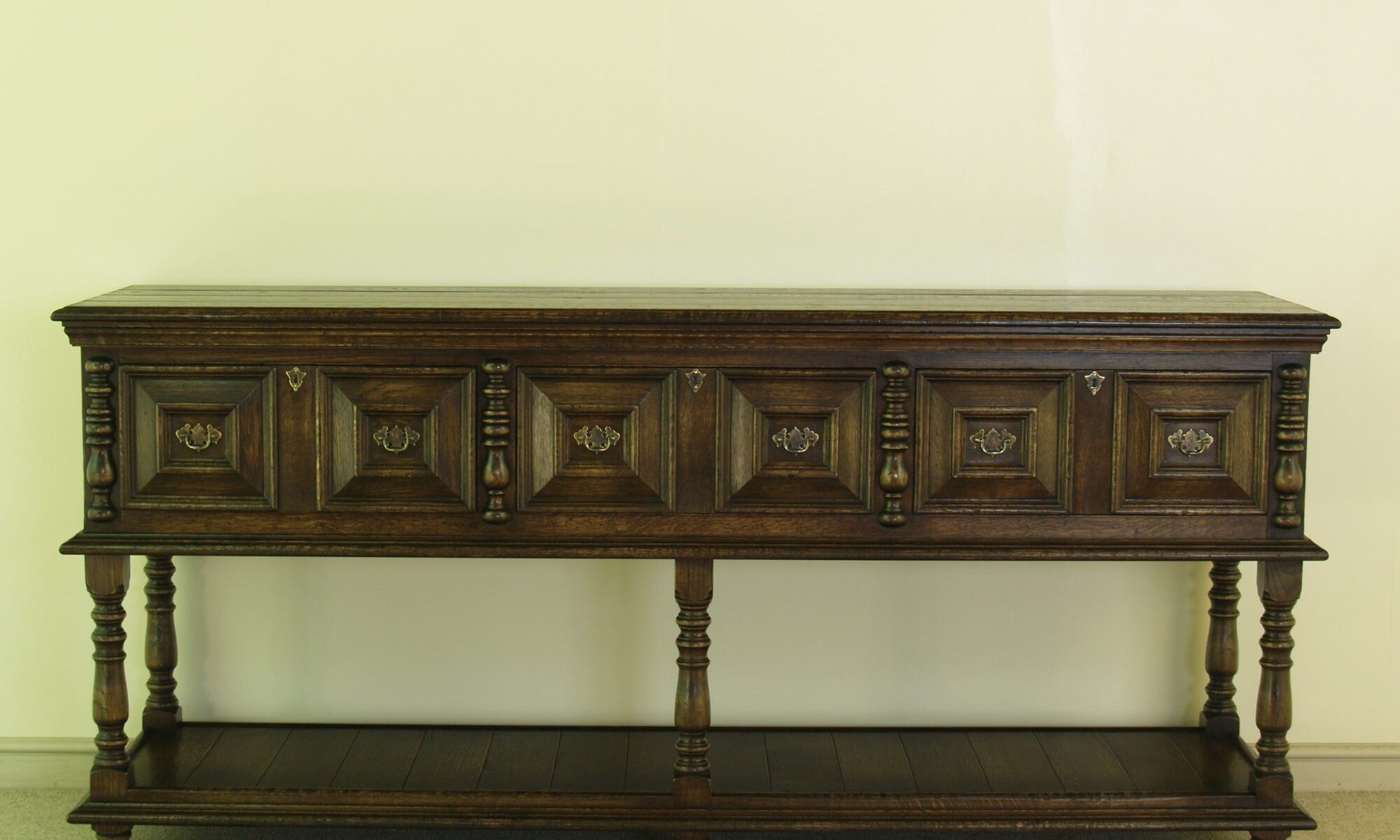
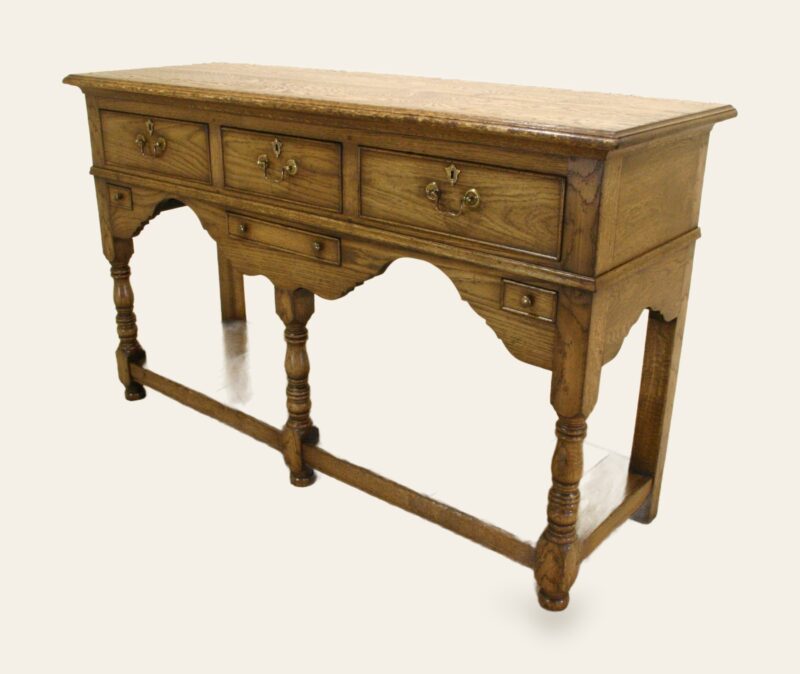
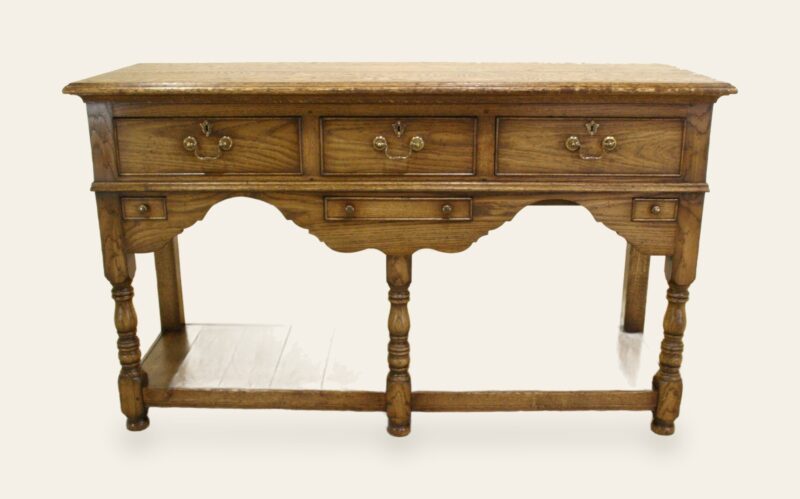
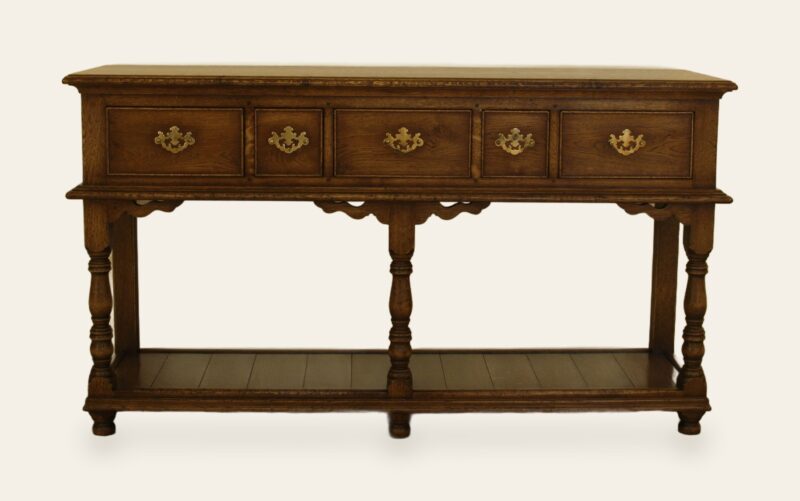
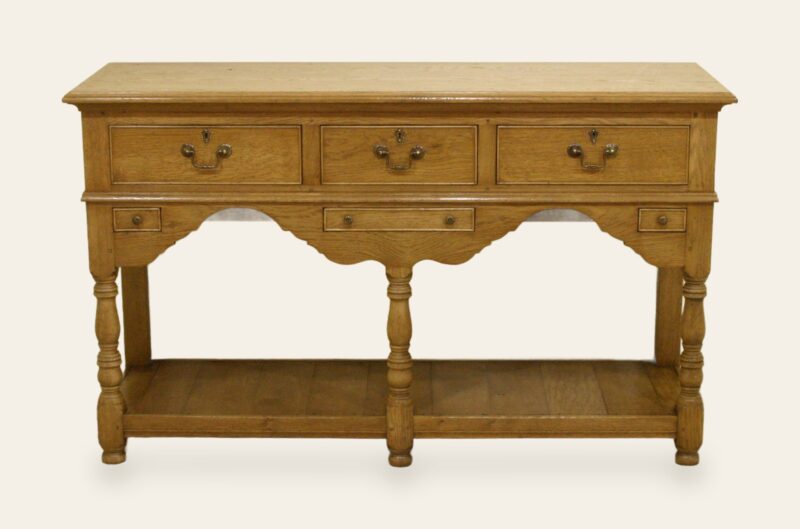
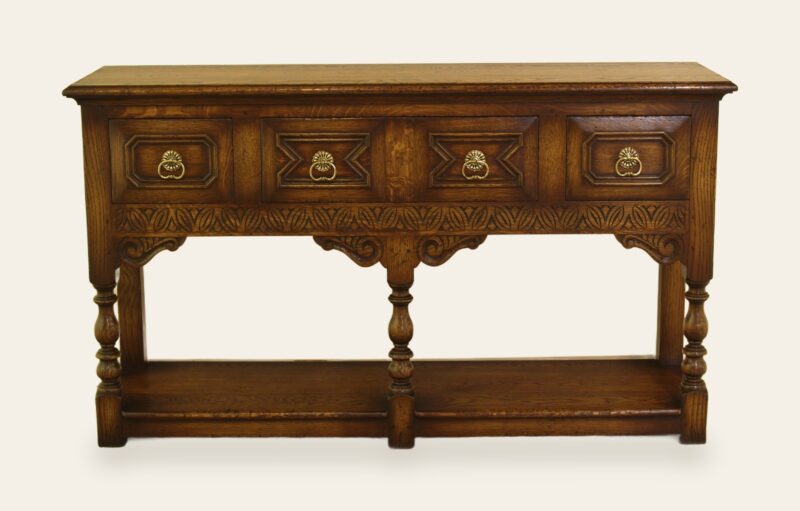
A potboard dresser base has an open shelf low between the legs instead of cupboards. Drawers run across the top under a solid working surface; below them the piece is open, and near the floor a boarded shelf spans from leg to leg. That shelf is the potboard, and it is the whole point of the form.
On this page
What a potboard actually is
In a farmhouse kitchen the heavy things were the cooking pots — iron, glazed earthenware, big enough to need two hands. You could not lift them onto a shelf and you did not want them on the floor. So the base was built with a board slung low between its legs, at shin height, where a pot could be slid on and dragged off. The name is literal: it is the board the pots stood on.
Everything else follows from it. The base is open at the front and sides rather than panelled, so a pot goes on from any direction. The legs are substantial, because they carry the load. The drawers sit high, under the top, because the space beneath is committed to the board.
Why people want one now
Almost nobody buys one for cooking pots now. They buy it for three other reasons.
It is much lighter to look at. A cupboard base is a solid block against the wall. A potboard base is a top, a row of drawers, and then air with four legs in it. In a small or low-ceilinged room that is the difference between a piece that fits and one that dominates, and a flagstone floor keeps showing.
It is honest storage. Baskets, stoneware, cookery books, a dog bed. What goes on a potboard is meant to be seen, so it stays tidy in a way a cupboard never does.
It is the country dresser. Ask people to picture a Welsh dresser and this is what they picture.
The bases we make
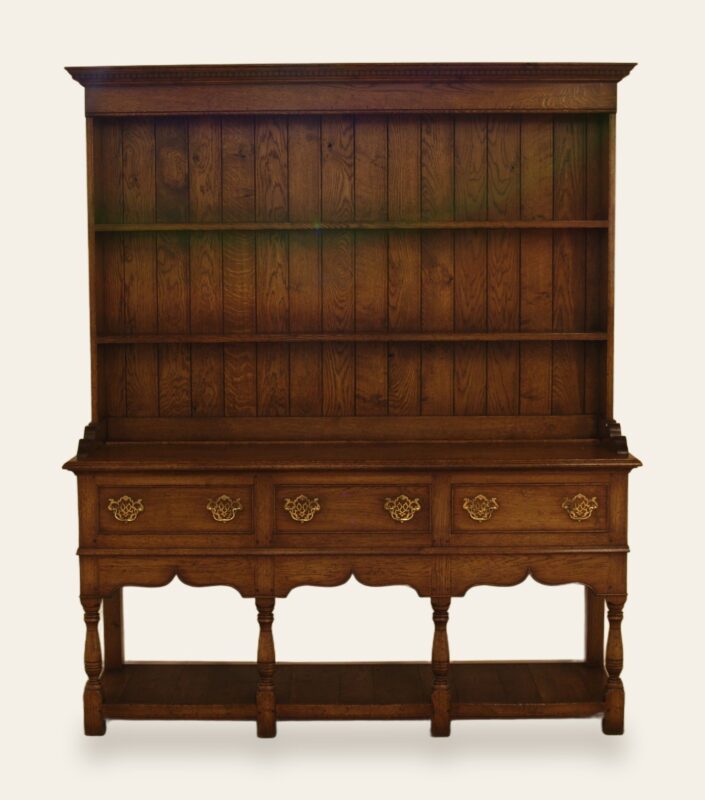
Three-drawer potboard base. The standard and the most-specified size: three drawers across the front, turned or square legs, and a boarded potboard between the lower rails. Also made narrower, for a chimney return.
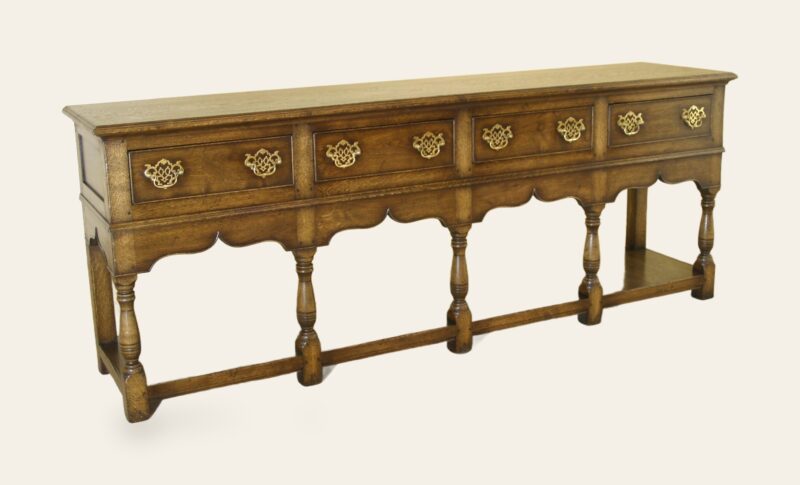
Four- and five-drawer potboard bases. The same form lengthened. Four is the proportion most people want on a full wall; five is for a large kitchen where four would look short.
South Wales five-drawer potboard base. The regional pattern: five drawers, with the leg turning and front framing of the South Wales dressers rather than the plainer English one.
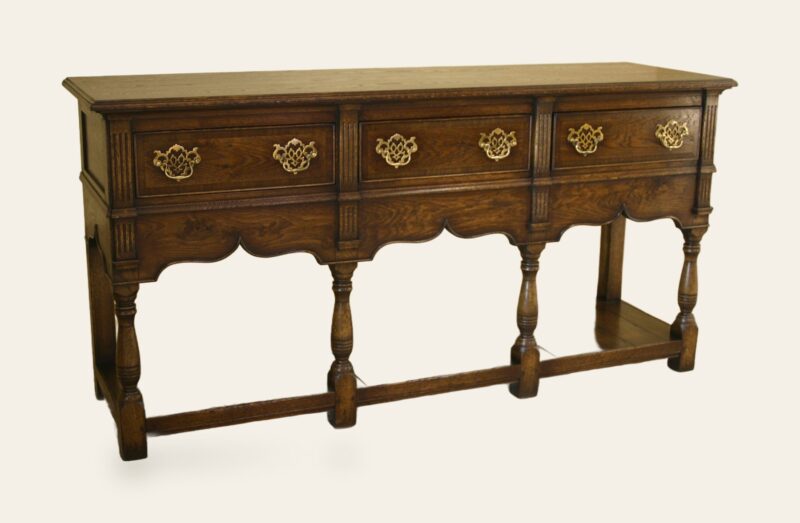
Moulded front potboard base. A moulded frame worked around the drawer fronts and rails, giving shadow lines across the front that lift the piece out of plainness without making it formal.
Carved potboard base with candle drawers. Carved detail to the frieze and rails, with candle drawers in the front — shallow drawers, originally for tapers. Made in three- and four-drawer versions.
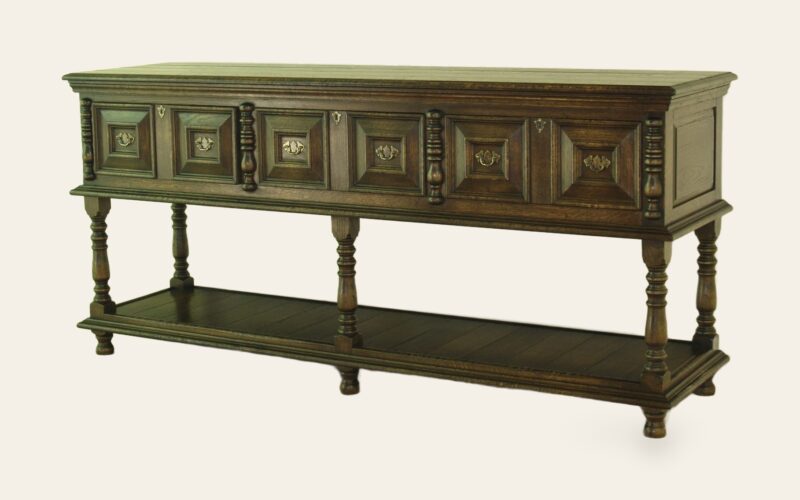
Architectural potboard base. A stronger cornice and plinth treatment, from the Montgomeryshire range.
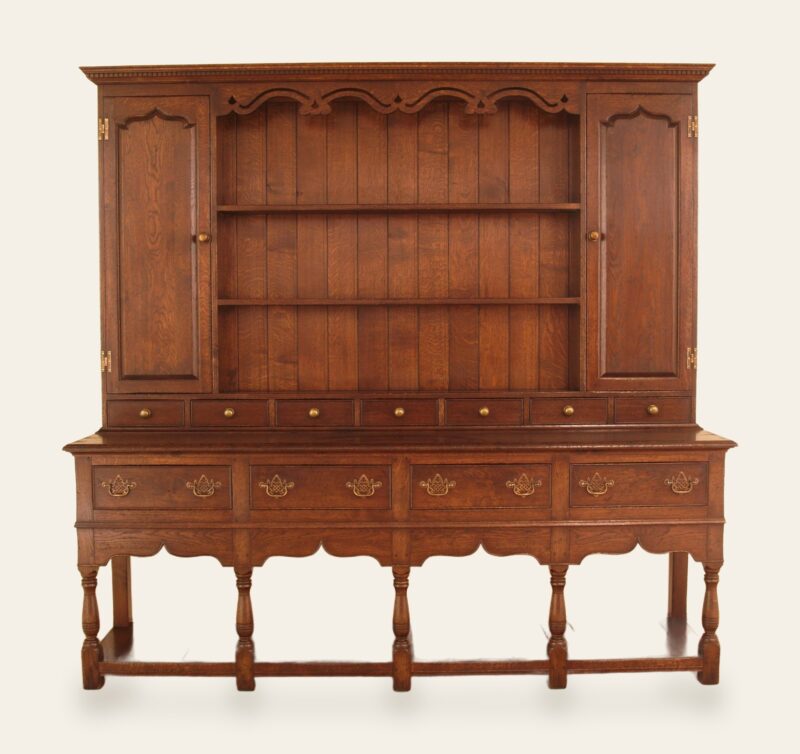
Six-leg potboard base. Six legs rather than four, the extra pair at the centre, so a long base stops looking under-supported and the potboard gains a middle bearer.
Timbers
Oak, cherry, mahogany and walnut are the standard four, and every potboard base is made in all of them. Oak is much the most specified.
Specials, on application: character oak, with knots and movement left in, the most-requested special here; pippy oak in light, medium and heavy grades, for tops; oak selected for medullary ray, the silver figure across quarter-sawn oak, within or without the timber; and clean timber with no knots at all.
Finishes: polished, painted, limed, sand-blasted, rub-through paint, natural, or colour matched. We can match furniture that is 100 years old to new reproduction purchases made the year before.
Order timber and finish samples. On a potboard base you see the timber from three sides and from underneath, so the colour has nowhere to hide.
Standard sizes
3 piecesSouth Wales 5-drawer potboard base
Width 59″ (149cm)4ft 11in149cm1490mmDepth 17″ (43cm)1ft 5in43cm430mmHeight 33″ (84cm)2ft 9in84cm840mm
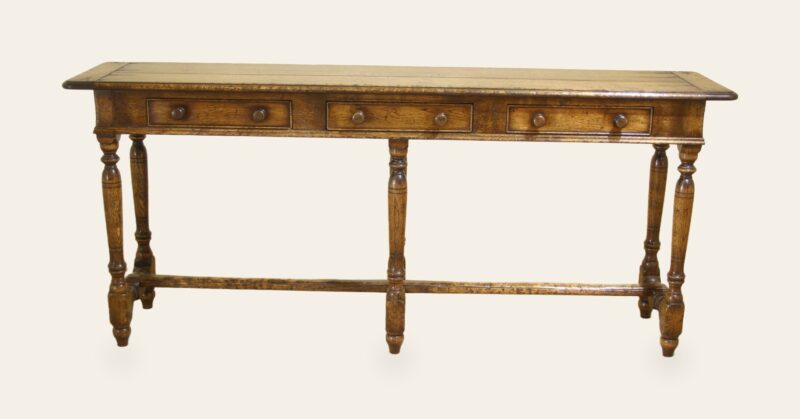
Farmhouse server table with a potboard
Width 60″ (152cm)5ft152cm1520mmDepth 19″ (47cm)1ft 7in47cm470mmHeight 30″ (76cm)2ft 6in76cm760mm
Potboard table with drawer
Width 22″ (56cm)1ft 10in56cm560mmDepth 22″ (56cm)1ft 10in56cm560mmHeight 27″ (69cm)2ft 3in69cm690mm
Made in oak, cherry, mahogany or walnut
These are the sizes we make as standard. Every piece is made to order in our own workshop, so any size between — or beyond — those listed can be made for you. Heights and depths can be altered to suit a room, and dimensions are nominal.
Made to your size
A potboard base is easy to alter, because it is a frame rather than a box.
Common changes: width set to an alcove; height set to match a kitchen worktop; the potboard raised or lowered to take a particular basket; the board solid or slatted; drawer count changed; candle drawers added; turned legs substituted for square; a middle pair of legs on a long base.
The commonest request of all is a change of a few millimetres to fit a space exactly, which is how everything here is made. For a genuinely new design, our designers draw it first. See bespoke and commissioning.
Related pieces: the farmhouse server table with a potboard, the closed dresser base, and potboard coffee tables and lamp and side tables.
Prices
Quoted individually, because no two are the same size. Tell us the number of drawers, the width, the timber and the finish and we will give you a guide price. Special timbers and finishes are on application. Lead time is normally twelve weeks, and up to sixteen when the workshop is busy. Your date is confirmed when you order.
Every potboard dresser base we make leaves the same Suffolk workshop as our fitted joinery. Where a project also calls for panelling, a library or a fitted kitchen, that work is done by our sister companies, Reeve & Co Interiors and Square & True.
Every size, timber and finish for our potboard dresser bases is priced on the Potboard dresser bases order page, where you can choose the options and pay the deposit online.
Frequently asked questions
What is a potboard on a dresser?
The low open shelf between the legs of a country dresser base, near the floor. It held heavy cooking pots that could be slid on and off rather than lifted. Today it carries baskets, stoneware, logs or books.
What is the difference between a potboard base and a dresser base?
A potboard base is open below the drawers, with a low board between the legs. A dresser base is closed, with panelled cupboard doors. The potboard version is lighter to look at; the cupboard version stores more.
Can a potboard base take a dresser rack?
Yes — the complete piece is a Welsh dresser. The rack stands on the base rather than being built into it, so it can be ordered with the base or added later.
How much weight will a potboard hold?
More than you will put on it. The board is carried on the lower rails and, on a long base, on a centre bearer between an extra pair of legs.