 Skip to content

How furniture is made at Bryn Hall, from the board arriving to the last coat of polish. Nine stages, in the order they happen.
On this page
Every piece leaves Mickfield having passed through the same sequence. It is worth setting it out, because most of the cost of good furniture sits in stages you never see, and because knowing the sequence tells you what to ask us about.
Three pages go into detail: timbers, finishes and the construction glossary. This is the route from board to room.
1. Timber selection and conversion
The piece begins at the board, not at the bench.
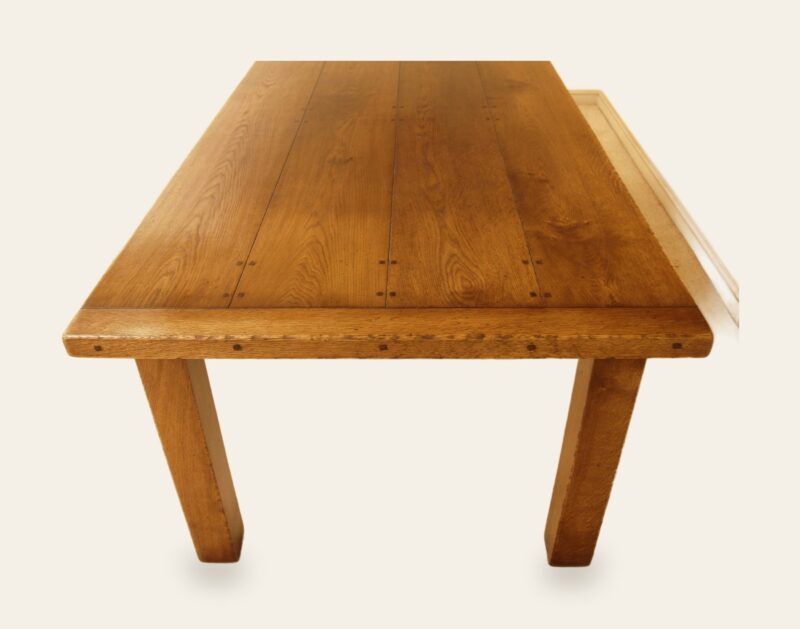
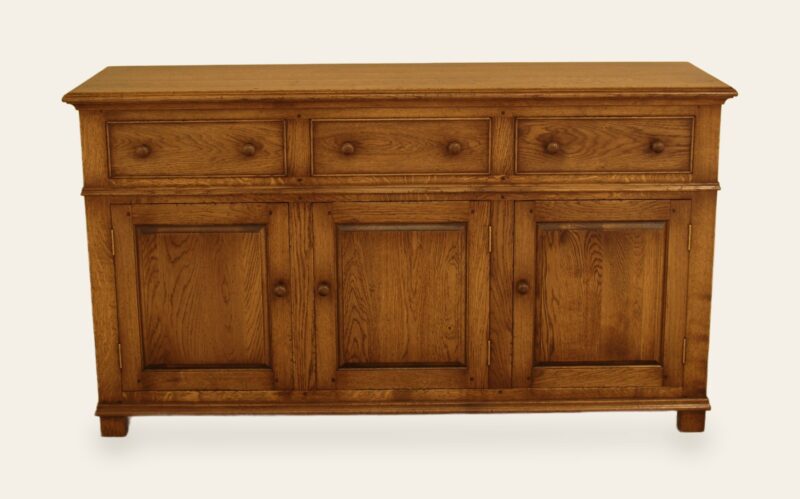
We buy in oak, cherry, mahogany and walnut, and we select from the stack for the job in hand. That means looking at figure, colour and movement before anything is cut. A table top wants boards that agree with each other across their width. A run of drawer fronts wants the grain running through the whole run, so that it reads as one piece of timber rather than four.
Where the specification calls for character oak, the knots and shakes are chosen deliberately rather than tolerated. Where it calls for pippy oak, or for oak selected for medullary ray, or for clean timber with no knots at all, the selection is made at this stage and cannot be corrected later.
Timber is then converted: cut to rough size, and left to settle. Wood moves as it comes to the moisture content of the workshop, and it is far better for it to do that on the rack than in your dining room. More on this on timbers.
2. Drawing
Nothing is cut from a description.
For a catalogue piece in a changed size, the existing drawing is amended and the cutting list rewritten. For a one-off, our designers draw the piece from scratch and you approve it before anything happens. For fitted work, we measure on site first, because walls are never square and a drawing made from nominal figures will not fit.
The drawing settles the things that are expensive to change later: proportion, the reveal around a door, the section of a leg, where a stretcher lands, how deep a drawer can be given what is behind it.
3. Machining
The cutting list goes to the machine shop. Boards are planed square, thicknessed, sawn to width and length, and the joints are cut.
This is where accuracy is created or lost. A carcass that is out by a millimetre at this stage is out by a millimetre for the rest of its life, and every subsequent operation has to work around the error. Getting it right here is what makes the hand work quick and the assembly quiet.
Mouldings are run at this stage too — the thumbnail profile to a top, the moulding below a frieze, the cock beading that goes around a drawer front.
4. Hand work
Machining takes a piece to within a hair. Hands take it the rest of the way.
Joints are fitted individually. Drawers are made and then fitted to their own openings, one at a time, so that each drawer belongs to one aperture and slides on a consistent shadow line. Panels are raised and fielded and eased so that they can move within their frames without splitting the frame apart. Turnings are cut on the lathe. Carved detail is cut by hand.
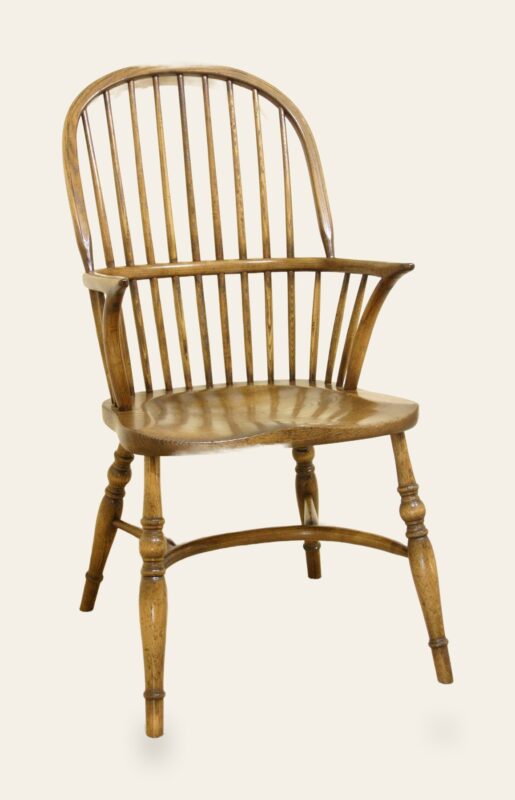
This is also where a chair becomes a chair. Windsor chairs are built up from the seat, with ash bent for the frames, and every stick is set into its own hole.
5. Assembly
The piece comes together dry first, so that everything can be checked and adjusted while it can still be taken apart. Then it is glued, cramped and squared, and left.
Doors and drawers are hung and fitted at this stage: exposed butt hinges cut in flush, doors adjusted until the gap is even top to bottom, drawer stops set. Ironmongery is fitted and then taken off again for polishing.
A carcass sitting on the bench at this point is structurally the finished piece. Everything after it is surface.
6. The finishing shop
Finishing is where a good piece becomes a piece you want to keep, and it takes longer than most people imagine.
The surface is prepared, then the colour is built in stages, with drying and assessment between each. Polished, painted, limed, sand-blasted, rub-through paint, natural and undistressed — each has its own sequence, and they are set out on finishes.
Colour matching to a sample happens here. The polisher works against the physical reference you have sent us, in daylight, adding and checking until the new piece and the old one read as one. That is why colour matching and natural finishes are priced on application: they are bought in polishing hours.
Ironmongery goes back on last.
7. The check
Every piece is looked over before it leaves. Doors and drawers opened and closed. The top run over by hand. The colour checked against the specification and, where relevant, against the sample. Feet checked on a flat floor, because a table that rocks in the workshop will rock in your kitchen.
Anything that is not right goes back rather than out.
8. Delivery
We deliver by our own arrangement and put the piece where it is going, rather than leaving it in the hall on a pallet. On fitted work, the same people who made it install it, scribe it to the wall and finish it on site where that is needed.
Standard lead time is normally twelve weeks, and up to sixteen when the workshop is busy. Your date is confirmed when you order from confirmed order. One-off pieces usually add around four weeks. Details on delivery and care.
One workshop, one point of responsibility
Selection, drawing, machining, hand work, assembly, finishing and delivery all happen in the same building at Stonham Road, Mickfield. Nothing is sent out and nothing is bought in finished.
That is not a romantic preference. It is what makes it possible to match a colour, to change a dimension halfway through, and to give you one person to ring if something is not right.
Read further
Timbers — the four standards, the specials, and how each ages. Finishes — polished, painted, limed, sand-blasted, natural and colour matched. Construction — the glossary, from cock beading to medullary ray.
Order timber and finish samples · Enquire about a piece · Book a workshop visit · 01449 710500