 Skip to content

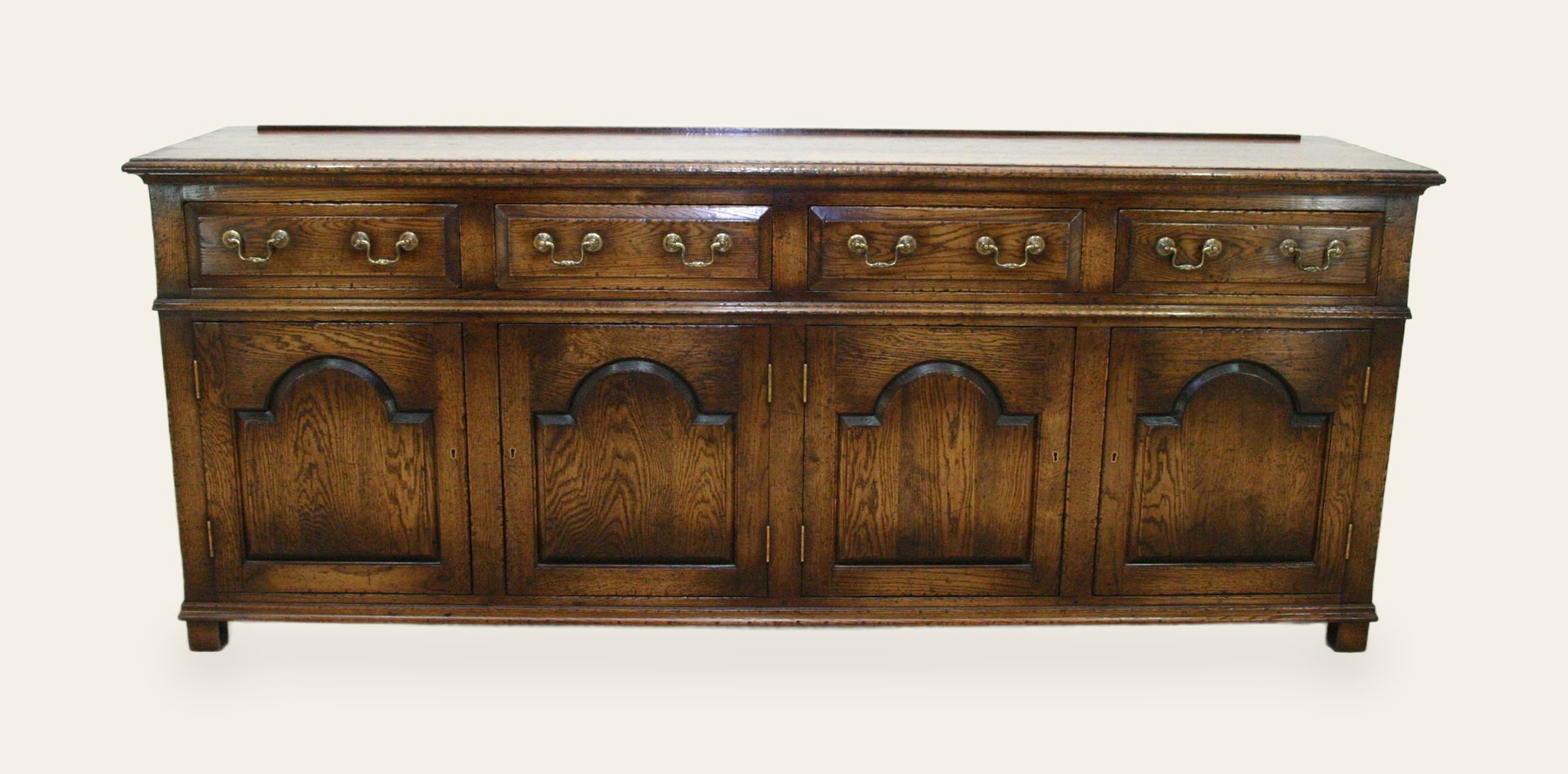
A Welsh dresser is a base and a rack made as a pair: storage below, open shelving above, and a working top between the two. It is still the best answer to a long blank wall, because it stores, it displays and it gives you a surface, all in the footprint of a sideboard.
On this page
We build them in solid oak as standard, one at a time, to the width and height of the wall they are going against.
What makes it a Welsh dresser
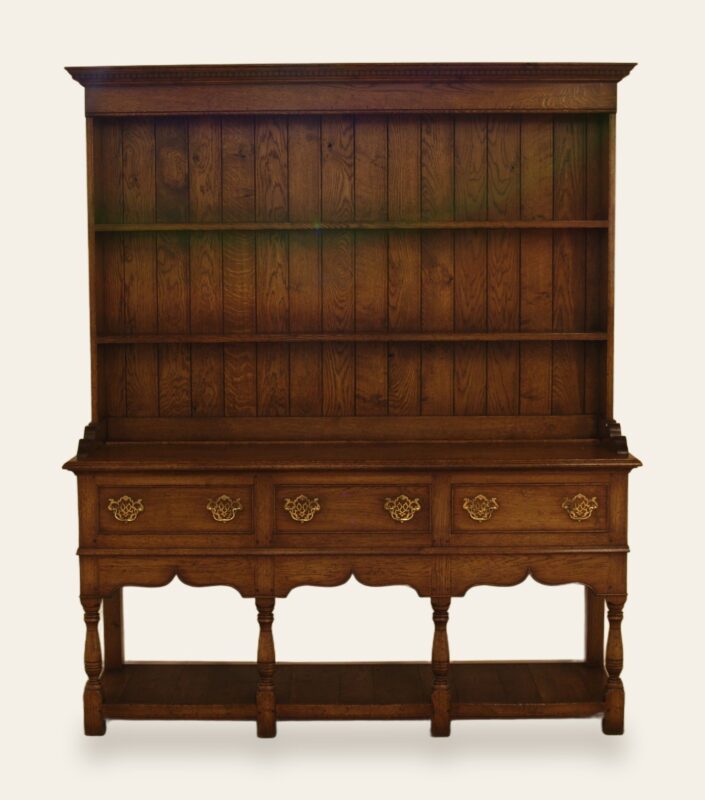
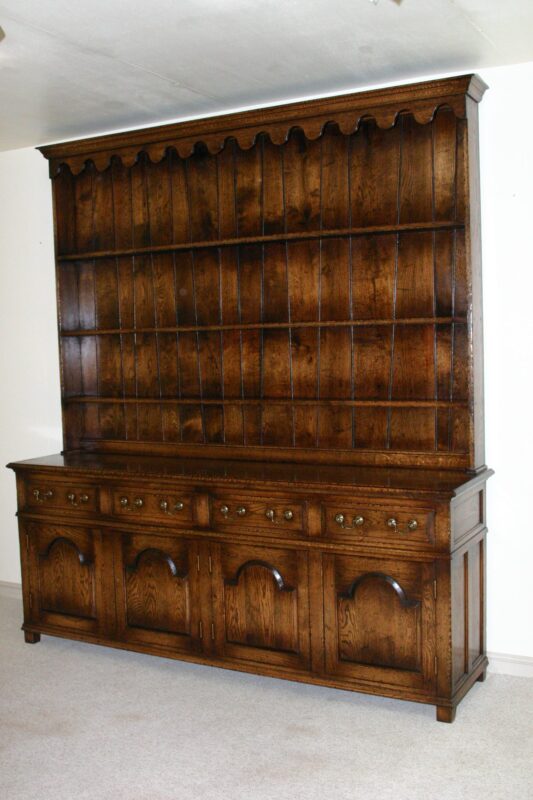
A separate rack. The rack stands on the base rather than being built as one tall carcase. That is how the form has always been made, and it is what gets a dresser up a staircase.
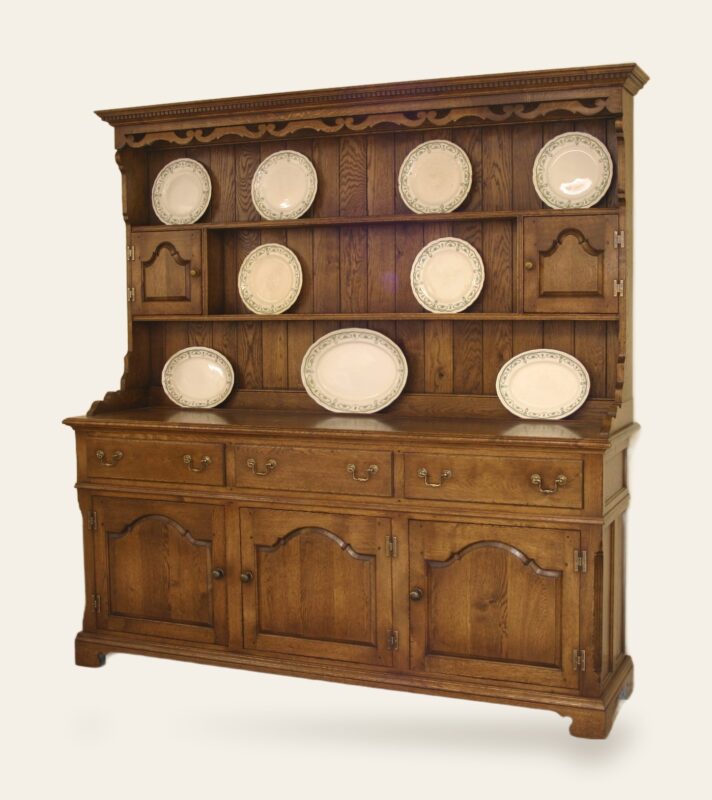
Open shelves with a plate groove. A shallow groove run into each shelf so a plate stands on its edge and leans back.
A usable top. The rack is normally set back from the front edge of the base, leaving a run of top in front of it.
Country proportions. Wide front framing, honest thicknesses, and drawers deep enough for linen rather than cutlery alone.
The dressers and racks we make
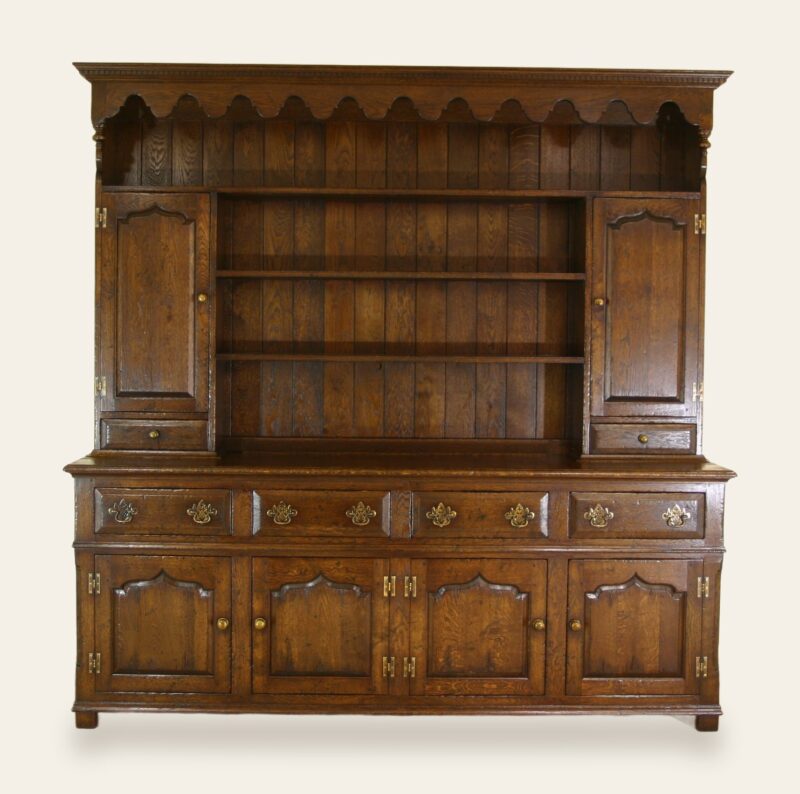
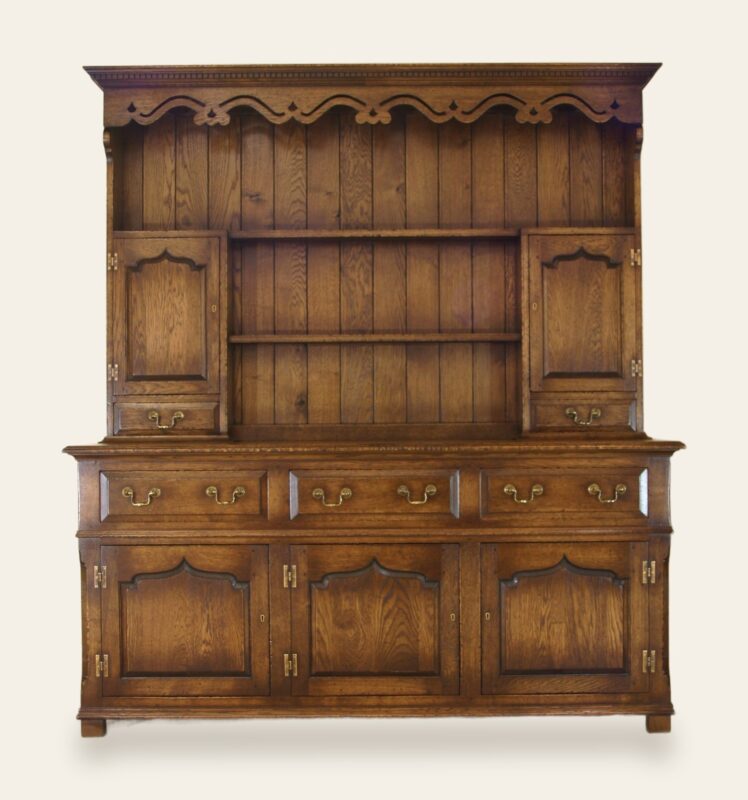
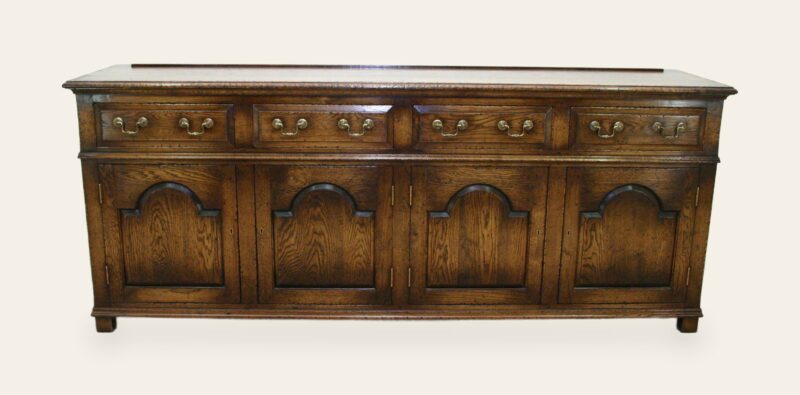
Denbigh dresser and rack, three- and four-door. The formal one. Raised and fielded panelled door fronts — the panel stands proud in the middle and is chamfered away at the edges — with framed side panels, cock beaded drawer fronts, moulded detail below the top, a decorative moulded plinth with a cut-out, and solid ironmongery: exposed butt hinges, brass knobs and swan neck handles. Available with the standard rack or a plain rack.
Ruthin dresser and rack. Welsh country formality, sitting between Denbigh’s cabinetmaking and Oakamoor’s plainness. The pattern for a room a Denbigh would overdress.
Montgomeryshire dresser and rack. Made in three- and four-drawer configurations, with an architectural base variant carrying a stronger cornice and plinth treatment for rooms that already have deep skirtings and cornices.
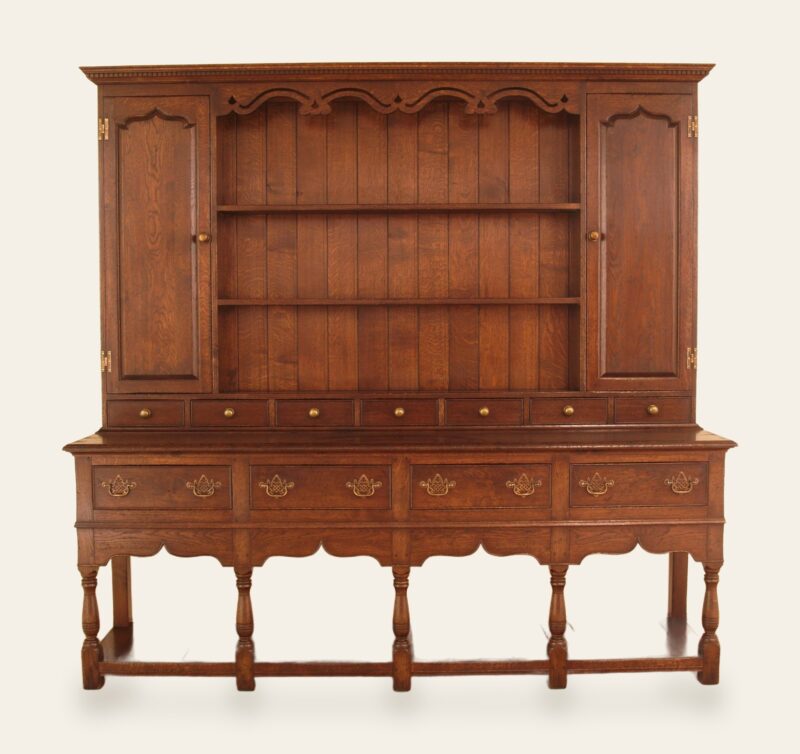
Potboard dresser and rack. The country form: an open board low between the legs instead of cupboards, with drawers above and a rack over. Lighter to look at than a panelled base, and the version most people picture when they picture a Welsh dresser. Also made as a narrower three-drawer potboard base with rack, for a shorter wall. The base on its own is covered on the potboard dresser bases page.
Welsh dresser base and rack. Our plainest complete dresser: no fielded panels, no carved detail, wide front framing and a straight rack. The one for a kitchen with a stone floor and a beam.
Denbigh base with a glazed bookcase top. A Denbigh base carrying a glazed upper stage rather than an open rack, so everything on the shelves stays clean. The version to specify if the dresser sits near a range or an open fire.
Delft racks
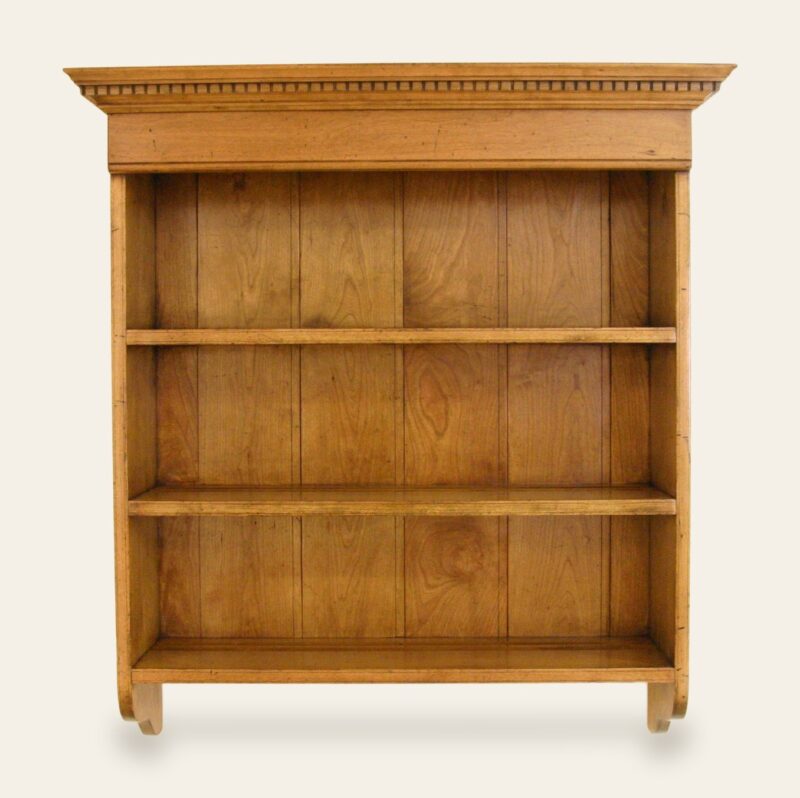
A delft rack is the top half on its own, hung on the wall. Named for the Dutch tin-glazed earthenware it was built to hold, it suits a room where a full dresser would be too much, or a wall already occupied by fitted units.
We make them two ways: plain, as open shelves with a boarded back and a cornice; and with a row of small drawers along the bottom rail, which gives you somewhere for candles, string and keys and anchors the rack so it does not float.
A loaded delft rack is heavy. Tell us the wall construction and we will specify the fixings with the piece.
Timbers
Oak, cherry, mahogany and walnut are the standard four, and every dresser and rack is made in all of them. Oak is the traditional and much the most common choice for this form.
Specials, quoted on application: character oak, with the knots and movement left in, which suits the potboard and plain Welsh patterns particularly well; pippy oak in light, medium and heavy grades, for tops; oak selected for medullary ray, the silver figure across quarter-sawn oak, within or without the timber; and clean timber with no knots at all, worth considering on a Denbigh where the same fielded panel repeats four times.
Finishes: polished, painted, limed, sand-blasted, rub-through paint, natural, or colour matched to a sample. We can match furniture that is 100 years old to new reproduction purchases made the year before.
Order timber and finish samples. A dresser and rack shows more timber than anything else in the room.
Standard sizes
6 piecesRuthin dresser and rack
Width 72″ (183cm)6ft183cm1830mmDepth 20″ (50cm)1ft 8in50cm500mmHeight 85″ (217cm)7ft 1in217cm2170mm
Denbigh dresser and rack
3-door
Width 63″ (160cm)5ft 3in160cm1600mmDepth 20″ (50cm)1ft 8in50cm500mmHeight 79″ (200cm)6ft 7in200cm2000mm
Denbigh dresser with plain rack
3-door
Width 54″ (138cm)4ft 6in138cm1380mmDepth 22″ (55cm)1ft 10in55cm550mmHeight 80″ (202cm)6ft 8in202cm2020mm
Denbigh dresser and rack
4-door
Width 84″ (213cm)7ft213cm2130mmDepth 20″ (50cm)1ft 8in50cm500mmHeight 79″ (200cm)6ft 7in200cm2000mm
Montgomeryshire architectural dresser & rack
3-drawer
Width 66″ (168cm)5ft 6in168cm1680mmDepth 20″ (50cm)1ft 8in50cm500mmHeight 79″ (200cm)6ft 7in200cm2000mm
Montgomeryshire dresser and rack
4-drawer
Width 84″ (213cm)7ft213cm2130mmDepth 20″ (50cm)1ft 8in50cm500mmHeight 79″ (200cm)6ft 7in200cm2000mm
Made in oak, cherry, mahogany or walnut
These are the sizes we make as standard. Every piece is made to order in our own workshop, so any size between — or beyond — those listed can be made for you. Heights and depths can be altered to suit a room, and dimensions are nominal.
Made to your size
Almost every dresser we make is altered, and the usual reason is the wall.
Common changes: overall width set to an alcove or between a door and a chimney breast; rack height reduced to clear a beam or a sloping ceiling; rack depth reduced so more of the top stays usable; shelf spacing set around your own plates and jugs; the plate groove moved or left out; cupboards swapped for a potboard, or a potboard for cupboards; wooden knobs instead of brass; the base made to worktop height to run in with a kitchen.
We also make dressers in separate sections where access is difficult, joined on site so the joints do not read.
If the piece you want does not exist in the catalogue, our designers draw it first. See bespoke and commissioning.
Prices
Quoted individually, because no two dressers are the same size. Tell us the pattern, the width, the height available, the timber and the finish and we will give you a guide price. Special timbers and finishes are priced on application. Standard lead time is normally twelve weeks, and up to sixteen when the workshop is busy; a one-off commission usually adds about four weeks.
A Welsh dresser is often one part of a larger scheme. When it is, the panelling and built-in work alongside it come from Reeve & Co Interiors, and the kitchen from Square & True — the same benches, the same hands.
Every size, timber and finish for our welsh dressers is priced on the Welsh dressers order page, where you can choose the options and pay the deposit online.
Many Welsh dressers stand on a potboard base. See potboard dresser bases for the versions we make.
Frequently asked questions
What is a Welsh dresser?
A base of drawers and cupboards, or drawers over an open potboard, with a separate open shelved rack standing on top. It stores, displays and gives you a working surface in the footprint of a sideboard.
Can I buy the base without the rack?
Yes. Many clients do, and either live with it as a sideboard or add the rack years later. See dresser bases. Tell us at the outset if a rack may follow and we will record the dimensions and finish.
How deep is the rack compared with the base?
The rack is normally shallower, so there is usable top in front of it. How much shallower is your decision: a deeper rack takes larger chargers, a shallower one leaves more surface.
Will it fit through my door?
Almost always, because the base and rack separate. Where access is genuinely tight we build the base in sections. Send us door widths, stair turns and ceiling heights.