 Skip to content
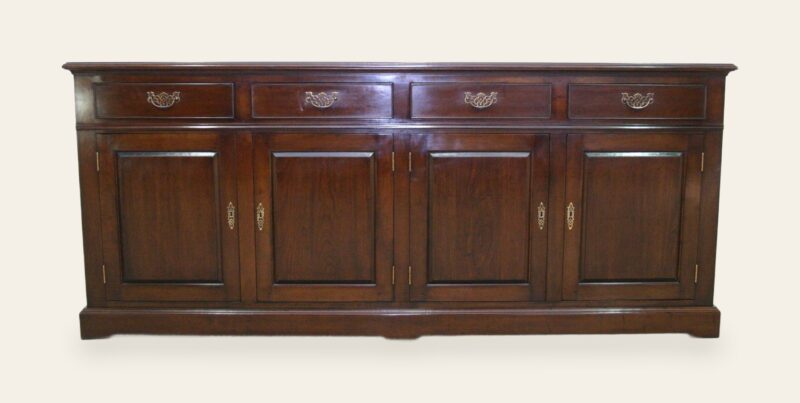
Denbigh is the most formal thing we make. It is eighteenth-century cabinetmaking, and it is the range clients choose when the room is already good and the furniture has to hold its own.
On this page
Everything in Denbigh comes back to one idea: the framework. The stiles and rails around the doors and drawers are precisely crafted, and the panels sit inside them with the gaps consistent all the way round. Get that right and the piece looks calm. Get it wrong and no amount of moulding will rescue it.
Every piece is made to order in our Suffolk workshop. Standard designs are normally twelve weeks from order to delivery, and when the workshop is busy that can run to fifteen or sixteen. A genuine one-off usually adds around four weeks. Your date is confirmed when you order.
The details that define it
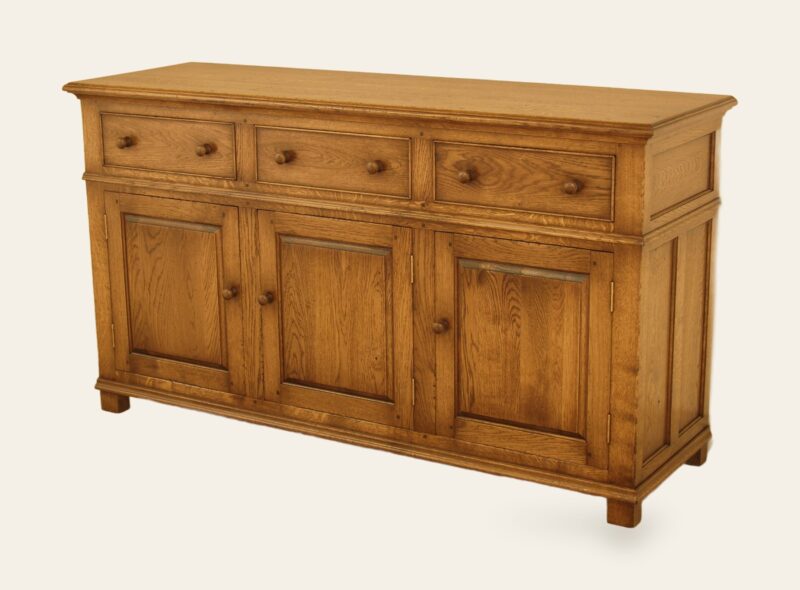
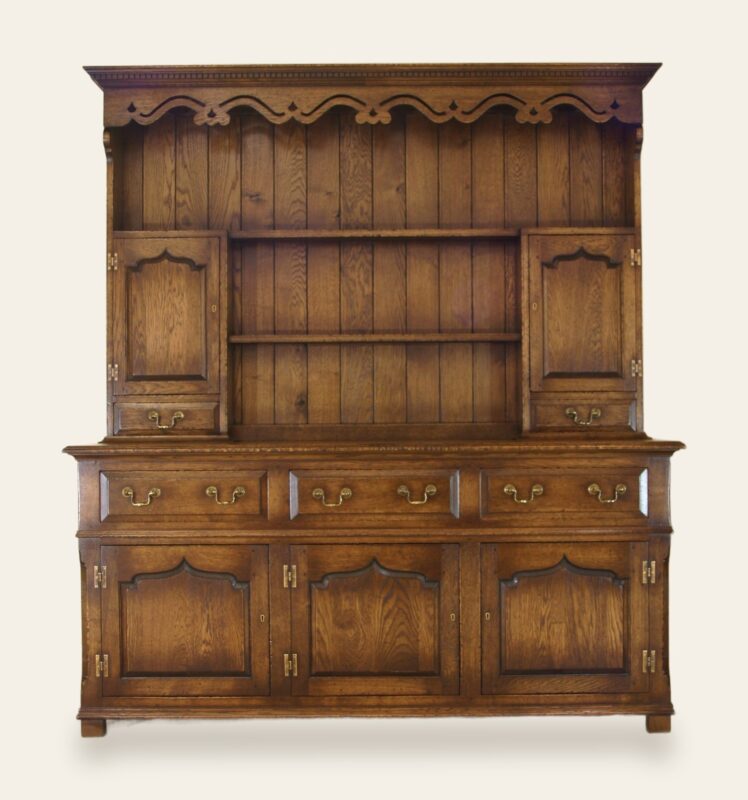
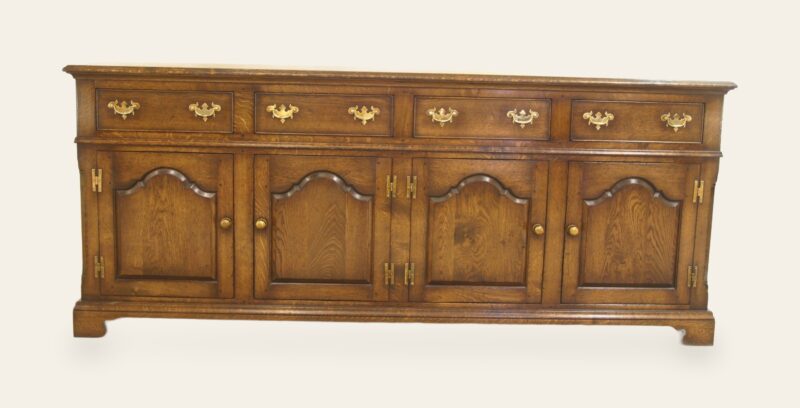
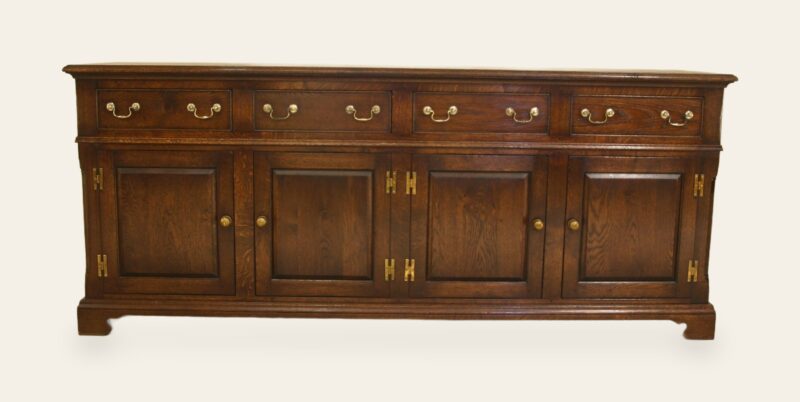
Raised and fielded panelled door fronts. The panel is not flat. Its centre stands proud and its edges are bevelled away to a field, so the door catches light across three planes instead of one. It is the single most recognisable Denbigh detail.
Framed side panels. The sides are treated as carefully as the front, panelled in the same frame-and-panel construction rather than being a plain board. It matters when a dresser sits away from a wall or turns a corner.
Cock beaded flat drawer fronts. Cock beading is a fine raised bead run around each drawer front. It catches the light, sharpens the shadow line and conceals the gap between drawer and carcass.
Moulded detail below the top and above the doors. A run of moulding under the top and another above the door line divides the piece horizontally and stops a tall carcass reading as a slab.
Decorative moulded plinth with a cut-out. The plinth is moulded rather than square-edged, and a shaped decorative cut-out lifts the piece off the floor visually.
Thumbnail profile to the top. A rounded, thumbnail-shaped edge worked along the top. Comfortable to lean against, and correct for the period.
Solid ironmongery. Exposed butt hinges, solid brass knobs and swan neck handles. The hinges are meant to be seen. Wooden knobs are an alternative if you want the piece quieter. Every term here is defined on the construction glossary.
What the range covers
Denbigh is principally a dresser and cabinet range. The pieces are:
| Piece | Notes |
|---|---|
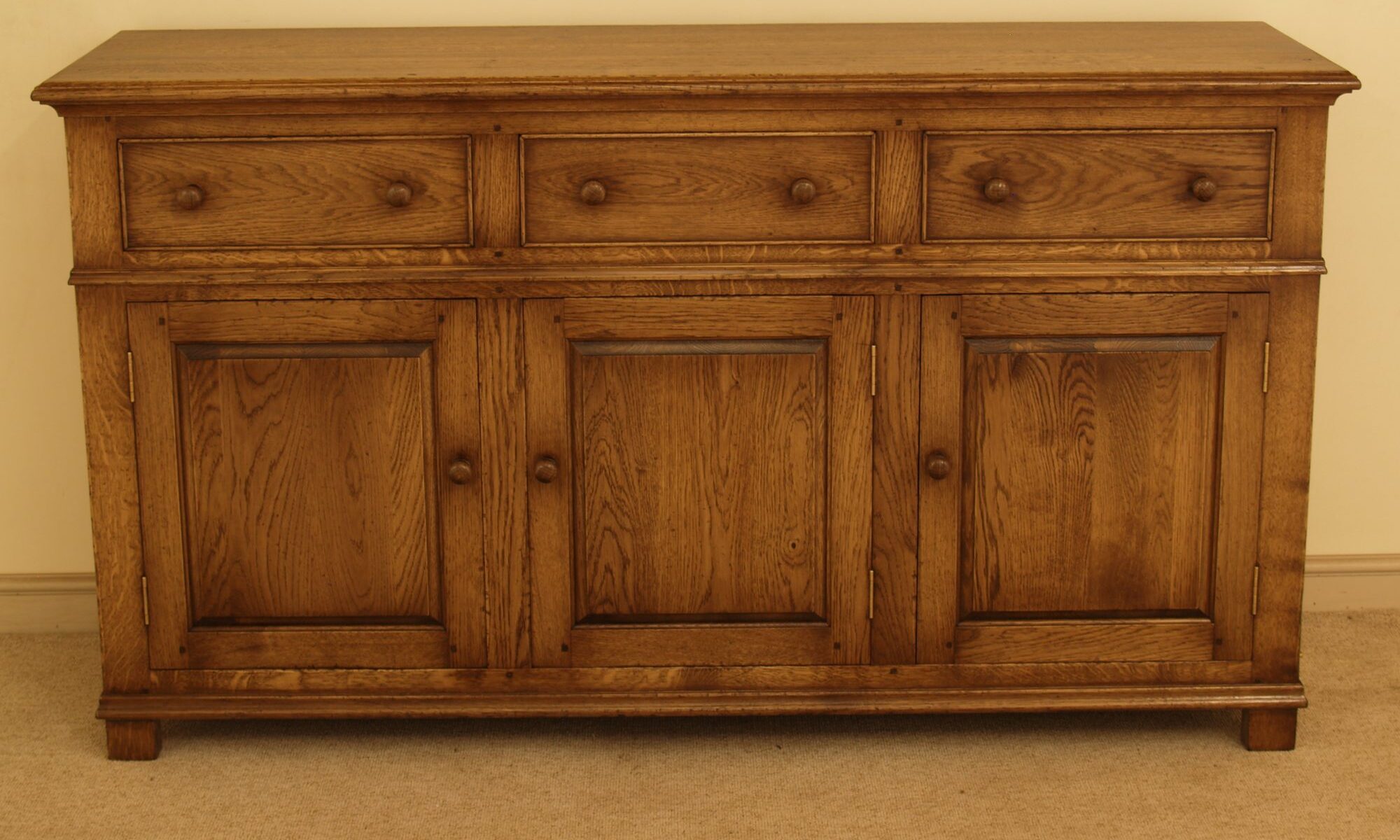
| Denbigh dresser and rack | Three-door and four-door versions |
| Denbigh dresser and rack, plain rack | The same base with a simpler, unmoulded rack |
| Denbigh dresser base | Used on its own as a sideboard or server |
| Denbigh base with glazed bookcase top | A dresser base carrying a glazed upper section |
See the related type pages for Welsh dressers, dresser bases, dressers, sideboards and servers, bookcases and cupboards and cabinets.
Because the Denbigh details are drawn rather than fixed to a single carcass, they can be carried onto pieces that are not in the list above. A chest of drawers, a wardrobe or a fitted run of cupboards can be made with the same fielded panels, cock beading and plinth treatment so that it belongs with the dresser.
If it is specifically Georgian proportion and restraint you are after, rather than eighteenth-century panelled detail, look at the Georgian collection, which covers dresser bases and bookcases in that idiom.
Timbers
Every Denbigh piece is priced in the four standard timbers: oak, cherry, mahogany and walnut.
Oak is the usual choice and carries the mouldings well. Cherry darkens over the years to a deep reddish brown and suits the finer detail. Mahogany is the most formal of the four and reads correctly against eighteenth-century architecture. Walnut gives the strongest figure.
Specials are available on application: character oak, pippy oak for tops in light, medium or heavy grades, oak selected for medullary ray, and clean timber with no knots at all. More on our timbers.
Make it yours
Nothing in Denbigh is fixed. The things clients most often change are:
- Dimensions. Height, width and depth to the millimetre, to fit an alcove, a chimney breast or a low ceiling.
- Door and drawer configuration. Three doors or four, more drawers, fewer drawers, a cupboard where a drawer would normally be.
- The rack. Full moulded rack, plain rack, a shallower rack for a lower ceiling, or no rack at all.
- Ironmongery. Solid brass knobs, swan neck handles or turned wooden knobs, and the finish on the brass.
- The plinth cut-out. Kept, simplified or omitted.
- Finish. Polished, painted, limed, sand-blasted, rub-through paint or natural, and colour matched to a sample you send us.
- Interior. Shelf positions, cutlery trays, wine storage, a drawer sized for particular objects.
If you want a Denbigh piece to sit beside an antique you already own, that is the kind of work we do most. See matching antique furniture, or read how commissioning works.
Order timber and finish samples and see the timbers and finishes in your own light before you decide.
Questions about Denbigh
What is the difference between Denbigh and Oakamoor?
Denbigh is formal cabinetmaking with panelled and moulded detail throughout. Oakamoor is deliberately plain and chunky, with the timber doing the work. If your room has cornices and panelling, Denbigh usually sits better. If it has beams and flagstones, Oakamoor often does.
How does Denbigh differ from the Georgian collection?
Both cover dresser bases and bookcases, but they are after different things. Denbigh is eighteenth-century panelled cabinetmaking: raised and fielded panels, cock beading and moulded detail throughout. Georgian is about proportion and restraint, where moulding divides rather than decorates, often on a painted base with a pippy oak top. Denbigh for a room with panelling and cornices; Georgian for a room that is symmetrical and well proportioned.
Can I have a Denbigh piece that is not in the range?
Yes. The range is a set of details rather than a fixed list of carcasses. We can draw a chest of drawers, a wardrobe, a corner cupboard or a fitted bookcase using the same fielded panels, cock beading and plinth, so the room reads as one.
How long does a Denbigh piece take?
Standard designs are normally twelve weeks, and up to sixteen when the workshop is busy from order to delivery. A one-off piece drawn from scratch usually adds around four weeks. We confirm the timing when we quote.
Can you match the colour of furniture I already own?
Yes. We can match furniture that is 100 years old to new reproduction purchases made the year before. Send us a photograph, and where possible a sample, and we will match to it. Colour matching is priced on application because of the extra polishing time.