 Skip to content

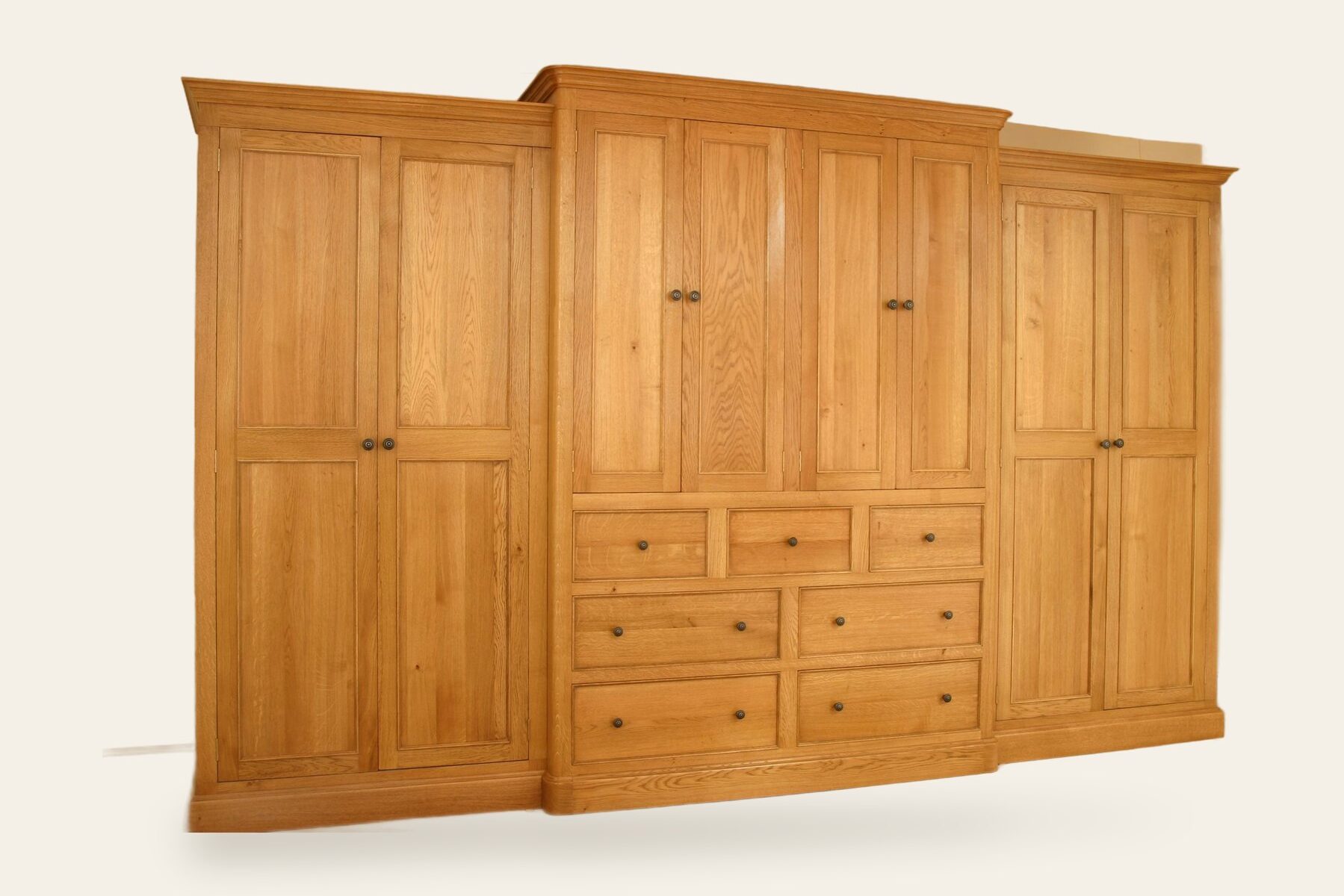
Depth is the dimension stock wardrobes get wrong, and it is the one to settle before anything else. A wardrobe has to be deep enough that a coat hanger and the shoulder of your bulkiest garment clear the closed door. Get that wrong and every coat in the wardrobe hangs at a slight angle and rubs against the inside of the door for the next thirty years, no matter how well the thing is made.
The standard depths we build to are twenty inches (51cm) on a two door wardrobe, twenty-one inches (53cm) on the Chippendale-style pattern, and twenty-four inches (61cm) on the single door and on the Gothic wardrobe in cherry. Those are starting points. If you own a lot of heavy winter coats, ask for more; if the wardrobe has to stand in a bedroom where the door only just clears the bed, every inch you can lose from the depth is worth having.
The forms we make
The patterns divide roughly by weight of detail. A single door wardrobe is one hanging compartment behind one door, at thirty-six inches (91cm) wide and sixty-six inches (168cm) high, and it is the piece for a small room or a spare bedroom. The two door wardrobe, fifty-one inches (130cm) wide and seventy-eight inches (198cm) high, is the workhorse: full hanging, or split with hanging on one side and shelves on the other.
Above that sit the dressier versions. The two door carved wardrobe, and the plainer no-style variant of the same pattern without the carving. The Chippendale-style wardrobe with its moulded cornice, fielded panels and lighter proportions. The Gothic wardrobe in cherry, with pointed-arch tracery doors, at eighty inches (203cm) high. Then the large breakfront wardrobe, eight doors and seven drawers, which is a wall of storage rather than a cupboard, and the press cupboard in mahogany, an older English form with a cupboard above a bank of drawers.
The inside is where the piece is won or lost
A wardrobe is one box with a set of decisions inside it. The elements available are ordinary enough, and the skill is in choosing the right combination for the clothes you actually own rather than the clothes a catalogue photograph implies.
- Long hanging for coats and dresses, and short hanging doubled up for shirts and jackets, which gets twice as much on the rail in the same height
- Adjustable shelves, so the balance between folded and hung can change later
- Drawers, either in the carcase or as a bank in the plinth below
- Shoe shelves, and tie and belt rails
- A top box for seasonal things you want out of the way
Count your hanging in running feet before you specify. Most people underestimate short hanging and overestimate long. The ironmongery is solid brass knobs and swan neck handles with exposed butt hinges, and it is worth handling a sample of the handle before you settle it, because a wardrobe door is where you touch the piece every day.
Height, cornice and the ceiling
Wardrobes are the tallest furniture most houses take, so the ceiling is a real constraint rather than a formality. Measure the ceiling height where the wardrobe will stand, not in the middle of the room, and measure it in more than one place if the house is old. Then allow for the fact that a piece has to be tilted or walked upright into position, which needs more clearance than its finished height.
If the room has height to fill, a taller carcase with a stronger cornice reads better than a standard height wardrobe with a gap above it. If it does not, the sensible move is a shorter piece rather than a cornice pressed against the plaster.
Built in sections, assembled in the room
Tall wardrobes are built in sections and assembled in the room, and the doors are hung on site. That is a design decision made at the drawing stage rather than a concession at the door, and it is the answer to the question everybody asks first, which is whether the thing will get up the stairs. What has to make the turn is the largest single component, not the finished wardrobe.
A wardrobe counts as a large piece, so it goes out with two of our own people as standard at no extra charge, and the packaging leaves with them. Delivery is to a ground-floor room unless it has been agreed otherwise, so if the wardrobe is going upstairs, say so before you order rather than on the day. Send the stair width, the turn, and the tightest doorway on the route before you order and it can be confirmed in advance. Where access is genuinely doubtful, an access survey is carried out beforehand rather than discovered on the day.
Freestanding or fitted, honestly
Freestanding is the better answer when the room has architecture worth keeping, when the house is listed, when you may move and want to take the piece with you, or when you want the wardrobe read as furniture rather than as building. Fitted is the better answer when you need every cubic inch of an alcove, when the ceiling slopes, or when the wardrobe should disappear into the wall.
There is a middle option worth knowing about: a freestanding wardrobe made to fill an alcove exactly, with a scribed filler at the wall and the cornice run to the ceiling, which looks fitted and is not. Where genuinely fitted work is the right answer, that route runs through Reeve & Co Interiors, the same team in the same workshop, with a site survey and installation rather than a delivery.
Timber, finish and matching what is in the room
The four standard timbers are oak, cherry, mahogany and walnut, with character oak, pippy oak, oak selected for medullary ray and clean knot-free timber quoted on application. Finishes run from polished through painted, limed, sand-blasted and rub-through to natural, or matched to a sample you send in.
A wardrobe rarely stands alone, so decide early whether it is matching a bed and chest you already own or setting the tone for pieces yet to come. If it is matching, send photographs, dimensions and a sample of the finish. Guide prices are quoted by size, doors and drawers, timber, finish, interior fit-out and the amount of carving, which is why there is no single figure for a wardrobe.
The sensible order is to measure the room and the route, count your hanging, then order timber and finish samples and look at them beside the bed and the other bedroom pieces in daylight. The specification tends to write itself after that.