 Skip to content

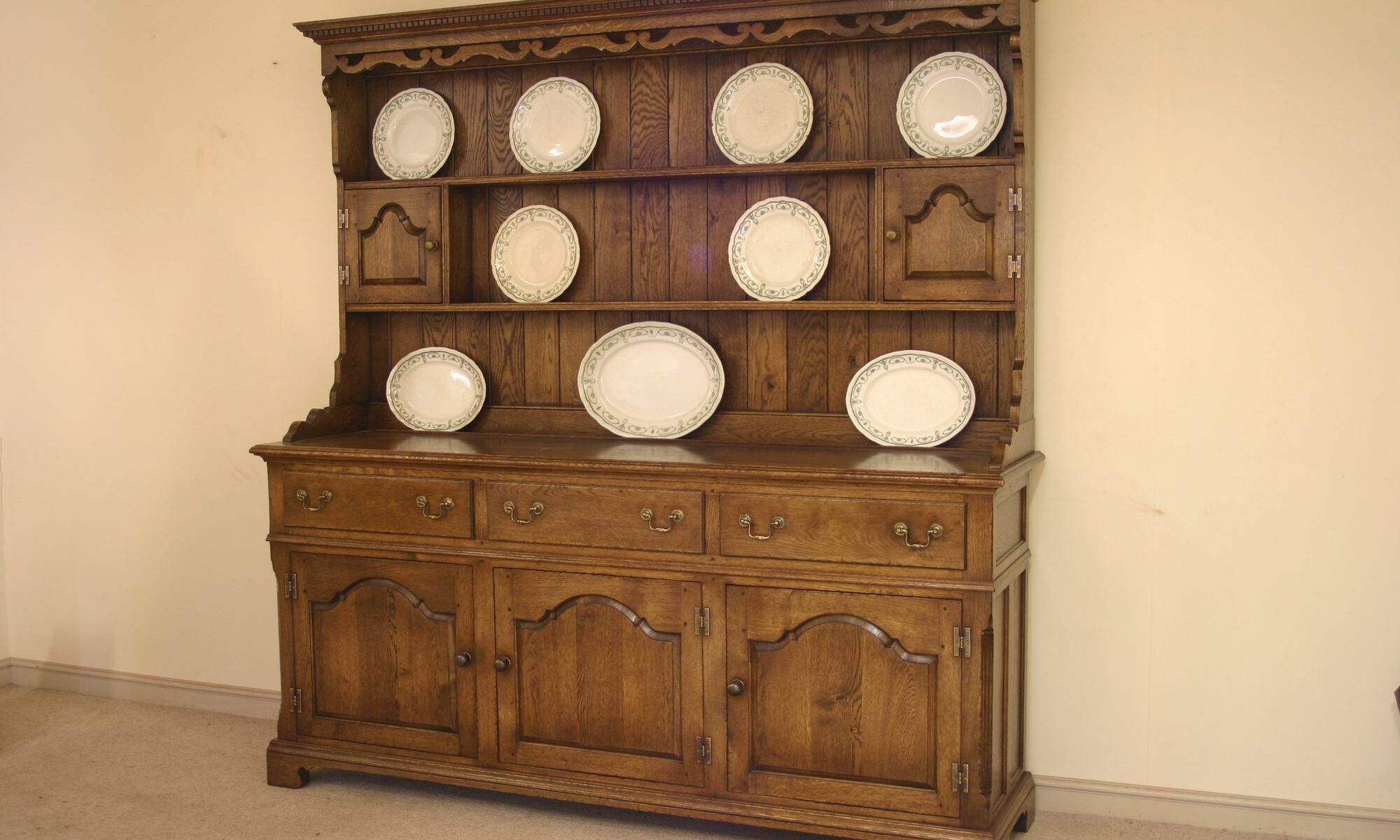
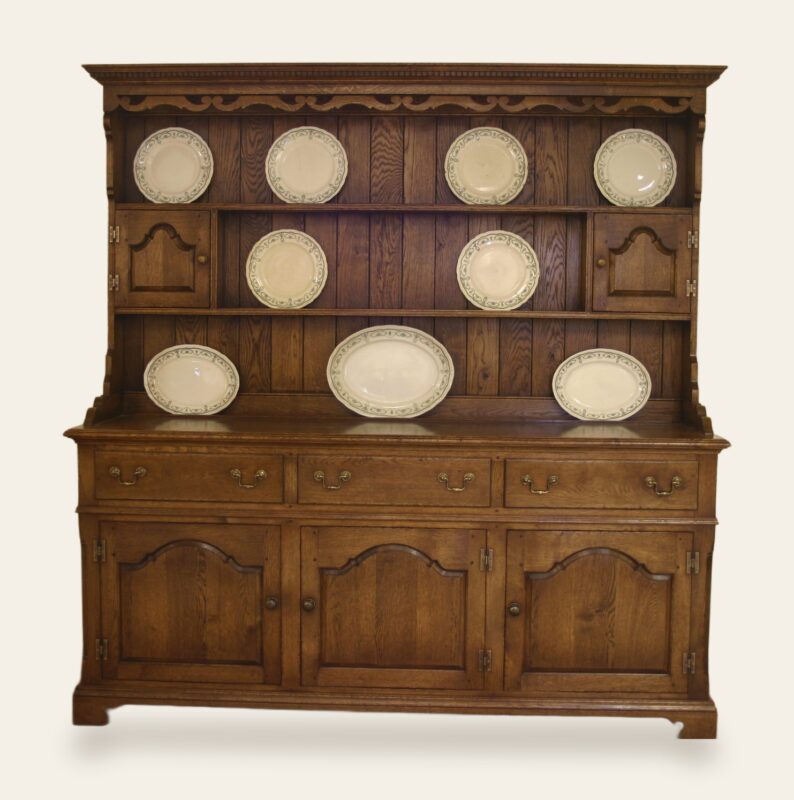
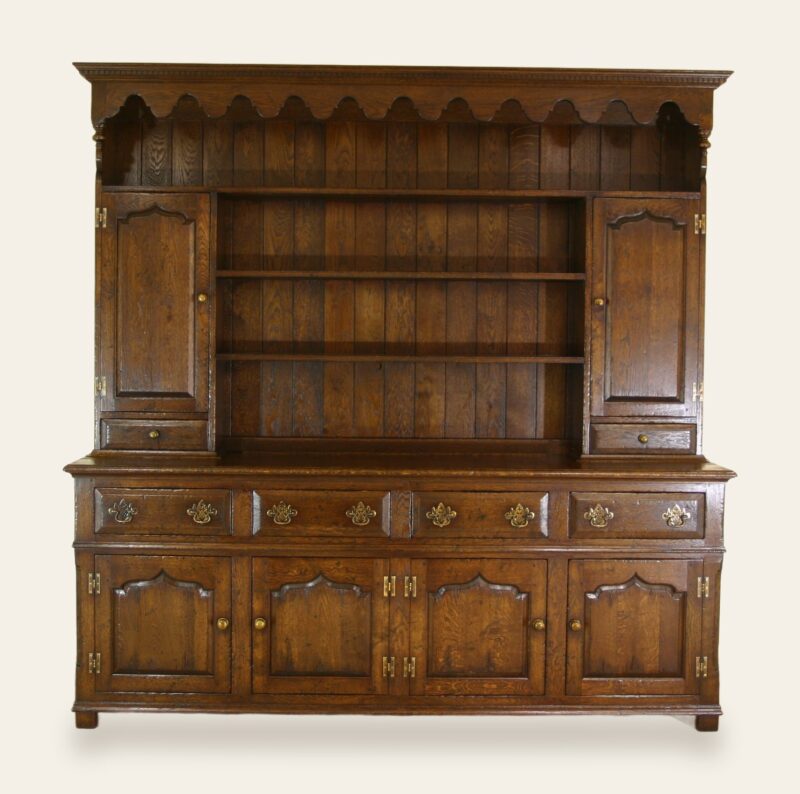
Montgomeryshire is the range to look at when the room has height. Its architectural base carries a stronger cornice and a heavier plinth than anything else we make, which is what allows a dresser to hold its proportion under a tall ceiling instead of looking as though it has been left short. It is made as a dresser and rack in three-drawer and four-drawer forms, and as a base on its own.
On this page
Every piece is made to order in our Suffolk workshop, to your dimensions, in one of the four standard timbers and in the finish you choose. Nothing is held in stock. Standard designs are normally twelve weeks from order to delivery, and when the workshop is busy that can run to fifteen or sixteen. A genuine one-off usually adds around four weeks. Your date is confirmed when you order.
The architectural base
The architectural variant carries a stronger cornice and a heavier plinth treatment than the standard base. In plain terms, the piece is given more weight at the top and at the floor, and the middle is left to look calmer between them.
That treatment suits rooms with height. In a tall room a standard dresser can look as though it has been left short, and adding depth to the cornice and plinth is a more honest fix than simply making the whole piece taller.
What the range covers
| Piece | Notes |
|---|---|
| Montgomeryshire dresser and rack | Three-drawer configuration |
| Montgomeryshire dresser and rack | Four-drawer configuration |
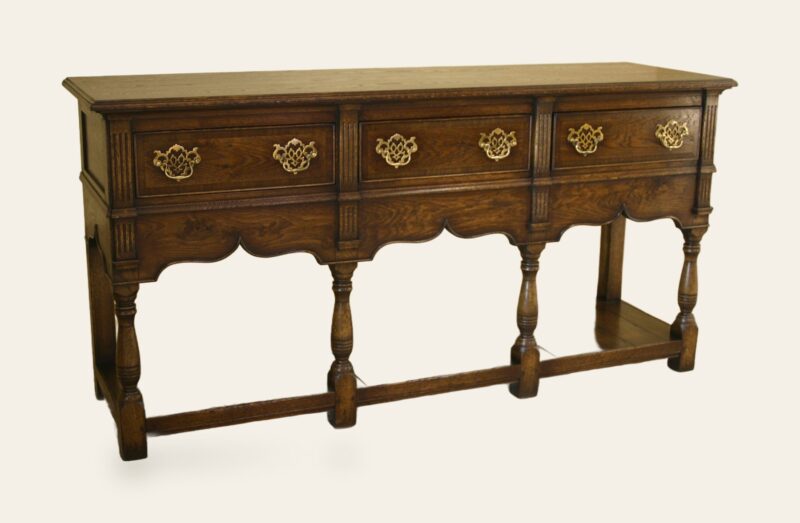
| Montgomeryshire dresser base | Used on its own as a sideboard or server |
| Montgomeryshire architectural base | Stronger cornice and plinth treatment |
Related type pages: dressers, dresser bases and sideboards and servers. If it is specifically a Welsh dresser you are after, see the Ruthin collection.
Timbers
Montgomeryshire is priced in the four standard timbers: oak, cherry, mahogany and walnut.
Oak is the usual specification. Cherry darkens over the years to a deep reddish brown, mahogany is the most formal of the four, and walnut carries the strongest figure. The heavier cornice and plinth of the architectural base show a timber’s character more than a plain edge does, so the choice matters here.
Character oak, pippy oak for tops, oak selected for medullary ray and clean timber with no knots at all are available on application. More on our timbers.
Make it yours
- Drawer count. Three or four as standard, or another arrangement if that suits what you keep in it.
- Dimensions. Height, width and depth to the millimetre. Rack height is usually the critical measurement.
- Cornice and plinth. Standard, or the architectural treatment, or somewhere between the two.
- The rack. Shelf count and spacing, plate grooves, and whether the rack is fitted at all.
- Ironmongery. Solid brass knobs, swan neck handles or turned wooden knobs.
- Finish. Polished, painted, limed, sand-blasted, rub-through paint or natural, and colour matched to a sample.
If you want the architectural cornice carried onto a different piece so a room reads as one, that is straightforward to draw. Read how commissioning works, and order timber and finish samples.
Questions about Montgomeryshire
What is the difference between the standard base and the architectural base?
The architectural base has a stronger cornice and a heavier plinth treatment. It gives the piece more presence, and it holds its proportion better in a room with a high ceiling. The carcass construction is the same.
Should I choose three drawers or four?
Four drawers usually means a wider piece and more shallow storage. Three means fewer, deeper drawers across the same width. Tell us what you intend to keep in them and we will advise before drawing.
Can I have the base without a rack?
Yes. The base is made as a piece in its own right and is commonly used as a sideboard. Tell us at the drawing stage if you may want to add a rack later.
How does Montgomeryshire differ from Ruthin?
Ruthin is the Welsh dresser proper, in the Welsh country tradition. Montgomeryshire is built around the architectural base, with a heavier cornice and plinth for rooms with height. Both are made to your dimensions in the same four timbers.