 Skip to content

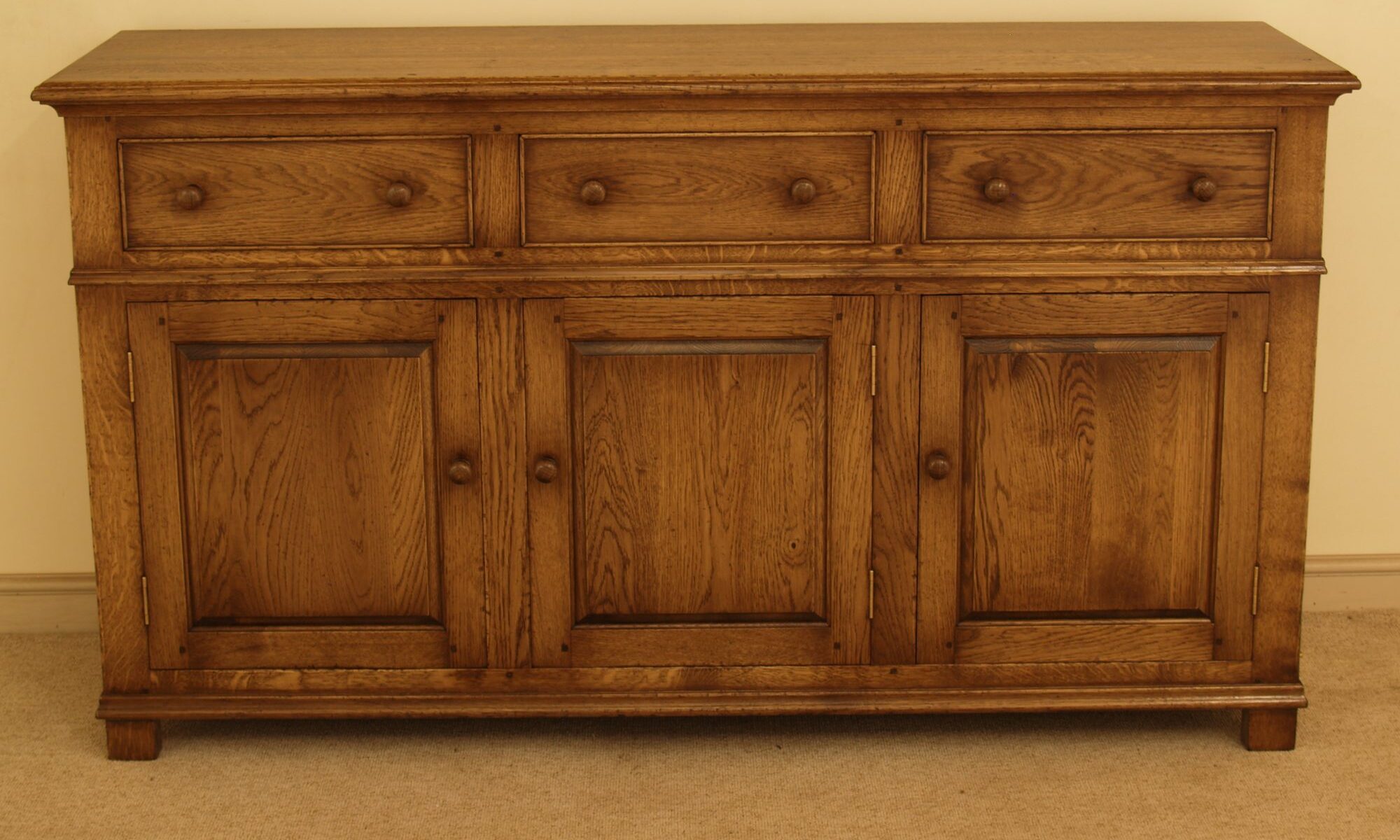
A dresser base is the lower half of a dresser used on its own: drawers across the top, cupboards or an open board below, and a solid top at worktop height. It is one of the pieces this workshop makes most often. It stores more than a sideboard and leaves the wall above free for pictures, a mirror or nothing at all.
On this page
Buy it as a piece in its own right, or add the rack later. The construction is identical either way.
What you are actually buying
A cabinet, not a table. The carcase is framed and panelled, with framed side panels rather than a flat board, so the piece stays square as it is loaded and as humidity changes.
Drawers built to be used. Cock beaded fronts on the formal patterns — a fine raised bead run round each drawer front, which catches the light and hides the gap — running on timber rather than metal.
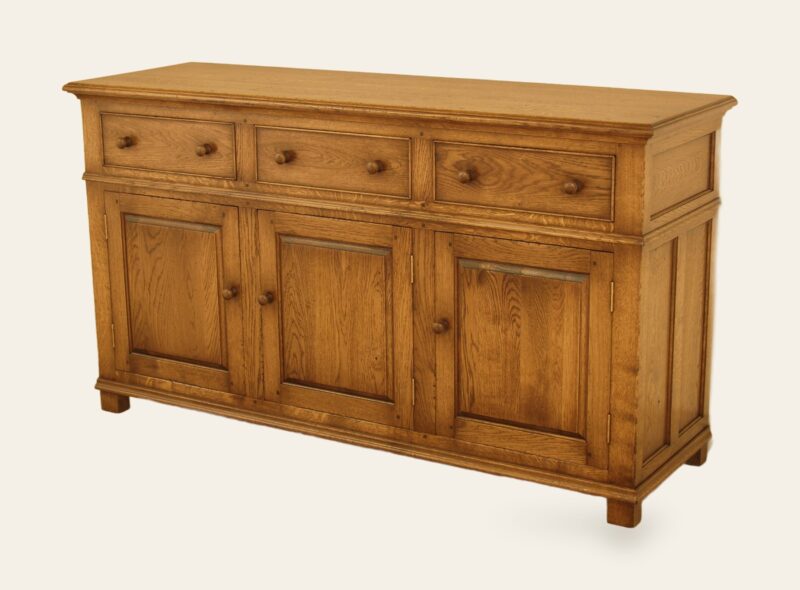
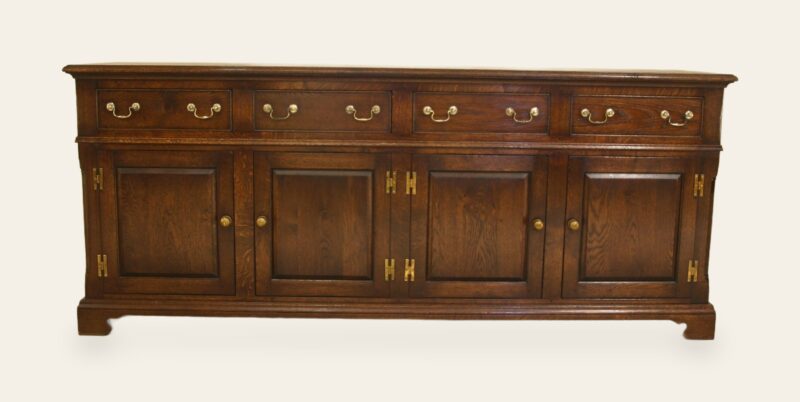
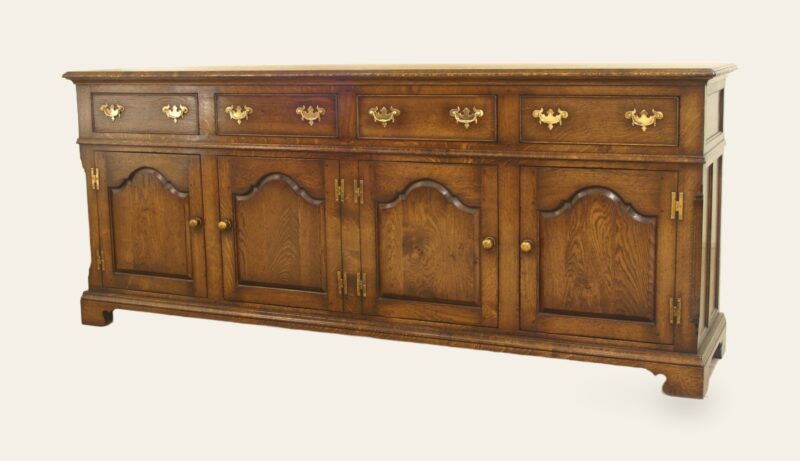
A solid top, and ironmongery you can feel. Exposed butt hinges, brass knobs and swan neck handles on the Denbigh and Oakamoor patterns, or turned wooden knobs where you want it quieter.
The bases we make
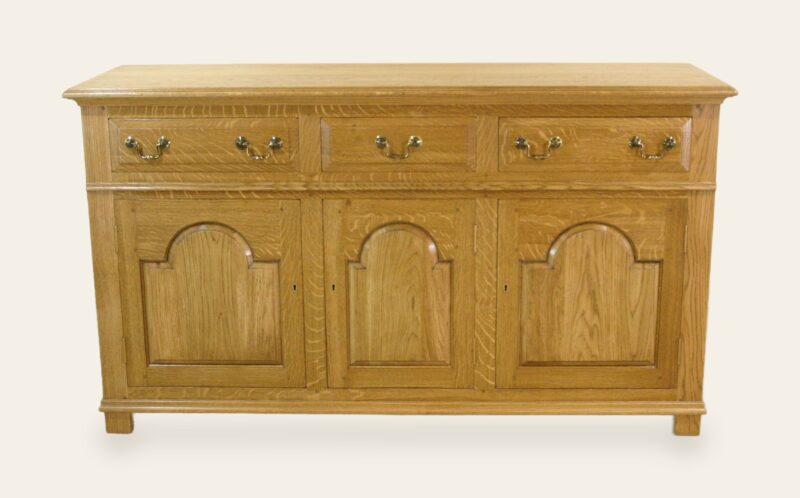
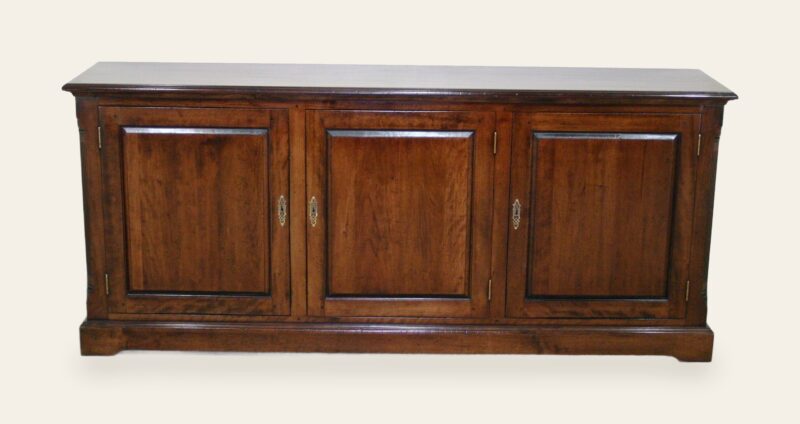
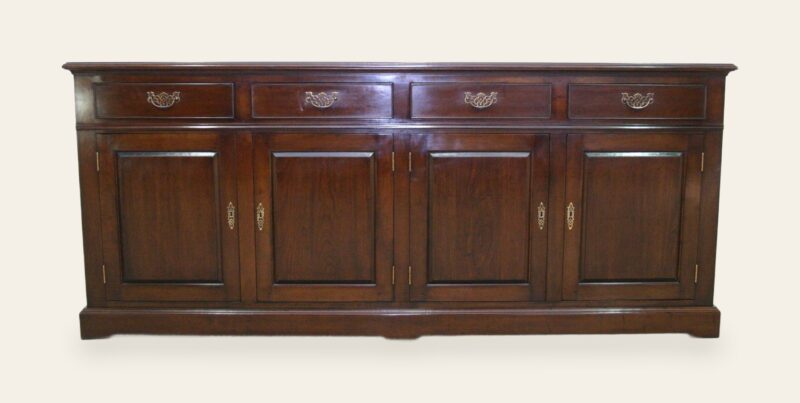
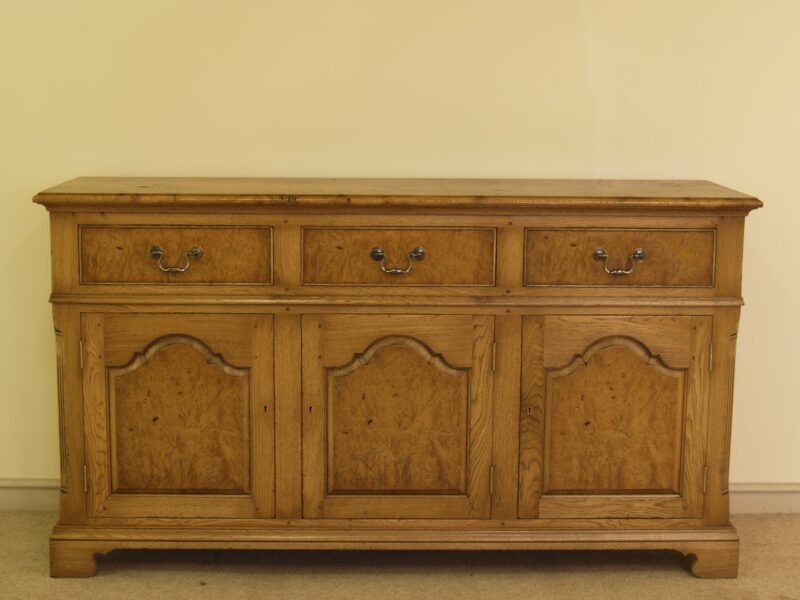
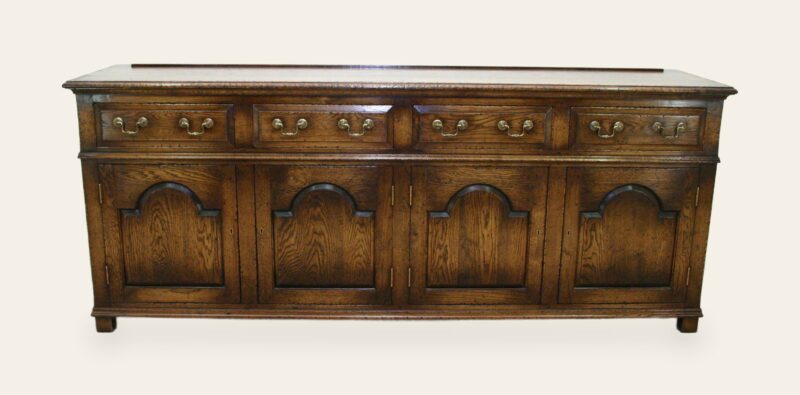
Denbigh three-door and four-door. The flagship, and the base most people mean when they ask for a dresser base. Raised and fielded panelled doors, framed side panels, cock beaded flat drawer fronts, moulded detail below the top and above the doors, a moulded plinth with a decorative cut-out, and a thumbnail profile to the top edge. Made with square or shaped fielded doors — the shaped version arches the top of each panel and reads considerably softer.
Oakamoor three-drawer base. Chunky, plain and timber-led. A simple historic frieze frames the space between the legs, the legs are substantial with a small bevel to the inside edge, and the front framing is deliberately generous to show off the patternation of the oak.
Montgomeryshire base, and the architectural variant. The standard base, and an architectural version with a stronger cornice and plinth treatment for a room that already has deep skirtings.
Corwen base with false drawers. A front that reads as a run of drawers but opens as cupboards, the drawer fronts being applied to the doors.
Georgian-style dresser base. From the Georgian range, and the pattern most often specified with a painted base and an oak top, in pippy or standard oak.
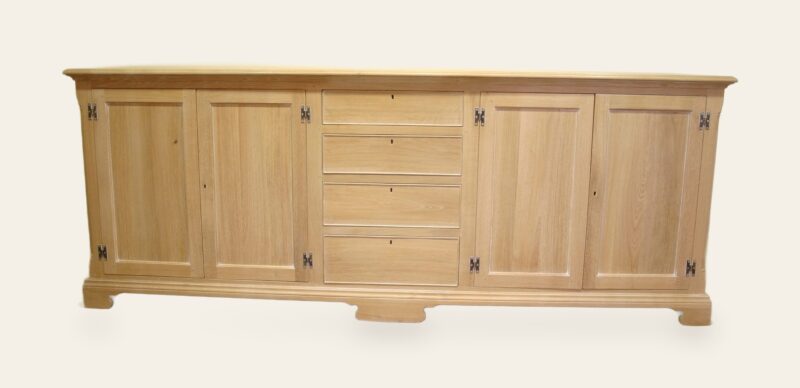
Windrush limed oak base. Four doors and a row of four drawers, in limed oak. Liming works white pigment into the open grain and polishes back, so the figure shows as pale lines against a darker ground.
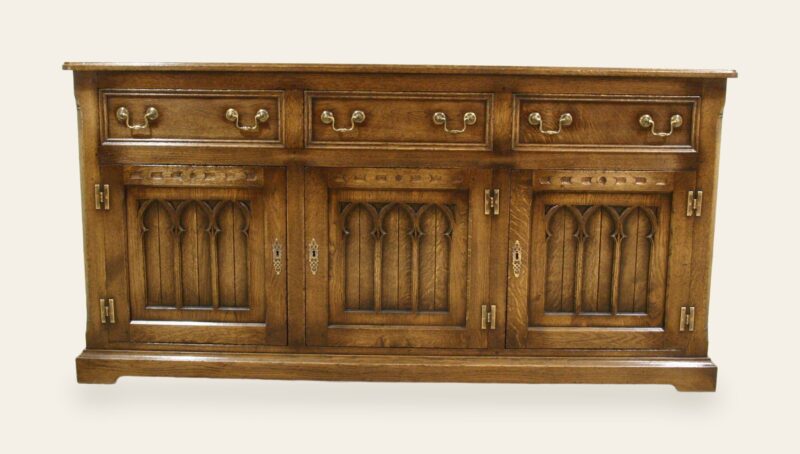
Gothic dresser base, three drawers. From the Gothic range: pointed-arch tracery and ecclesiastical detail, frequently made in cherry.
Cherry versions. The three-door and four-door bases are made in cherry as well as oak. Cherry darkens markedly over the first few years into a deep red-brown, so the piece looks settled rather than new.
Timbers
Oak, cherry, mahogany and walnut are the standard four, and every base is made in all of them.
Specials, quoted on application: character oak, with knots and movement left in; pippy oak in light, medium and heavy grades, for tops; oak selected for medullary ray, the silver-grey figure across quarter-sawn oak, within or without the timber; and clean timber with no knots at all, worth considering where a fielded panel repeats four times.
Finishes: polished, painted, limed, sand-blasted, rub-through paint, natural, or colour matched to a sample. Sand-blasting erodes the softer growth and leaves the harder grain proud, so a new base reads as long-scrubbed. We can match furniture that is 100 years old to new reproduction purchases made the year before.
Order timber and finish samples before deciding between oak and cherry. The difference between them widens over the first five years rather than narrowing.
Standard sizes
20 piecesDenbighshire Tridan
Width 57″ (144cm)4ft 9in144cm1440mmDepth 22″ (55cm)1ft 10in55cm550mmHeight 80″ (202cm)6ft 8in202cm2020mm
Oak, cherry, mahogany or walnut
Ruthin base
Width 72″ (183cm)6ft183cm1830mmDepth 20″ (50cm)1ft 8in50cm500mmHeight 35″ (90cm)2ft 11in90cm900mm
Oak, cherry, mahogany or walnut
Denbigh base
3-door
Width 63″ (160cm)5ft 3in160cm1600mmDepth 20″ (50cm)1ft 8in50cm500mmHeight 35″ (89cm)2ft 11in89cm890mm
Oak, cherry, mahogany or walnut
Denbigh base
4-door
Width 84″ (213cm)7ft213cm2130mmDepth 20″ (50cm)1ft 8in50cm500mmHeight 35″ (89cm)2ft 11in89cm890mm
Oak, cherry, mahogany or walnut
Montgomeryshire base
3-drawer
Width 66″ (168cm)5ft 6in168cm1680mmDepth 20″ (50cm)1ft 8in50cm500mmHeight 33″ (84cm)2ft 9in84cm840mm
Oak, cherry, mahogany or walnut
Montgomeryshire base
4-drawer
Width 84″ (213cm)7ft213cm2130mmDepth 20″ (50cm)1ft 8in50cm500mmHeight 33″ (84cm)2ft 9in84cm840mm
Oak, cherry, mahogany or walnut
Montgomeryshire architectural base
3-drawer
Width 66″ (168cm)5ft 6in168cm1680mmDepth 20″ (50cm)1ft 8in50cm500mmHeight 33″ (84cm)2ft 9in84cm840mm
Oak, cherry, mahogany or walnut
Montgomeryshire architectural base
4-drawer
Width 84″ (213cm)7ft213cm2130mmDepth 20″ (50cm)1ft 8in50cm500mmHeight 33″ (84cm)2ft 9in84cm840mm
Oak, cherry, mahogany or walnut
Georgian-style dresser base
3 drawer
Width 66″ (168cm)5ft 6in168cm1680mmDepth 17″ (43cm)1ft 5in43cm430mmHeight 33″ (84cm)2ft 9in84cm840mm
Oak, cherry, mahogany or walnut
Oakamoor 3 drawer base
Width 66″ (168cm)5ft 6in168cm1680mmDepth 20″ (51cm)1ft 8in51cm510mmHeight 35″ (89cm)2ft 11in89cm890mm
Oak, cherry, mahogany or walnut
Corwen base
With false drawers
Width 69″ (175cm)5ft 9in175cm1750mmDepth 19″ (47cm)1ft 7in47cm470mmHeight 33″ (84cm)2ft 9in84cm840mm
Oak, cherry, mahogany or walnut
2-door base
Width 50″ (127cm)4ft 2in127cm1270mmDepth 19″ (48cm)1ft 7in48cm480mmHeight 35″ (89cm)2ft 11in89cm890mm
Cherry
Farmhouse 2-door base
Width 48″ (122cm)4ft122cm1220mmDepth 18″ (46cm)1ft 6in46cm460mmHeight 15″ (39cm)1ft 3in39cm390mm
Oak, cherry, mahogany or walnut
Denbigh base with glazed bookcase top
Width 63″ (160cm)5ft 3in160cm1600mmDepth 19″ (48cm)1ft 7in48cm480mmHeight 80″ (203cm)6ft 8in203cm2030mm
Oak, cherry, mahogany or walnut
Painted dresser base and rack with pippy oak shelves
Width 48″ (122cm)4ft122cm1220mmDepth 18″ (46cm)1ft 6in46cm460mmHeight 80″ (203cm)6ft 8in203cm2030mm
Hand-painted · oak, cherry, mahogany or walnut beneath
Painted dresser base and rack with standard oak shelves
Width 48″ (122cm)4ft122cm1220mmDepth 18″ (46cm)1ft 6in46cm460mmHeight 80″ (203cm)6ft 8in203cm2030mm
Hand-painted · oak, cherry, mahogany or walnut beneath
Painted base with 5 drawers and pippy oak top
Width 48″ (122cm)4ft122cm1220mmDepth 18″ (46cm)1ft 6in46cm460mmHeight 36″ (91cm)3ft91cm910mm
Hand-painted · oak, cherry, mahogany or walnut beneath
Painted base with 5 drawers and standard oak top
Width 48″ (122cm)4ft122cm1220mmDepth 18″ (46cm)1ft 6in46cm460mmHeight 36″ (91cm)3ft91cm910mm
Hand-painted · oak, cherry, mahogany or walnut beneath
Painted base with 3 drawers, 3 doors and pippy oak top
Width 69″ (175cm)5ft 9in175cm1750mmDepth 20″ (51cm)1ft 8in51cm510mmHeight 36″ (91cm)3ft91cm910mm
Hand-painted · oak, cherry, mahogany or walnut beneath
Painted base with 3 drawers, 3 doors and standard oak top
Width 69″ (175cm)5ft 9in175cm1750mmDepth 20″ (51cm)1ft 8in51cm510mmHeight 36″ (91cm)3ft91cm910mm
Hand-painted · oak, cherry, mahogany or walnut beneath
These are the sizes we make as standard. Every piece is made to order in our own workshop, so any size between — or beyond — those listed can be made for you. Heights and depths can be altered to suit a room, and dimensions are nominal.
Made to your size
A dresser base almost always has to fit something: an alcove, a wall between two doors, or a run of kitchen units.
Common changes: width and depth set to the space; height set to match a worktop; the door and drawer layout rearranged; false drawers substituted for real ones or the reverse; a potboard put in place of the cupboards, covered on the potboard dresser bases page; a heavier or thinner top; brass handles changed for turned wooden knobs; the plinth cut out for an uneven stone floor; the piece made in two sections for difficult access.
We are also asked to make bases that match furniture a client already owns, including antiques. Send photographs, dimensions and a sample of the finish. See matching antique furniture, bespoke and commissioning.
Prices
Quoted individually, because no two bases are the same size. Tell us the pattern, the width, the depth, the timber and the finish and we will give you a guide price. Special timbers and finishes are priced on application. Standard lead time is normally twelve weeks, and up to sixteen when the workshop is busy. Your date is confirmed when you order.
A dresser base is often one part of a larger scheme. When it is, the panelling and built-in work alongside it come from Reeve & Co Interiors, and the kitchen from Square & True — the same benches, the same hands.
Every size, timber and finish for our dresser bases is priced on the Dresser bases order page, where you can choose the options and pay the deposit online.
If you want the length without the depth, a server table is the lighter alternative to a dresser base: legs and drawers, with the space open below.
Frequently asked questions
What is a dresser base?
The lower half of a dresser used on its own: a run of drawers over cupboards or an open potboard, with a solid working top. It does the job of a sideboard with more storage, and it can take a dresser rack later.
Can you make a dresser base to worktop height for a kitchen?
Yes, and it is a common request. Give us the finished height of your worktop and the depth of the run, and we will build the base to sit in line with it.
What is the difference between the Denbigh and Oakamoor bases?
Denbigh is formal 18th-century cabinetmaking: fielded panels, cock beading, mouldings and a decorative plinth. Oakamoor is plain country: substantial legs, a simple frieze and wide front framing, so the oak carries the piece.
Can I add a rack to a base I already have from you?
Usually, including bases we made years ago. Send the piece number if you have it, or photographs and dimensions, and we will match the timber, mouldings and finish.