 Skip to content
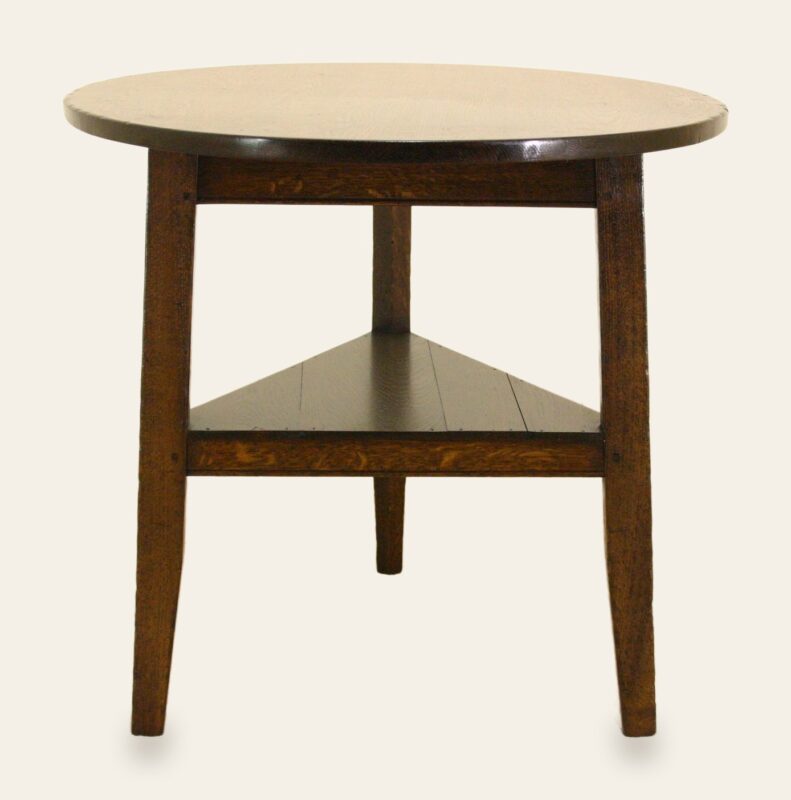
A cricket table is a small round table on three splayed legs. No stretcher, no fourth leg, nothing underneath but air. It is one of the plainest and most useful pieces in English country furniture, made more or less unchanged for three hundred years. We make ours to order in oak, cherry, mahogany or walnut, at whatever diameter and height you need.
On this page
Why three legs
A three-legged table cannot rock. Three points define a plane, so all three feet find the floor whatever it is doing. A fourth leg has to be shimmed or lived with.
That matters in old houses. Brick, flag, tile and old boards all move, and a four-legged table finds every bit of it. A cricket table sits still on a floor that is anything but flat, which is why the form belongs to farmhouses and cottages. The splay helps too: legs raked outwards give a wider footprint than the top, so it resists being knocked over.
The forms we make
The plain cricket table. A round top, a shallow frieze, three splayed legs, turned or square in section.
Cricket table in cherry. The same form in a warmer, closer-grained timber that darkens with age, better suited to a sitting room than oak.
With a potboard. A low triangular shelf between the legs, as on a potboard dresser base. It stiffens the base.
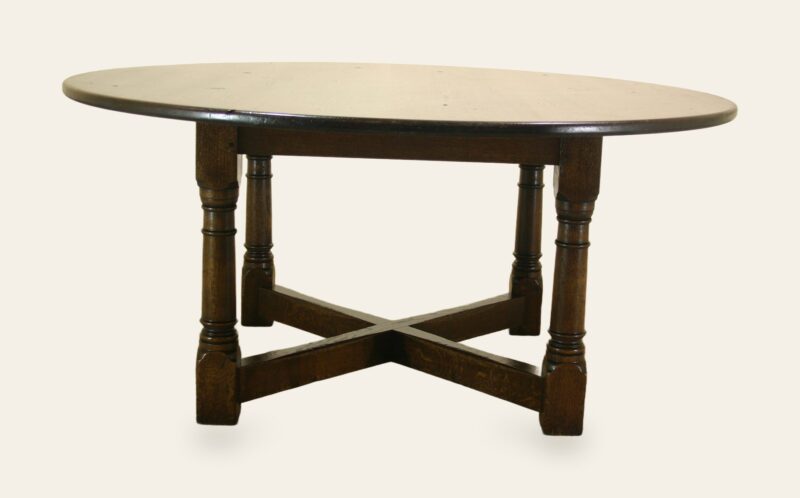
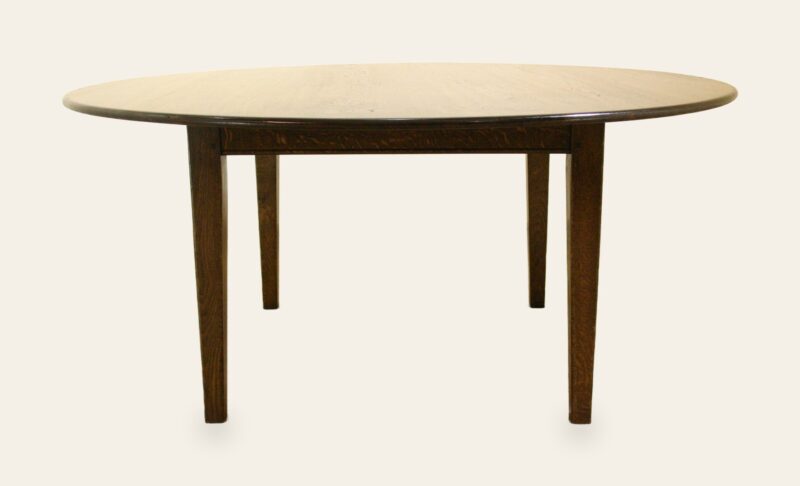
For a small round table with four legs and a stretcher, see monks’ tables or the fixed-top round under farmhouse tables.
Sizes
Made to your dimensions. These are the sizes we make most often, not a fixed list.
For a lamp table, height is usually matched to the arm of the chair it stands beside — tell us the arm height and we will work to it.
Round tripod table
Width 22″ (55cm)1ft 10in55cm550mmDepth 22″ (55cm)1ft 10in55cm550mmHeight 26″ (66cm)2ft 2in66cm660mm
Made in oak, cherry, mahogany or walnut
These are the sizes we make as standard. Every piece is made to order in our own workshop, so any size between — or beyond — those listed can be made for you. Heights and depths can be altered to suit a room, and dimensions are nominal.
Timbers
Oak, cherry, mahogany and walnut are the standard four. Oak is the traditional choice; cherry is the one most often specified for a sitting-room piece.
Specials, quoted on application: character oak, which suits this form very well; pippy oak in light, medium and heavy grades; oak selected for medullary ray; and clean timber with no knots at all.
Finishes: polished, painted, limed, sand-blasted, rub-through paint, natural, or colour matched to a sample. A painted base under a bare oak top works as well here as on a farmhouse table.
Order timber and finish samples. On a piece this small the timber is the whole design.
Made to your size
Diameter, height, leg profile, splay, frieze depth and potboard are all open. Common changes: a height set to a particular chair; a diameter cut to fit a bay or landing; a drawer added to the frieze.
If it is not a variation on an existing piece, our designers draw it first. See bespoke and commissioning.
Prices
Quoted individually. Tell us the diameter, the height, the timber and the finish and we will give you a guide price. Special timbers and finishes are priced on application. Standard lead time is normally twelve weeks, and up to sixteen when the workshop is busy. Your date is confirmed when you order.
A cricket table is often one part of a larger scheme. When it is, the panelling and built-in work alongside it come from Reeve & Co Interiors, and the kitchen from Square & True — the same benches, the same hands.
Frequently asked questions
What is a cricket table?
A small round table on three splayed legs, with a shallow frieze and no stretcher. It is a country form, used as a kitchen, hall or lamp table, and made in England in essentially this shape since the seventeenth century.
Why do cricket tables have three legs?
Because three feet always meet the floor. A three-legged table cannot rock on an uneven surface, which is why the form belongs to houses with old floors.
What size cricket table should I choose?
For a lamp or hall table, 20–24in across; for a breakfast table, 30–36in; for two people to eat comfortably, 36–42in. Any diameter is possible.
Can a cricket table be used as a dining table?
For two people, at around 36–42in across. Beyond that the top overhangs the base too far to be steady, and a round farmhouse or pedestal table is better.