 Skip to content

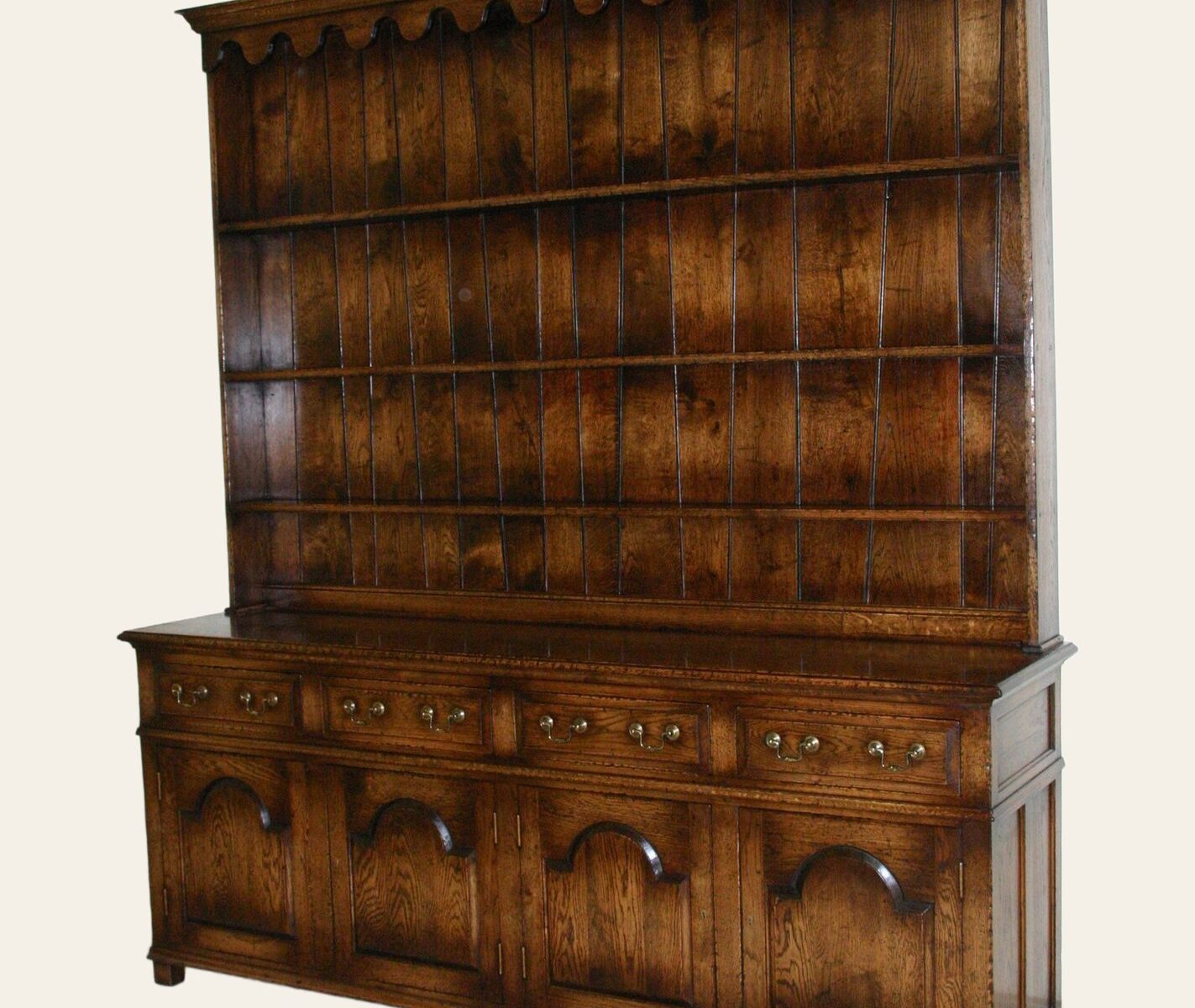
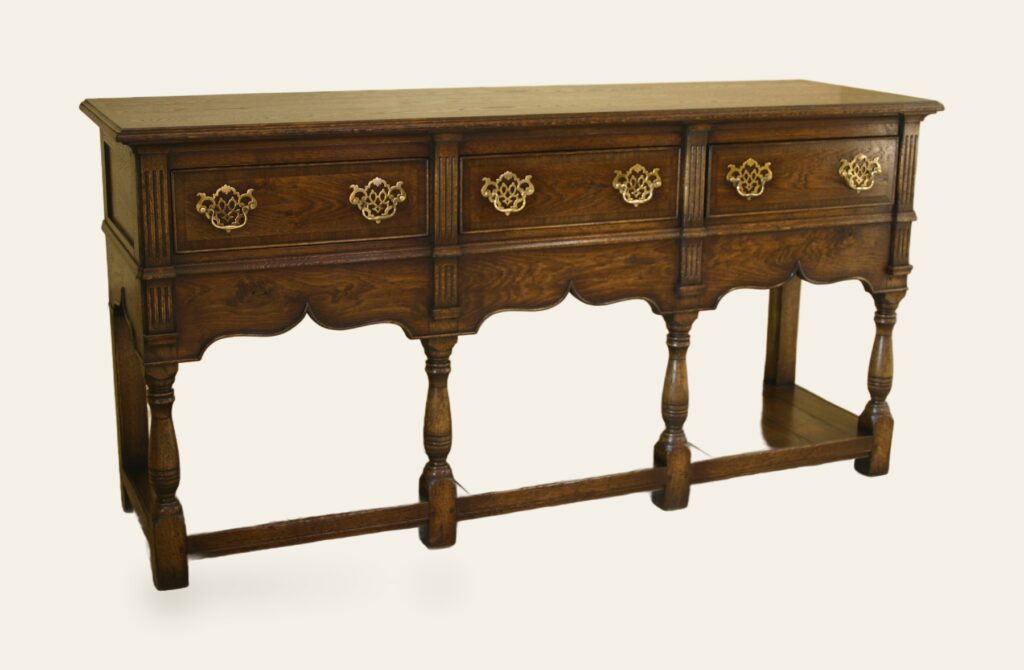
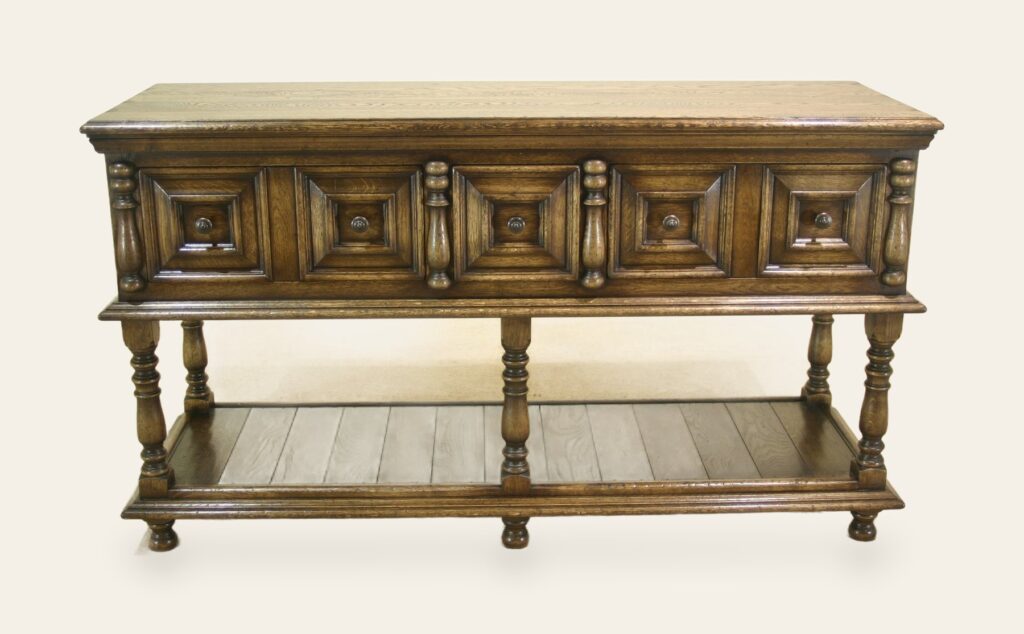
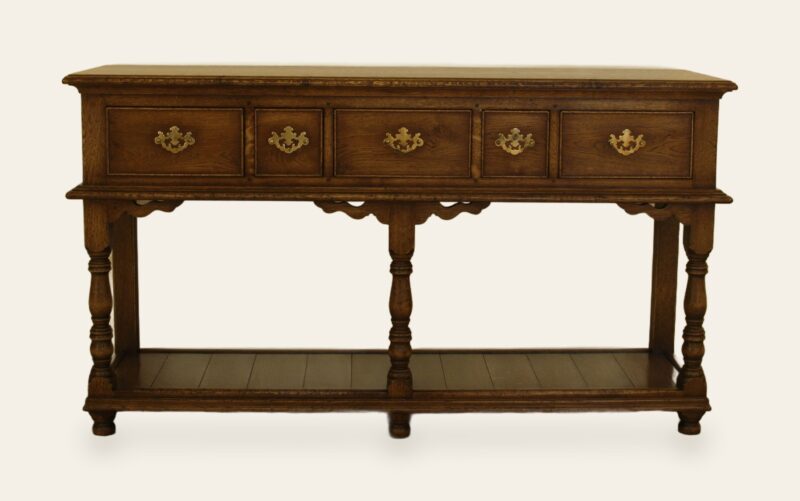
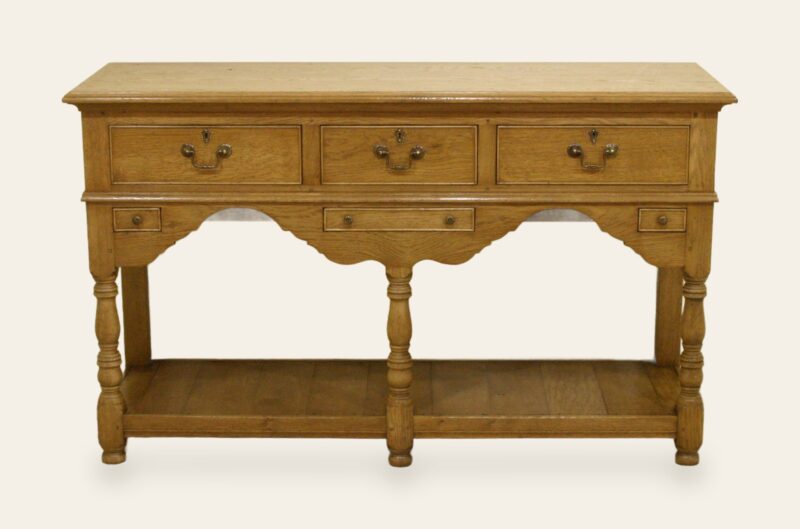
A potboard dresser base is a dresser base with an open shelf low between the legs instead of cupboards underneath. Drawers run across the top under a solid working surface. Below them the piece is open, and near the floor a boarded shelf spans from leg to leg.
On this page
That low shelf is the potboard, and it is the whole point of the form.
Where the name comes from
It held pots. Not decoratively: the heavy iron and earthenware cooking vessels of a working kitchen, which were too heavy to lift onto a shelf at waist height and too big to live in a cupboard.
The potboard put them at the height you could actually get at them, took their weight on a boarded shelf carried directly by the legs, and left the drawers above free for everything else. Warming pans, crocks, bread crocks, milk pans, the things a kitchen used daily.
Because it was a working solution rather than a fashionable one, the form persisted for a very long time in country furniture and particularly in Wales and the Welsh borders. That is also why it turns up in so many named regional patterns.
How it differs from a cupboard base
A dresser base does one of three things underneath the drawers: it has cupboards, it has nothing, or it has a potboard.
Cupboards hide what is in them and give you dust-free storage. They also make the piece read as a solid block, which in a small room can be heavy.
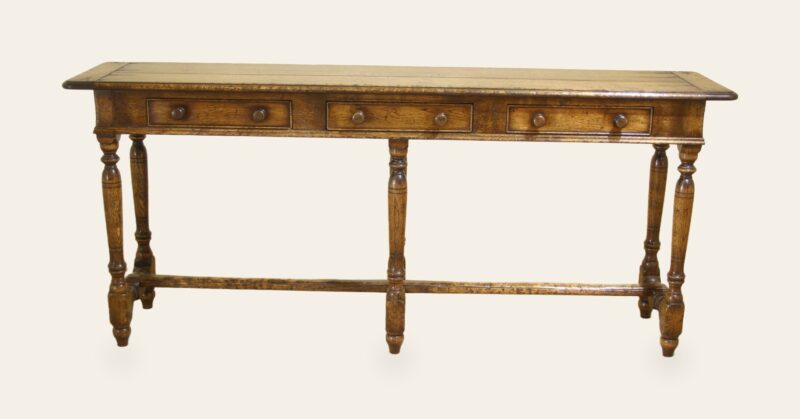
Open, with nothing below, gives you a side table with drawers. Light, but you lose the storage entirely.
A potboard is the compromise, and in practice it is the best one. You keep visible, accessible storage low down. The piece stays visually light because you can see the floor and the skirting underneath it, which makes a substantial dresser sit far more comfortably in a modest room. And the shelf braces the legs, so the base is stiffer than an open one.
The trade-off is honest: what sits on a potboard is on show. It suits things you do not mind looking at, and it is not the place for cardboard boxes.
What people actually put on them now
Very few clients are storing cauldrons. What we see is baskets, log baskets in a sitting room, stoneware and serving dishes, jugs, boots by a back door, a row of large plants, wine, and in dining rooms, the things that come out at the end of a meal.
Photographed empty, a potboard base looks like a design detail. Lived with, it turns out to be one of the more useful surfaces in a house, because it is the only storage in most rooms that is both open and below knee height.
The versions we make
The form scales, which is why there are so many of them.
Three-drawer potboard bases. The standard, and the most versatile. A row of three drawers under the top, open below, potboard beneath. Suits most alcoves and most walls.
Four- and five-drawer potboard bases. Longer pieces for longer walls. The five-drawer version, in the South Wales pattern, is the most emphatic of them: a long run of drawers over a long potboard.
Potboard bases with candle drawers. Small additional drawers, traditionally for candles and now for the things that get lost in a large drawer. A carved three-drawer version with candle drawers is one of the more characterful pieces we make.
Six-leg potboard bases. An extra pair of legs in the middle, which changes the proportions and stiffens a long piece considerably. Worth considering on anything wide.
Moulded front potboard bases. More formal, with the drawer fronts and the frame treated to a moulding rather than left plain.
Carved potboard bases. Where the frieze and the drawer fronts carry carved detail.
Architectural potboard bases. A stronger cornice and plinth treatment, which lifts the form towards a piece of joinery.
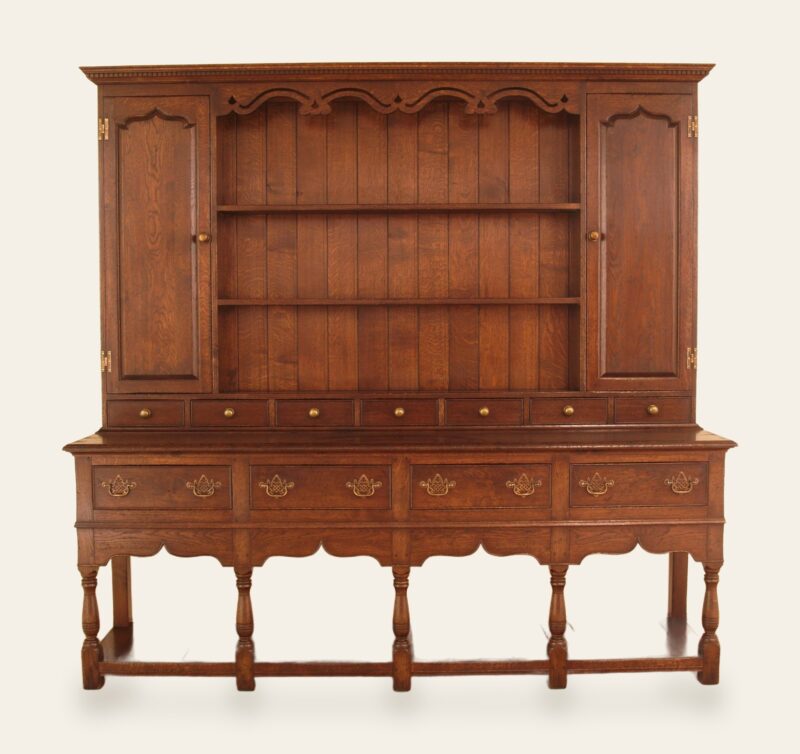
With a rack, or without. A potboard base takes a rack on top to make a full potboard dresser, or stands alone as a server or a side table. The base alone is the more useful piece in a low room.
See the full range of potboard dresser bases, or the wider dresser bases page.
How to choose one
Measure the wall, then the alcove. Everything we make is made to your dimensions, so a potboard base can be built to the exact width available, including the few millimetres that matter in an alcove.
Decide the drawer count from the width, not the storage. Drawer proportions are what make a base look right. A three-drawer base stretched to seven feet gives you drawers that look wrong and sag when loaded. If the wall is long, take four or five drawers, or six legs.
Look at what will sit on the potboard. Baskets in particular vary enormously, and the height from potboard to the underside of the drawers is worth checking against the actual basket rather than an imagined one.
Consider the skirting. A potboard base stands proud of the wall by the depth of the skirting unless the plinth or the back is scribed around it. Say so at the enquiry stage and we will deal with it.
Then choose the timber and the finish. Oak is the obvious answer and the traditional one. Cherry, mahogany and walnut are all available, and every catalogue piece is priced in the four. Character oak suits the form particularly well, because a potboard base is a country piece and looks better for showing the life of the tree.
Underfloor heating, briefly
Worth knowing because the potboard is the part of the piece nearest the floor and dries fastest.
Underfloor heating is not a problem in itself, but it is worth telling us at the enquiry stage, and worth keeping the floor temperature steady rather than cycling it hard. Our care guide covers this properly.
Start with the samples
Colour on a country piece matters more than on a formal one, because the timber is doing most of the work.
Order timber and finish samples, put them on the floor where the base will stand, and look at them against the skirting in daylight and after dark.
Potboard dresser bases · Welsh dressers · How commissioning works · Call 01449 710500
What Is a Potboard Dresser Base?
5 pieces from the workshop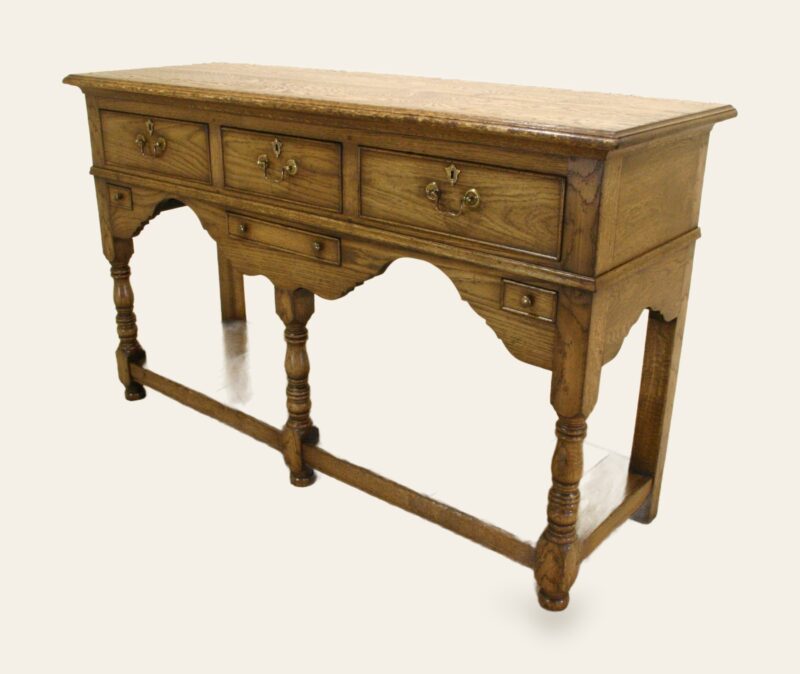
Dresser bases are made on the same benches as the fitted work. Where a kitchen calls for one built in rather than freestanding, that is a job for Square & True, or for Reeve & Co Interiors where it forms part of wider joinery.