 Skip to content
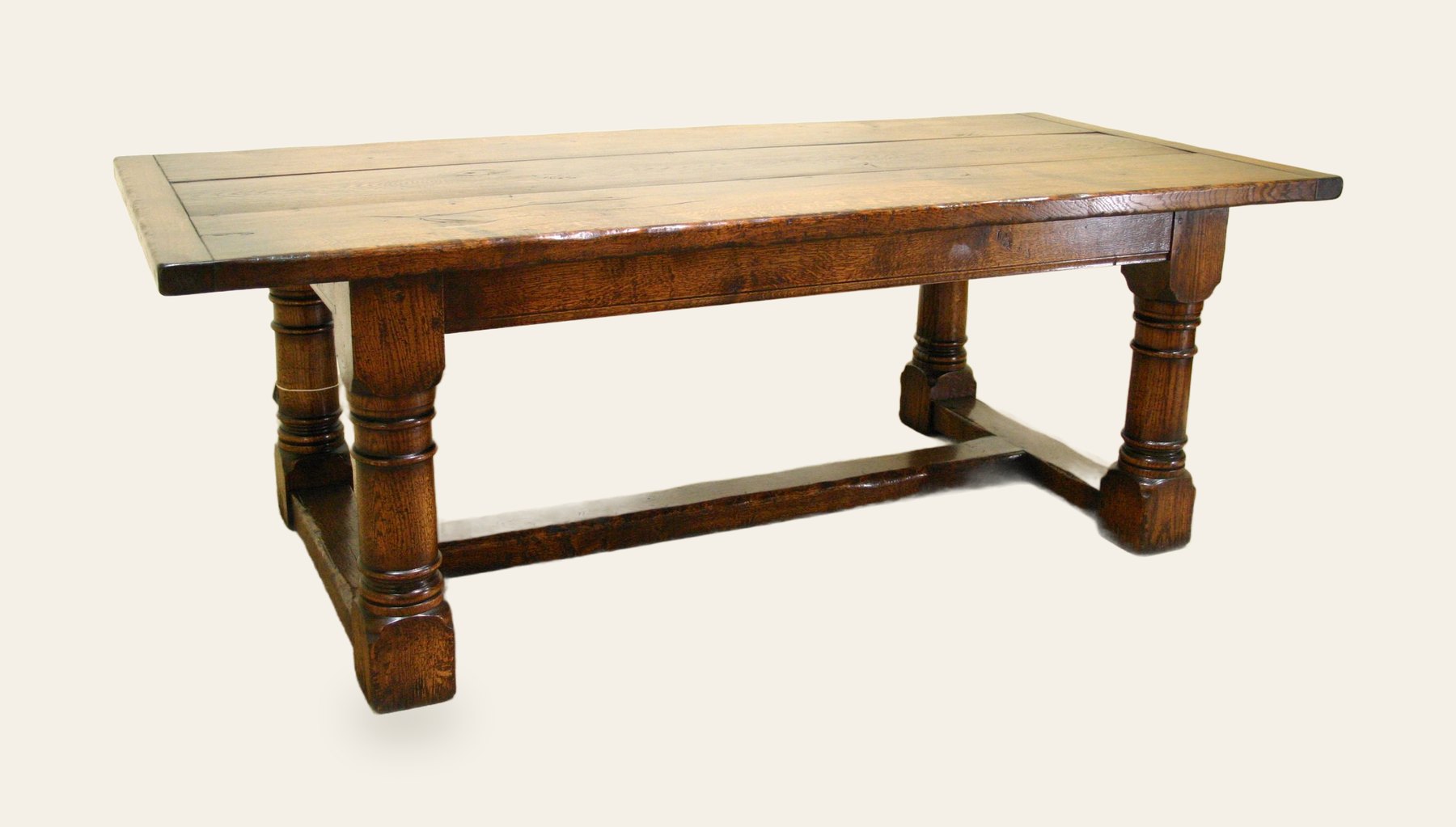
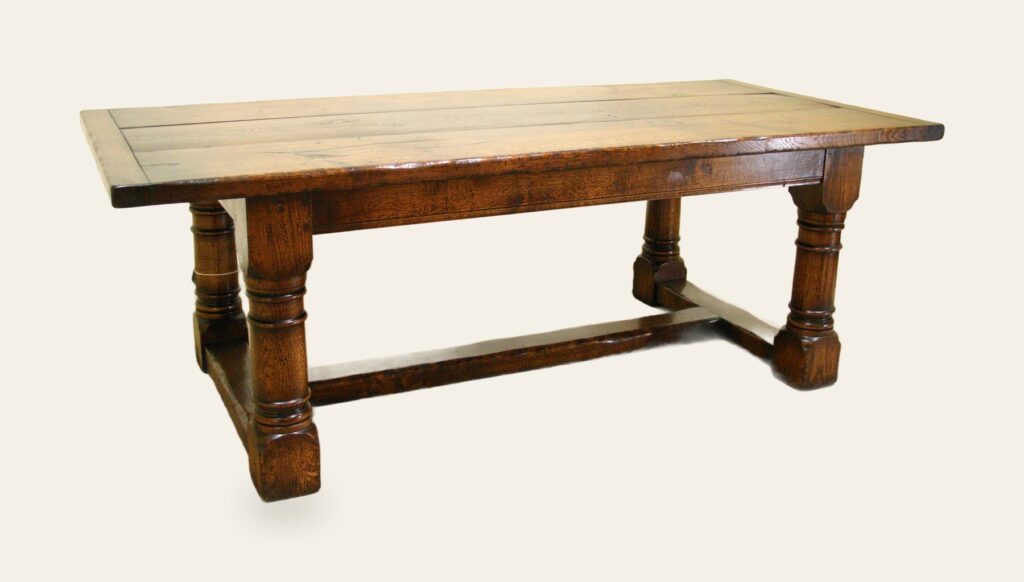
Character oak is oak with the knots, shakes and pronounced figure deliberately left in, rather than cut out. It is not a lower grade of timber, and it is not a finish applied afterwards. It is a decision about which parts of the tree you keep, taken at the board, before anything is cut.
Used in the right place, it makes a new piece read as old from the day it arrives. Used in the wrong place, it fights the room and the piece never settles. This is how we think about it in the workshop, and the questions we ask before we start selecting boards.
What the term actually describes
Every oak log contains both quiet timber and busy timber. Clear, straight-grained boards come mostly from the lower trunk. Above that, where the branches were, the grain swirls and knots appear.
Conventional furniture grades select the quiet timber and cut the rest away. Character grading keeps it. In a character oak piece you should expect to see sound knots of varying size, shakes — the natural splits that open as a board dries — and noticeable variation in colour and grain direction from board to board.
What you should not see is unsound material. A knot that is loose, or a shake that runs right through the thickness at a point that carries load, comes out regardless of grade. Character is a decision about appearance, not a licence to use poor timber.
That distinction matters, because “character” is a trade term rather than a defined grade. European oak is formally graded for appearance under BS EN 975-1, which sorts boards by the size and frequency of knots and other features. Nothing in that standard is called character oak. So the word means whatever the supplier using it has decided it means, which is why it is worth asking to see boards rather than a photograph.
Character oak is not pippy, burr or medullary ray
These four terms get used interchangeably by suppliers, and they describe entirely different things.
- Character oak is about knots and shakes. It is the only one of the four that can be used throughout a piece, in structure as well as surface.
- Pippy oak is dense clusters of small, burr-like pips, available in light, medium and heavy grades. We use pippy oak for tops only. It is too unpredictable structurally to put in a leg or a rail.
- Burr is the growth on the outside of a tree, and gives swirling, dense, unrepeatable figure. Burrs are structurally weak and come in small pieces, so they are decorative surfaces rather than structure.
- Medullary ray is not figure in the ordinary sense at all. The rays are sheets of cells running radially through the trunk, and they show as broad silver flecks when the board is quarter-cut. You can have the ray subdued within the timber, or brought out prominently.
The practical point: if someone offers you “character oak” and shows you a sample of heavy pippy, you are being shown something you cannot have throughout the piece.
What it changes in the workshop
Character oak takes longer at the board stage and no longer anywhere else. Our lead times run from six weeks to six months depending on the piece, and specifying character does not move that.
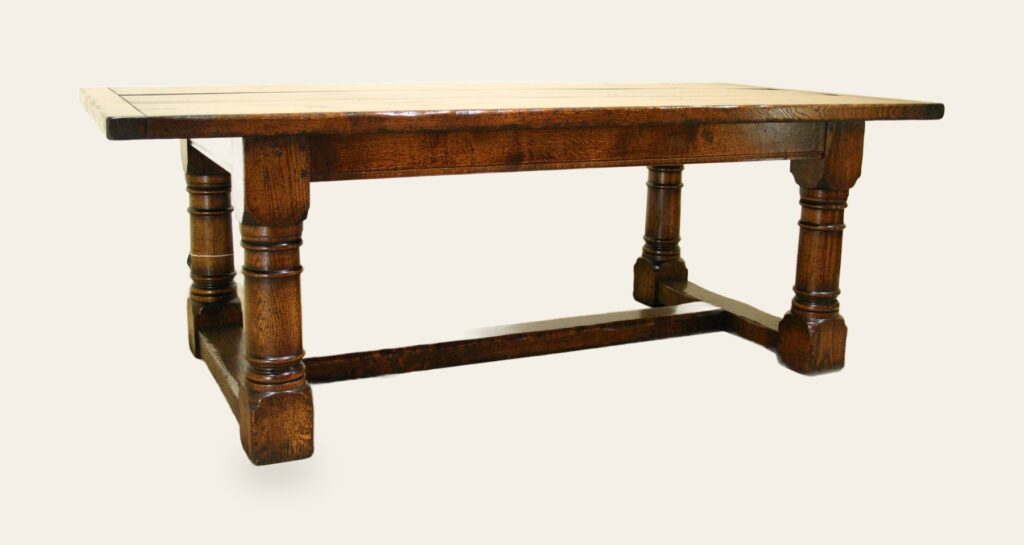
What it does change is selection. A refectory top at 39in deep is laid up from four planks in a nominal 2in section, with the joints showing as lines down the table. Those four boards have to be chosen together. Knots need balancing across the width and along the length, so the eye reads one considered surface rather than three clean planks and one busy one. That is a judgement made with the boards laid out on the bench, not from a photograph.
Shakes are stabilised and filled before the top is thicknessed. Movement is handled the same way as in any of our work: oak is hygroscopic and shrinks and swells across the grain, so panels float in their frames rather than being glued in, and tops are fixed so they can expand and contract. Knots move at a slightly different rate from the surrounding timber, which is one more reason the construction has to allow for it rather than resist it.
Where character oak works
Long refectory tables. This is the clearest case. Our character refectory table is made 96 or 120in wide, 35 or 39in deep and 30in high. At eight or ten feet, a top in quiet oak can read as flat and rather commercial across that much surface. Character carries the length. You can see the range on our oak refectory tables page.
Dressers and dresser bases. A dresser is seen mostly as one large flat elevation against a wall — a Ruthin dresser and rack stands 72in wide and 85in high — and that elevation benefits from something to look at. The Welsh dressers we make in the Denbigh, Ruthin, Montgomeryshire and Corwen patterns all take character oak well.
Vernacular pieces. Settles, benches and stools, blanket chests, coffers, plank-top tables. A bench settle at 72in wide and 45in high is a robust country form, and quiet timber can make it look like a reproduction of itself.
Rooms with existing old timber. Exposed beams, boarded floors, old doors and panelling. Character oak sits with them. New, clear oak in the same room tends to announce itself as the newest thing present, sometimes for a decade.
Where we would talk you out of it
Small pieces. A bedside chest is 20in wide, 20in deep and 27in high. A single knot of any size occupies most of a drawer front, and the piece looks accidental rather than characterful. Below roughly a 36in width, we would usually recommend light character at most.
Chairs. Windsor and ladder-back chairs depend on straight grain in the sticks, legs and stretchers, which are slender and structural. A stick back Windsor stands 35 to 38in high for a single chair, and every one of those components is doing work. Character in a chair belongs in the seat board, if anywhere.
Painted work. If a piece is being painted, character oak is money spent on something nobody will see. The usual and better pairing is a painted base with a pippy or figured oak top, so the timber shows exactly where it earns its place.
Matching a quiet antique. If the piece you are matching is itself clean, straight-grained timber, character oak will not read as sympathetic. It will read as a different piece of furniture standing next to it.
It is not all or nothing
Character comes by degree, and you can specify it by part. A common and very successful choice is a character top over a quieter base, or character on the rack shelves of a dresser with the carcass in cleaner timber. Extension leaves are worth a thought here too: our leaves are made 35, 39 or 42in wide and 20in deep, and they need to be selected from the same run as the top, or the table looks like two tables when it is opened.
Colour is the other thing to know. Oak darkens and warms over the years, moving from pale honey towards a deeper golden brown. Knots darken faster than the surrounding timber and stay darker, so the contrast in a character piece increases over the first few years rather than settling out. If you are judging from a sample, you are judging the quietest that piece will ever look.
Seeing it before you decide
Character oak is difficult to choose from a screen, because the whole point of it is variation, and any single photograph shows you one arrangement of it. We will send samples, and there is no charge for them. You can also see the range of forms and standard sizes in the catalogue, and anything listed can be made to a size between or beyond those given.
If you are weighing this up for a particular room, the quickest way through it is a conversation. Telephone the workshop on 01449 710500 and we will talk it through with you.