 Skip to content

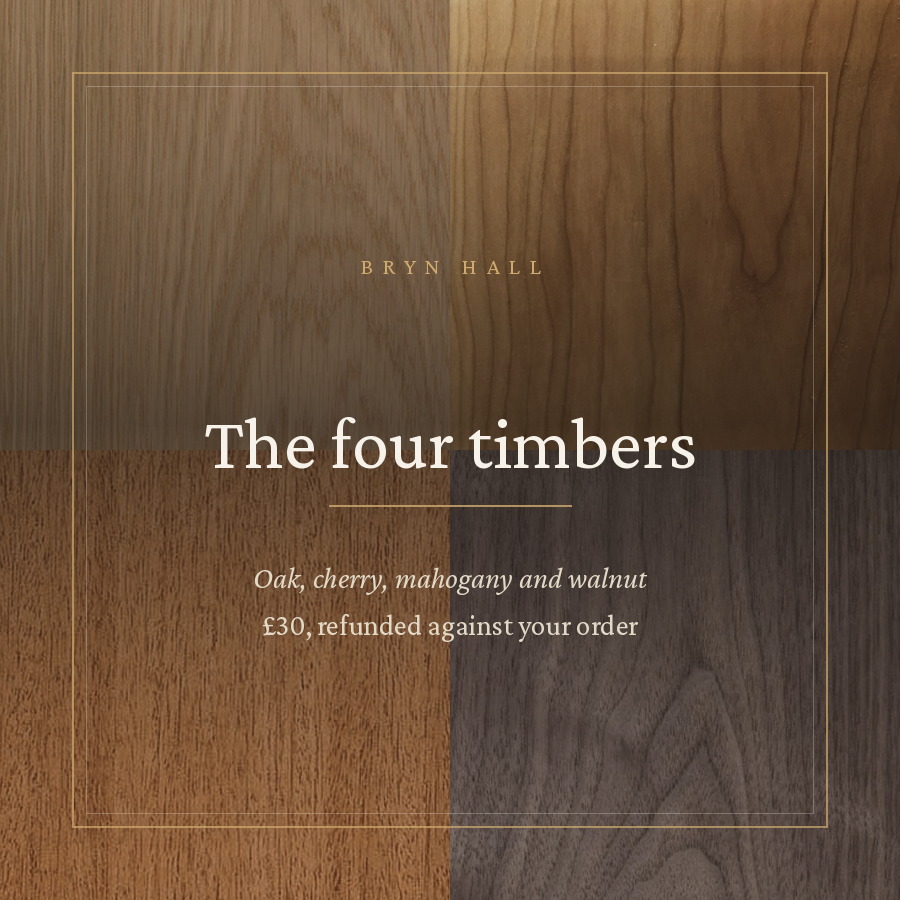
Every piece we make is offered in oak, cherry, mahogany or walnut. Clients almost always arrive having decided on one of them, and about a third of the time they change their mind once a sample is on the table. This is what each timber is actually like to live with.
Oak
The default, and for good reason. English oak is hard, stable, and has a visible grain that reads well at any size — it is the only one of the four that looks right on a nine-foot refectory table and on a lamp table. It takes every finish we offer, including limed and sand-blasted, which the other three do not.
It ages by darkening slowly and evenly. An oak table twenty years old looks like an oak table, only better. If you are furnishing a whole room and want the pieces to agree with each other over decades, oak is the safe answer, and safe is not a criticism.
Cherry
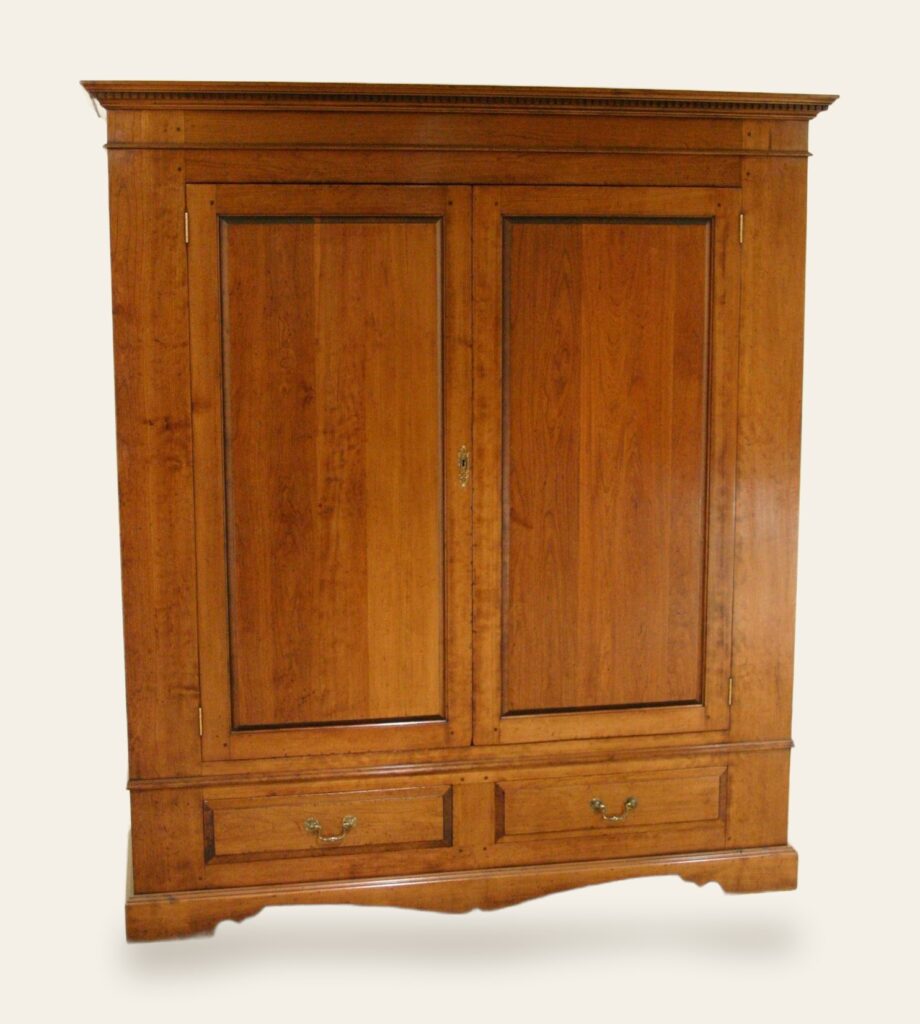
The timber that changes most, and the one most often misjudged from a photograph. Cherry arrives pale, pinkish and rather plain, and over one to two years darkens into a deep reddish brown with real depth to it. Clients who reject cherry from a sample are usually rejecting a colour it will not stay.
Its grain is fine and close, so it suits pieces where the form matters more than the figure — a bureau, a chest of drawers, a bookcase with a lot of visible edge. It is less good on a very large plain surface, where its evenness can read as bland until it has aged.
Mahogany
The formal one. Fine, even grain, a deep red-brown, and it takes a polish better than anything else we use — a polished mahogany top has a depth the others cannot reach. It is the traditional English choice for a dining room, a library or a study, and it still looks right in those rooms.
It is less at home in a kitchen or a boot room, where its formality works against the space. It is also the least forgiving of knocks, because the colour is in the timber rather than the finish, so a deep scratch shows pale.
Walnut
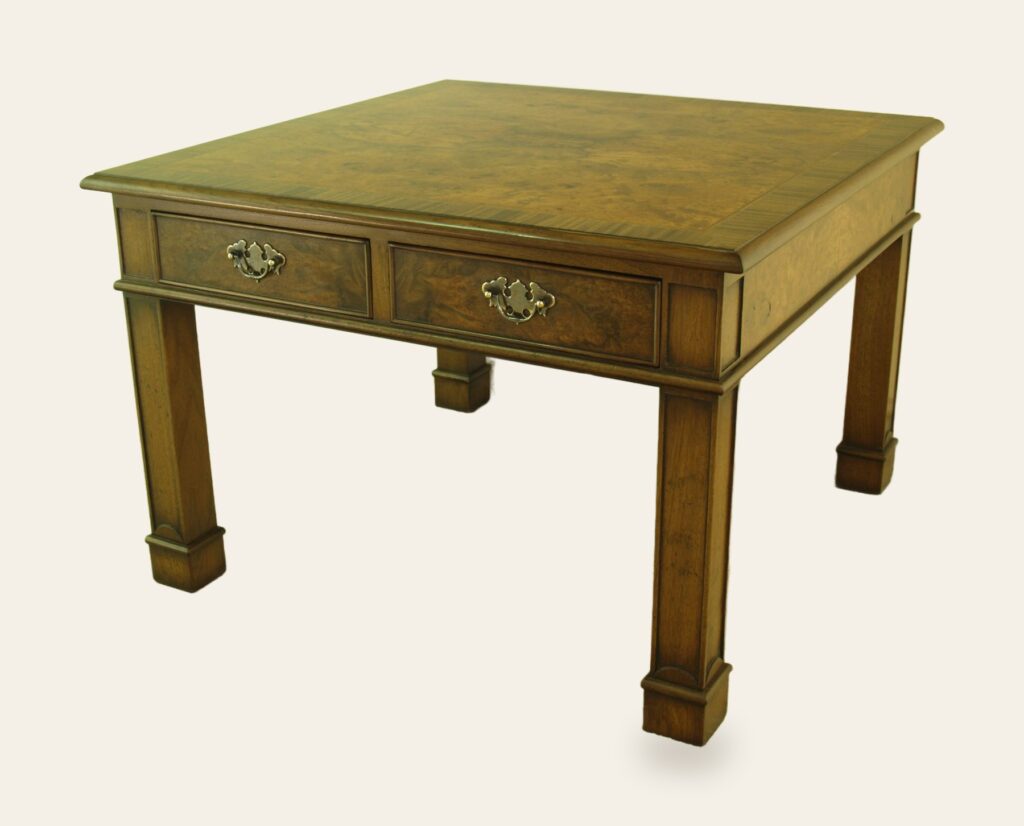
Cooler and browner than mahogany, with dark streaking running through it and no red at all. It is the timber to choose when oak feels too rustic for a room and mahogany too formal, which is a more common position than it sounds.
Walnut has more variation board to board than the other three, so a large piece needs careful selection to avoid looking patched. That is our problem rather than yours, but it is why walnut carries a premium.
Character oak and pippy oak
Both are oak, cut differently. Character oak leaves the knots, shakes and sapwood in rather than selecting them out, so every board is different — it makes a new piece read as old from the day it arrives. Pippy oak has dense clusters of small pin knots and comes in light, medium and heavy grades.
Neither is a lower grade of timber and neither is cheaper. They are available on suitable pieces and quoted on application. There is a longer piece on what character oak really means if that is the direction you are going.
Mixing timbers in one room
It works, but it needs a reason. Two timbers in a room reads as considered; three reads as accident. The usual successful combination is one timber for the large pieces and a second for a single smaller piece that is meant to stand apart — a walnut lamp table in an oak room, for instance.
What does not work is two timbers of similar tone but different species. Cherry and mahogany in the same room fight each other quietly and nobody can say why.
Matching something you already own
If you are adding to existing furniture, tell us at the outset rather than at the end. It changes which timber we recommend, which boards we select, and how we build the finish. We can match new work to pieces a hundred years old, and to reproduction furniture bought last year, but only if we know before we cut.
How to actually decide
Not from a screen. Timber photographs badly, and all four of these change completely between daylight and lamplight. Order samples — £10 each or £30 for all four — put them where the piece will stand, and look at them in the morning and again at night. The money comes off your order.
If you would rather we chose, tell us the room, what is already in it and what the piece is for, and we will send the two most useful samples rather than all four.