 Skip to content
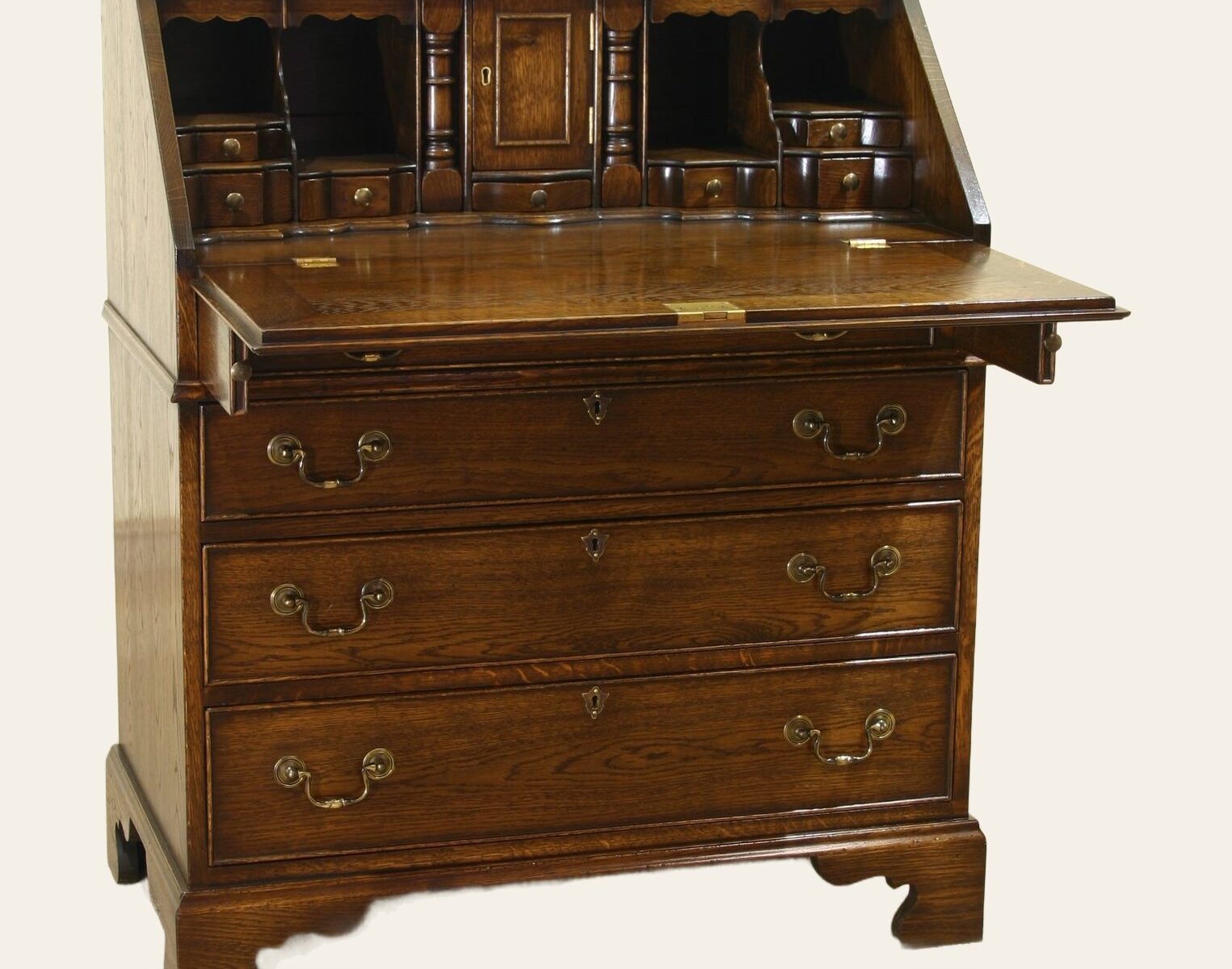
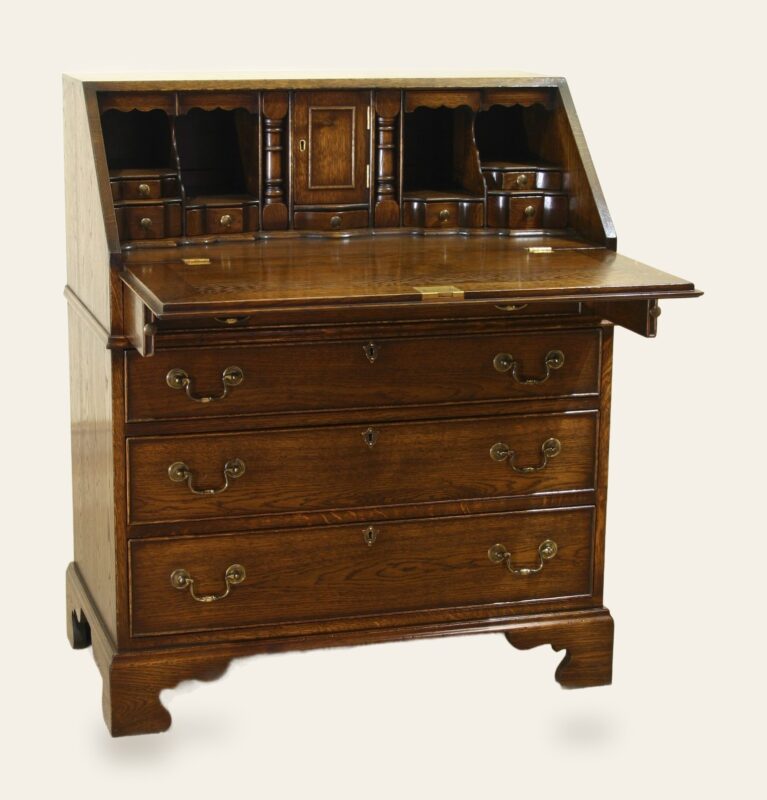
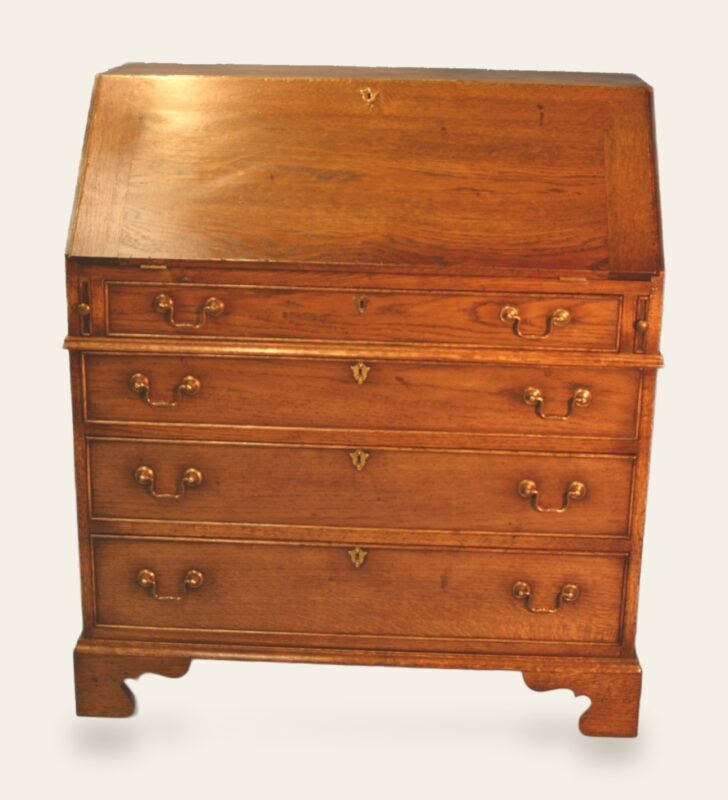
A bureau is a writing desk that shuts. A sloping front hinged at its lower edge falls forward to become the writing surface, revealing a fitted interior of pigeonholes and small drawers. Below sits a bank of full-width drawers. Closed, it gives nothing away.
On this page
That is the argument for it. A desk left open is a desk covered in paper by Thursday. A bureau lets you stop mid-task, lift the front, and have the room back.
It is the right piece for a study that is also a spare bedroom, for a landing, and for a sitting room where a pedestal desk would look like office furniture. We make ours to order, in solid timber, in Suffolk.
The fall front, and how it works
The fall is the sloping front. It drops to horizontal and is carried on two lopers — square-section runners that pull out from the carcase on either side. Lopers separate a properly made bureau from a badly made one: they must be long enough to support the fall to its outer edge, and cut so they slide with a finger.
The fall is made so that it stays flat. A fall that has twisted will not close, and a bureau that will not close has failed at its only job.
A leather-inset fall is standard on #902. A panel of hide is set into a shallow rebate on the inner face, flush with the timber and framed by polished wood, so the writing surface is quieter under a pen and does not throw lamplight back at you. A polished timber fall is made instead where you would rather see the wood right across.
The angle of the slope is set by the pattern: too shallow and the piece looks like a box, too steep and the interior is unusable.
The fitted interior
The standard arrangement is a bank of pigeonholes — open compartments divided by thin partitions, sized for letters — with small drawers below or between them, and often a central cupboard. The divisions usually have a shaped or arched top edge, which is where a bureau shows its hand.
Secret drawers are standard. The concealed compartments behind the central cupboard are part of the #902 pattern rather than an extra to be asked for. They are the detail most clients show people first, and the reason a bureau has always been the piece papers actually get kept in.
The interior is not fixed. Tell us what you keep in a desk and we will lay it out around that: more small drawers for someone who files, a slot sized to a laptop.
The forms we make
Bureau #902. The standard pattern: fall front over a bank of full-width drawers, with the fitted interior behind. Moulded top edge, moulded plinth and solid brass ironmongery.
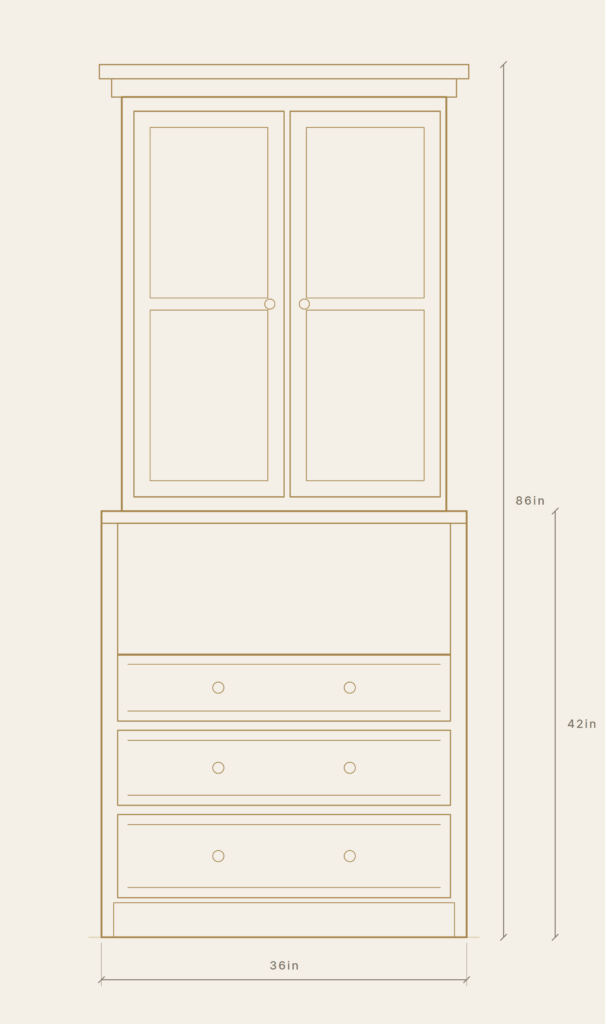
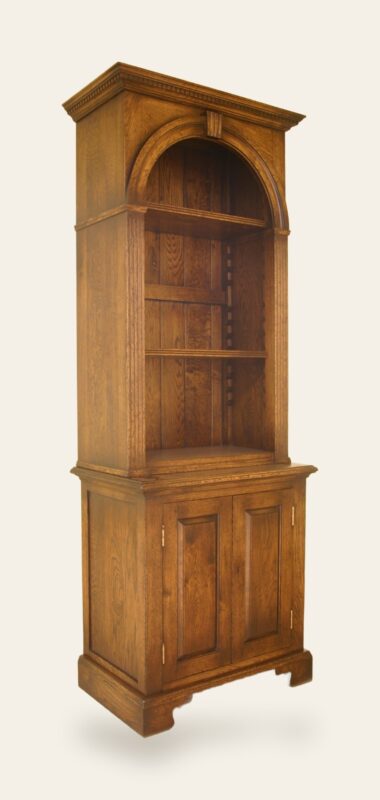
Bureau with a glazed bookcase top. A glazed cabinet standing on the bureau, so the piece runs from floor to near ceiling: books above, writing in the middle, drawers below. Much the most useful piece of furniture per square foot of floor that we make.
Bureau with a panelled bookcase top. The same, with solid panelled doors instead of glass, where you do not want the contents on show.
Both tops are made as a separate carcase, which is how they are delivered and how they come apart.
Timbers
Oak, cherry, mahogany and walnut are the standard four, and every bureau is made in all of them. Oak is the most-specified; mahogany suits a bureau bookcase in a formal room; cherry gives the warmest colour.
Specials, quoted on application: character oak; pippy oak in light, medium and heavy grades, at its best used for the fall alone, where the figure becomes the front of the piece; oak selected for medullary ray, within or without the timber; and clean timber with no knots at all.
Finishes: polished, painted, limed, sand-blasted, rub-through paint, natural, or colour matched to a sample. We can match furniture that is 100 years old to new reproduction purchases made the year before.
Order timber and finish samples. The fall is a single unbroken face, and it is what you see from across the room.
Standard sizes
1 pieceBureau
Width 35″ (89cm)2ft 11in89cm890mmDepth 20″ (51cm)1ft 8in51cm510mmHeight 40″ (102cm)3ft 4in102cm1020mm
Made in oak, cherry, mahogany or walnut
These are the sizes we make as standard. Every piece is made to order in our own workshop, so any size between — or beyond — those listed can be made for you. Heights and depths can be altered to suit a room, and dimensions are nominal.
Made to your size
Every dimension is open. Height set so the writing surface lands where you want it for your chair; width set to the wall or alcove; depth set so the fall, when down, gives the working area you need.
Common changes: a drawer added or taken away; the interior redrawn around a laptop; the bookcase top made shallower than the base; the piece narrowed for a landing. See bespoke and commissioning.
The carcase, the frame and the joints are guaranteed for as long as you own the piece, with ten years on drawer and door fitting, ironmongery and finish. Our guarantee sets out the position in full.
See also bookcases, pedestal desks and the Denbigh collection, whose raised and fielded panelled fronts and cock beaded drawers suit a formal bureau.
Prices
Guide price on request, quoted by size, timber, finish, the complexity of the fitted interior and whether there is a bookcase top. Special timbers, colour matching and natural finishes are priced on application. Standard lead time is normally twelve weeks, and up to sixteen when the workshop is busy. Your date is confirmed when you order, a one-off commission four weeks longer.
We make each bureau to sit in a room our own joiners have frequently fitted. Reeve & Co Interiors handles the built-in work and Square & True the kitchens, all from the same yard in Mickfield.
Frequently asked questions
What is a bureau?
A writing desk with a sloping front hinged at its lower edge. The front falls forward onto pull-out runners to make the writing surface, revealing pigeonholes and small drawers, with full-width drawers below.
What holds the fall front up when it is open?
Two lopers: square-section runners that pull out from the carcase on either side. They carry the weight of the front and anything on it, and on a properly made bureau they support the fall to its outer edge.
Can the interior be laid out to suit what I keep in it?
Yes, and it should be. The standard arrangement is pigeonholes with small drawers, but we draw the interior around what you use.
What is a bureau bookcase?
A bureau with a separate cabinet standing on top of it, glazed or panelled. It gives books, writing and drawer storage in one floor-to-ceiling piece, which is why it suits small studies.