 Skip to content
A pedestal desk is a top carried on two banks of drawers, with a kneehole between them. It has outlasted every other desk form for a simple reason: the pedestals do the work of legs and of storage at once, giving a rigid desk and a filing system in one footprint.
On this page
It is also the desk that looks like a desk, which is why it usually faces the door. We make them to order, in solid timber, in Suffolk.
The forms we make
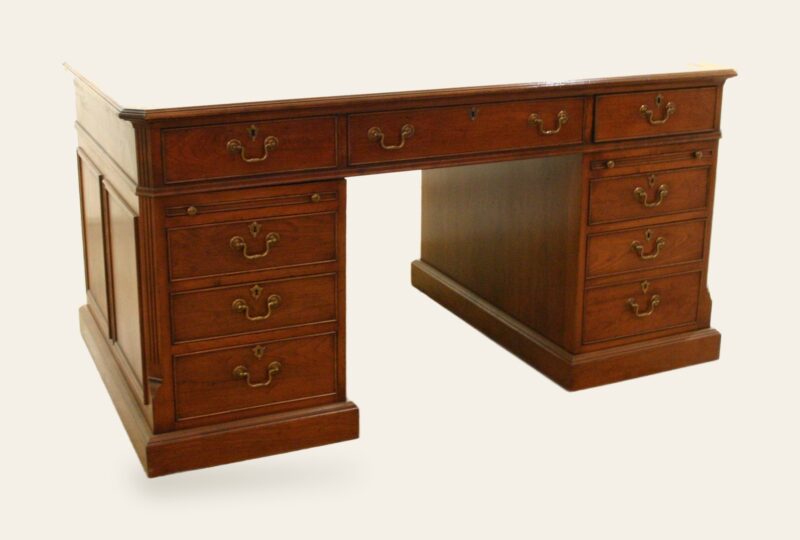
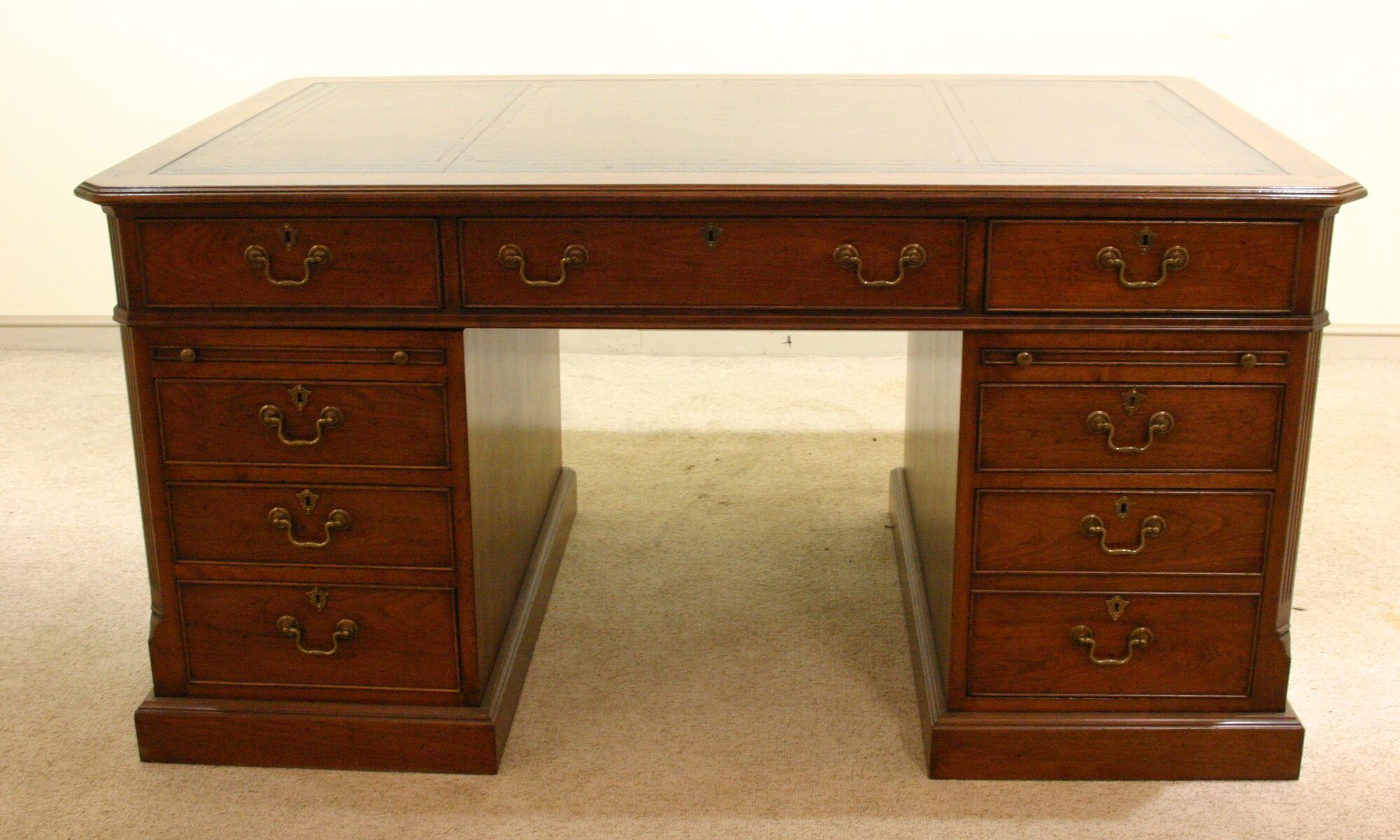
Pedestal desk #901. The standard pattern, shown in cherry. A moulded top over two pedestals of graduated drawers, with a drawer in the frieze between. Cock beaded drawer fronts, solid brass handles, and a finished back so it can stand in the middle of the room.
Partners’ desk #901C. The same desk finished on both sides, with drawers or cupboards facing each way. Described below.
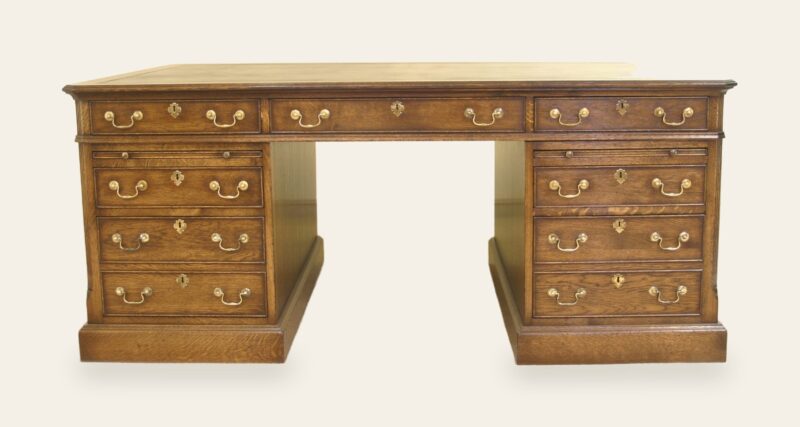
Victorian desk with a green leather top. Heavier proportions, a deeper moulded edge and the green hide writing surface the form is known for. Most often specified for a panelled study.
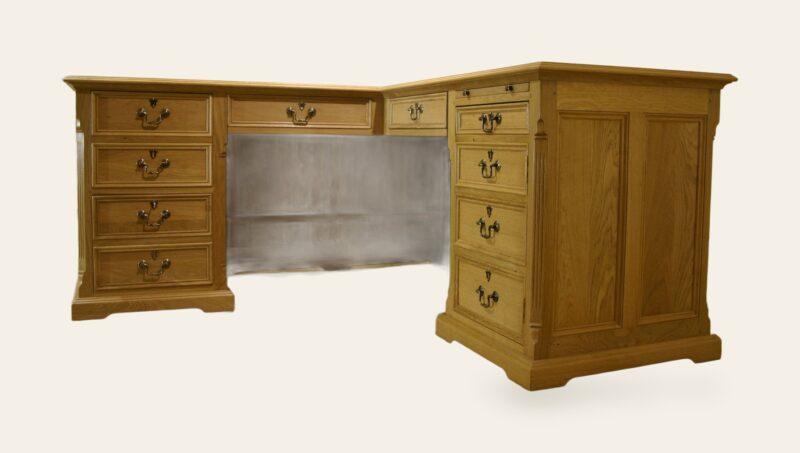
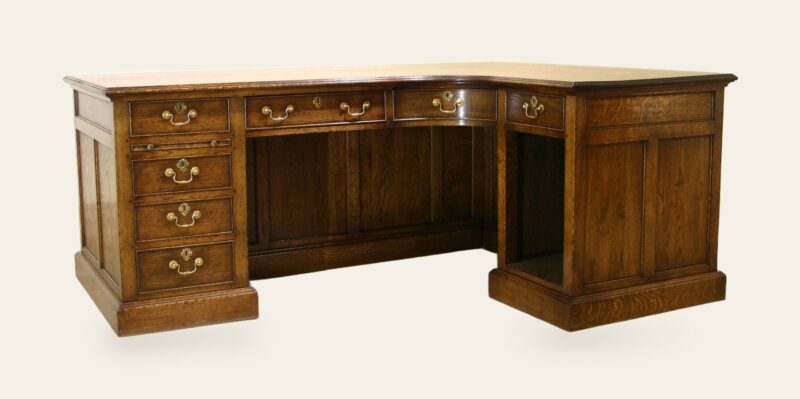
Large corner desk with a leather top. An L-shaped desk running along two walls, with leather over the whole working surface. For a study where the window is on one wall and the door on another.
Large corner desk with a rounded drawer. The same L-shape with the internal corner curved and a curved drawer front following it. It removes the dead corner and gives a continuous sweep to swivel across.
Leather tops
A leather top is a panel of hide set into a shallow rebate in the top, flush with the timber and framed by polished wood.
Why have one. Quieter to write on, softer under a pen, and it stops a polished top throwing lamplight into your face. It is the traditional surface for the form.
Colour. Green is the classic, and the one specified for the Victorian pattern. We hold a range of standard leather colours, so the hide is chosen from what is here rather than ordered in specially. Tell us the timber you have settled on and we will set the two side by side.
Tooling. The border pattern blocked into the edge of the hide, in gold or blind. Tooling is what makes a leather top read as a desk rather than a mat. We offer a range of tooling patterns, gold tooling among them. Choose the pattern with the colour rather than after it, because you see the two together and a gold border reads very differently on a dark hide than on a light one.
Or not. A polished timber top is plainer, and suits oak better than mahogany.
Partners’ desks, honestly
Finished on all four sides. There is no back: twice the show wood and twice the drawer fronts, which is reflected in the price.
Big. Two people need to sit at it without knocking knees, which sets a minimum depth well beyond a single desk. In a small room it becomes an obstacle.
It comes apart. Made as three parts, two pedestals and a top, so it can be carried in, assembled and taken out again.
One side need not match the other. Drawers facing you and cupboards facing your partner is common, and one side can take suspension files while the other does not.
Most clients who ask about a partners’ desk are not planning to share it. They want the finished-both-sides quality because the desk stands in the middle of the room. That is a good reason, and it changes what we put on the back.
Timbers
Oak, cherry, mahogany and walnut are the standard four, and every desk is made in all of them. Mahogany is traditional for the Victorian pattern; oak for a country study; cherry, as on #901, sits well with green leather.
Specials, quoted on application: character oak; pippy oak in light, medium and heavy grades, for the top; oak selected for medullary ray, within or without the timber; and clean timber with no knots.
Finishes: polished, painted, limed, sand-blasted, rub-through paint, natural, or colour matched to a sample. We can match furniture that is 100 years old to new reproduction purchases made the year before.
Order timber and finish samples, and if you are having leather, look at the timber and hide together under your desk lamp.
Standard sizes
1 piecePedestal desk with leather top
Width 48, 54, 60 or 72″ (122–183cm)4ft, 4ft 6in, 5ft or 6ft122, 137, 152 or 183cm1220, 1370, 1520 or 1830mmDepth 24, 27, 36 or 48″ (61–122cm)2ft, 2ft 3in, 3ft or 4ft61, 69, 91 or 122cm610, 690, 910 or 1220mmHeight 31″ (79cm)2ft 7in79cm790mm
Made in oak, cherry, mahogany or walnut
These are the sizes we make as standard. Every piece is made to order in our own workshop, so any size between — or beyond — those listed can be made for you. Heights and depths can be altered to suit a room, and dimensions are nominal.
Made to your size
Every dimension is open, and on a desk they are personal. Top height and knee clearance are set to you and your chair. Kneehole width is set so you can turn without catching a pedestal. Top depth is set to the screen you use, because a monitor needs more depth than a blotter did.
Cable management is designed in, not drilled in afterwards. Tell us where the socket is and what plugs in.
Common changes: a pedestal replaced with a cupboard; the desk narrowed for an alcove; the frieze drawer omitted for knee height; a keyboard slide fitted. See bespoke and commissioning.
The carcase, the frame and the joints are guaranteed for as long as you own the desk, with ten years on drawer fitting, ironmongery and finish. Our guarantee sets out the position in full.
See also bookcases, bureaux, fitted furniture and carver chairs.
Prices
Guide price on request, quoted by size, timber, finish, drawer arrangement and whether the top is leather. A partners’ desk is quoted separately, because it is finished on both sides. Special timbers, colour matching and leather tops are priced on application. Standard lead time is normally twelve weeks, and up to sixteen when the workshop is busy. Your date is confirmed when you order.
A pedestal desk is often one part of a larger scheme. When it is, the panelling and built-in work alongside it come from Reeve & Co Interiors, and the kitchen from Square & True — the same benches, the same hands.
Every size, timber and finish for our pedestal desks is priced on the Pedestal desks order page, where you can choose the options and pay the deposit online.
Frequently asked questions
What is a pedestal desk?
A desk whose top is carried on two banks of drawers with a kneehole between them, rather than on legs. The pedestals give both rigidity and storage.
What is a partners’ desk?
A pedestal desk finished on all four sides, with drawers or cupboards facing both ways so two people can work facing each other. It needs more depth than a single desk, and costs more.
Should I have a leather top?
Have one if you write by hand, work under a lamp, or want the traditional look. Have polished timber if the desk is oak, or if you would rather see the wood.
Can you make a desk to fit a corner?
Yes. Large corner desks are regular work, with a square internal corner or a curved corner and a rounded drawer following it. Send a sketch of the room with the window, door and socket positions marked.