 Skip to content
A monks’ table is a table and a seat in one piece. The top is hinged to the arms of a settle beneath it: swing it up and back for a high-backed settle to sit on; bring it forward and down and it becomes a table across the sitter’s lap. It belonged in a hall, where floor space was scarce and furniture had to earn its keep twice.
On this page
It is one of the oldest dual-purpose designs in English furniture, and it still solves a modern problem: a hall, snug or boot room where you want somewhere to sit and occasionally somewhere to eat, but not both at once. We make ours to order in the settle form and in the round table form that carries the same name.
The forms we make
The monks’ settle-table. The classic arrangement: a panelled or planked settle with a box seat, and a top pivoted on the arms so it drops forward into a table and swings back into a chair back. Because the base is a box, it also gives storage under the seat.
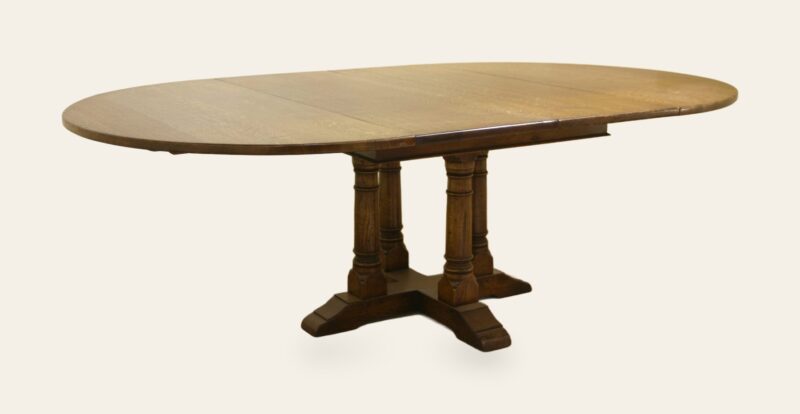
Round monks’ table with cross stretcher. A round top on four legs tied by a cross stretcher — two rails crossing at the centre of the base — with leaves that take the top out when you need it. The cross stretcher keeps the base rigid without a low rail where feet want to be, and it is the version most often bought purely as a dining table.
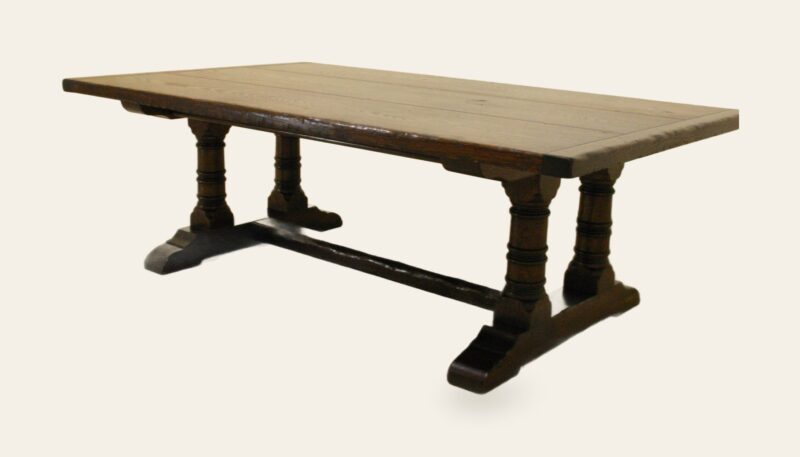
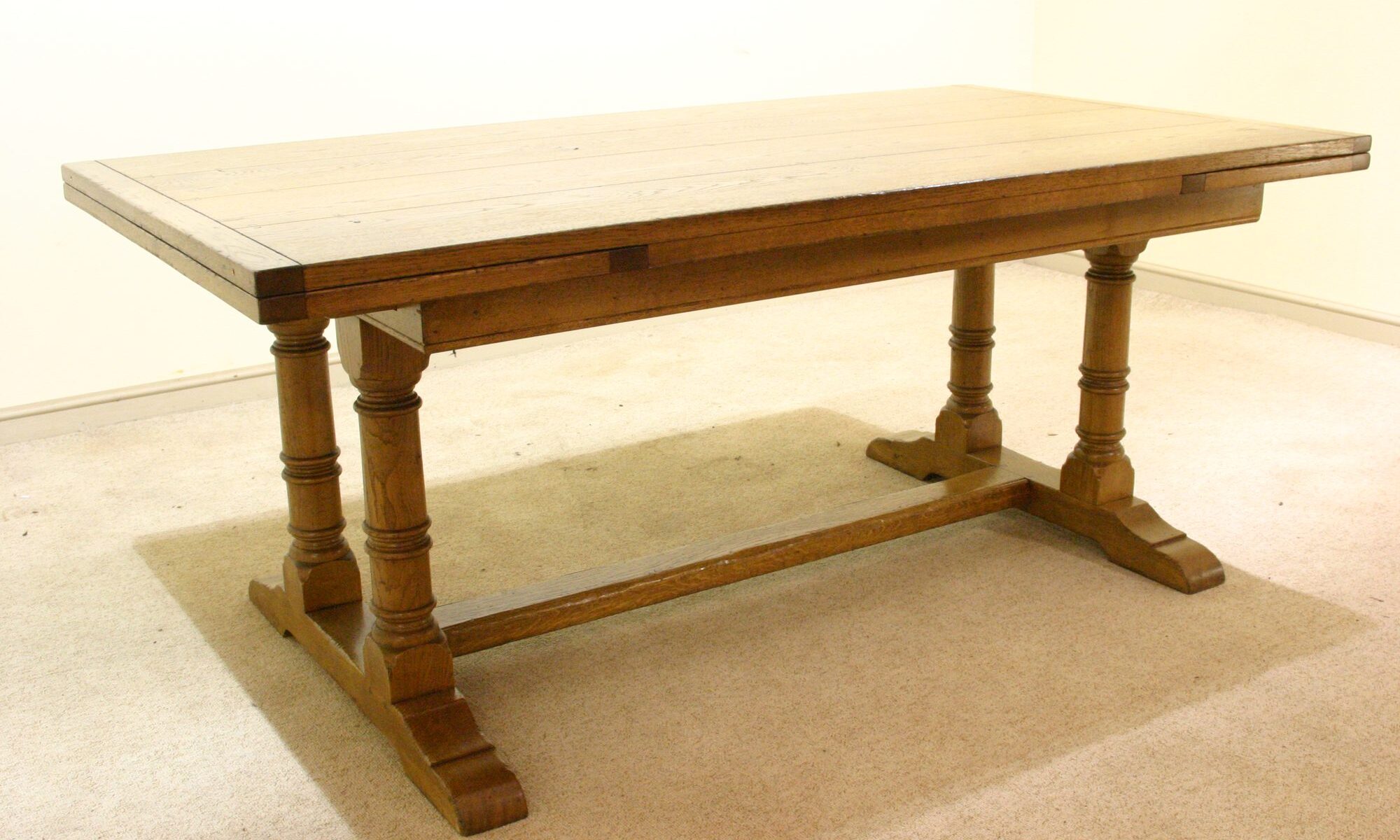
Drawleaf monks’ refectory. The monks’ arrangement with a full refectory top and base, and two 18in leaves under the top.
Fixed planked-top monks’ refectory. The same, without the leaves.
For the plain seating forms without the table action, see settles and benches.
Sizes
Made to your dimensions. Allow about 24in of seat or table edge per person, and check the swing clearance in front of a settle-table — the top needs room to come down.
Standard table height is 30in; seat height on the settle form is about 18in. Round tops start at 48in for four and 54in for five or six, with leaves adding length as an oval.
Drawleaf monks' refectory table
With 2 leaves of 45 cm (18″) each
Width 72, 78, 84, 90 or 96″ (182–244cm)6ft, 6ft 6in, 7ft, 7ft 6in or 8ft182, 198, 213, 228 or 244cm1820, 1980, 2130, 2280 or 2440mmDepth 35 or 39″ (90 or 100cm)2ft 11in or 3ft 3in90 or 100cm900 or 1000mmHeight 30″ (76cm)2ft 6in76cm760mm
Fixed planked top monks' refectory table
With nominal 5cm/2in top
Width 72, 78, 84, 90 or 96″ (182–244cm)6ft, 6ft 6in, 7ft, 7ft 6in or 8ft182, 198, 213, 228 or 244cm1820, 1980, 2130, 2280 or 2440mmDepth 35 or 39″ (90 or 100cm)2ft 11in or 3ft 3in90 or 100cm900 or 1000mmHeight 30″ (76cm)2ft 6in76cm760mm
Made in oak, cherry, mahogany or walnut
These are the sizes we make as standard. Every piece is made to order in our own workshop, so any size between — or beyond — those listed can be made for you. Heights and depths can be altered to suit a room, and dimensions are nominal.
Timbers
Oak, cherry, mahogany and walnut are standard, and every piece is made in all four. Oak is the traditional and much the most common choice for this form.
Specials, quoted on application: character oak, which suits an old form particularly well; pippy oak in light, medium and heavy grades, for tops; oak selected for medullary ray; and clean timber with no knots at all.
Finishes: polished, painted, limed, sand-blasted, rub-through paint, natural, or colour matched to a sample.
Made to your size
Top size, seat width, back height, storage depth and stretcher arrangement are all yours to set. Common changes: a settle-table made to the length of a hall wall; a deeper box seat for boots; a round top sized to a bay; a drop-in cushion in your own material or in leather we supply.
If the piece does not exist yet, our designers draw it first. See bespoke and commissioning.
Prices
Quoted individually to size and specification. Tell us the form, the dimensions, the timber and the finish and we will give you a guide price. Special timbers and finishes are priced on application. Standard lead time is normally twelve weeks, and up to sixteen when the workshop is busy. Your date is confirmed when you order.
We make each monk’s table to sit in a room our own joiners have frequently fitted. Reeve & Co Interiors handles the built-in work and Square & True the kitchens, all from the same yard in Mickfield.
Every size, timber and finish for our monks tables is priced on the Monks tables order page, where you can choose the options and pay the deposit online.
Frequently asked questions
What is a monks’ table?
A piece of furniture that works as both a settle and a table. The top is hinged to the arms of the seat beneath it, so it swings back to form a chair back or comes forward and down to form a table top.
Is a monks’ table practical in a modern house?
In the right place, yes: halls, boot rooms and snugs where you want seating most of the time and a surface occasionally, with storage in the box base. Where you eat every day, a refectory or farmhouse table is the better piece.
What is the round cross-stretcher monks’ table?
A round dining table on four legs tied by a stretcher crossing at the centre of the base, with leaves that extend the top. It carries the monks’ name but is bought as a dining table in its own right.
Can the seat be upholstered?
Yes — a loose or drop-in cushion in your own material, or in leather we supply. See settles and benches.