 Skip to content
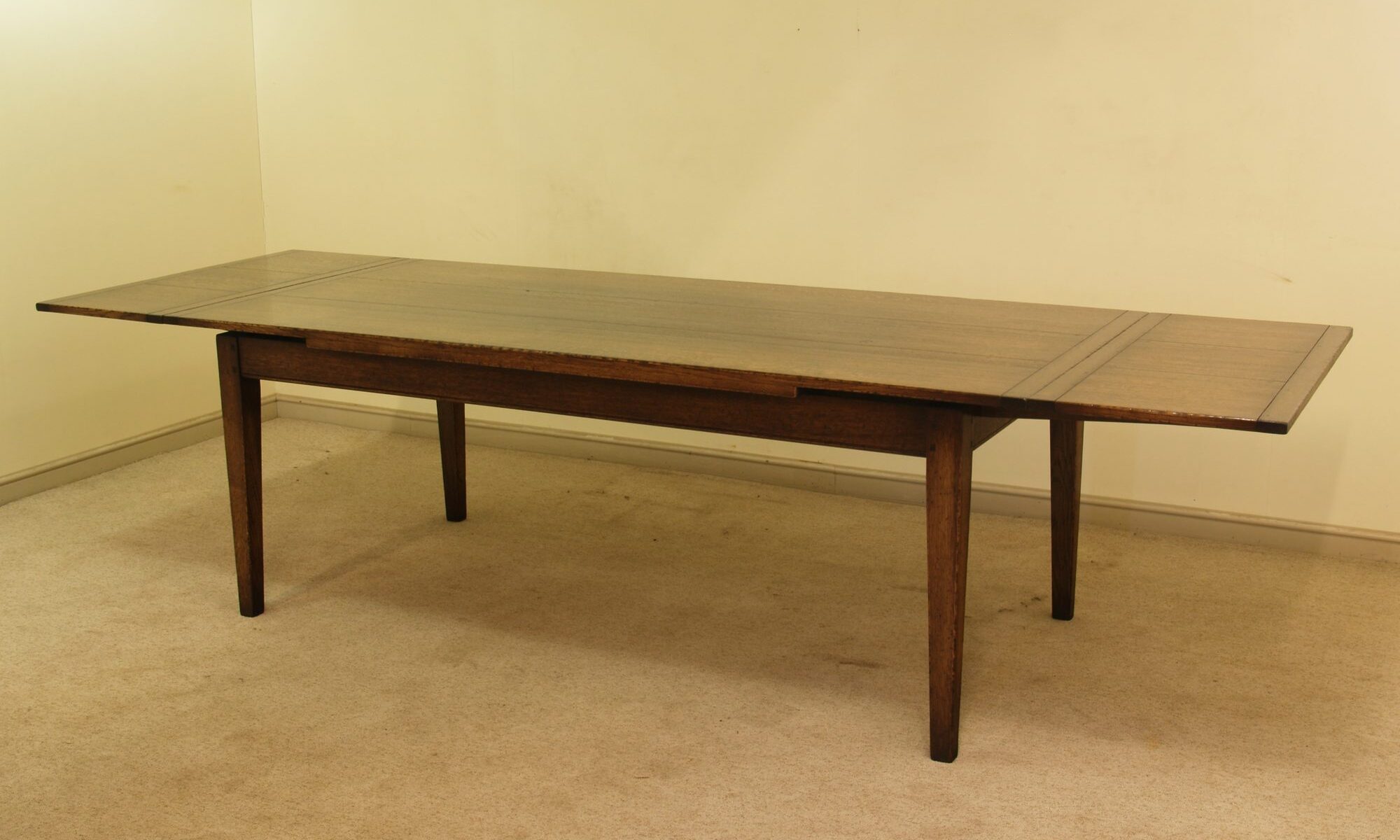
A drawleaf table extends without a separate leaf to store. The two leaves live permanently under the main top, and when you need the length you pull one out from the end. It rises as it comes and settles level with the top, flush and continuous, in about five seconds.
On this page
It is a very old idea, and it solves the problem every other extending table creates: where do you keep the leaf, and will it still match in ten years.
How the draw-leaf mechanism works
Each leaf sits on a pair of tapered bearers running in slides beneath the main top. Pull the leaf and the bearers travel out; because they are tapered, the leaf climbs as it goes, until its surface has risen exactly the thickness of the top and locks level against it.
The main top is loose on the frame, so as the leaves come out it stays centred over the base and floats down onto them. Three consequences:
- Nothing is stored anywhere else. The leaves never leave the table.
- The leaves are cut from the same boards as the top, matched at the same time, and they age at the same rate because they live in the same room.
- Either end works on its own. You can run one leaf out and leave the other in, which gives you three usable lengths rather than two.
The forms we make with draw-leaves
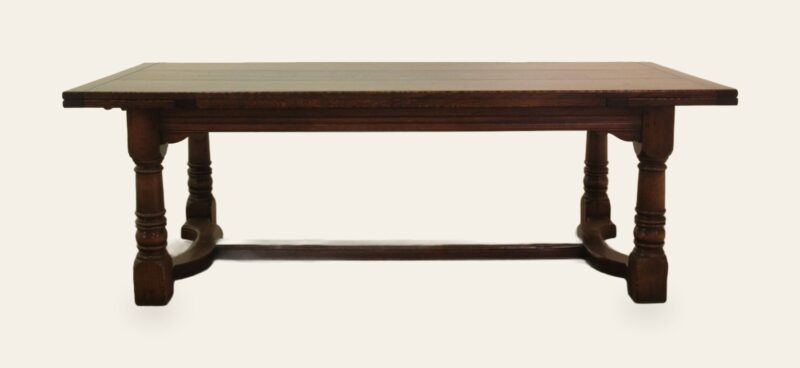
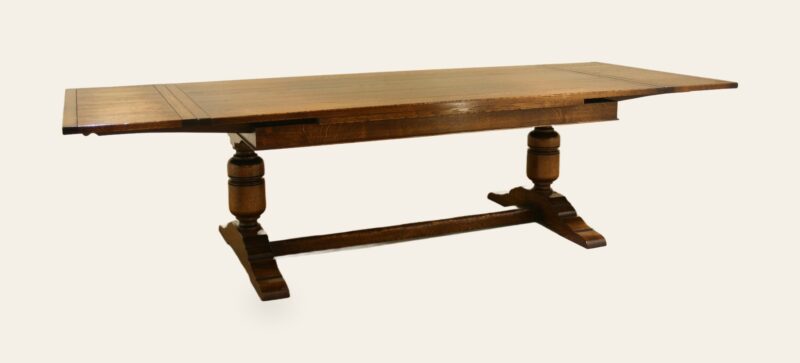
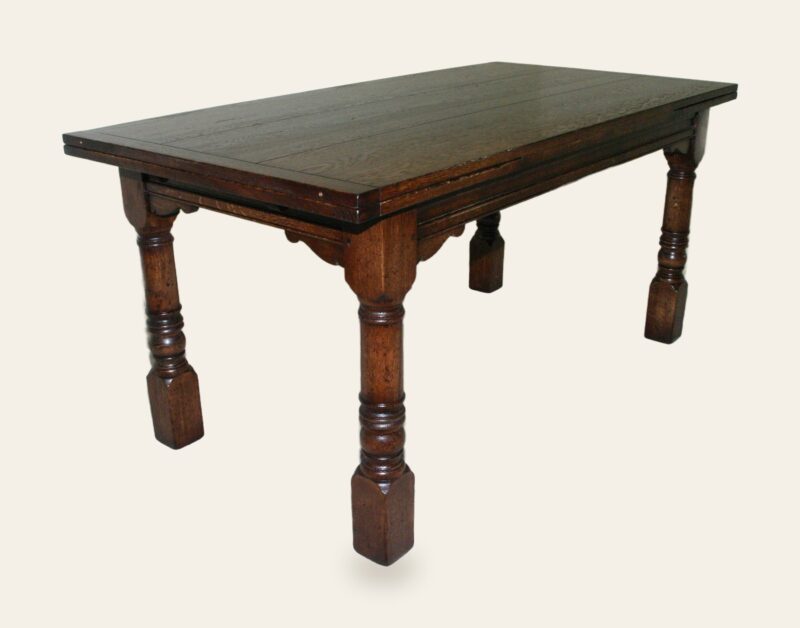
Drawleaf refectory. The most-specified table in the range: a planked top on a stretchered base, with two 18in leaves. See refectory tables.
Square-cut baluster leg drawleaf refectory. The same table on a baluster leg cut square rather than turned, for a heavier base.
Drawleaf monks’ refectory. The refectory drawleaf with the monks’ table arrangement.
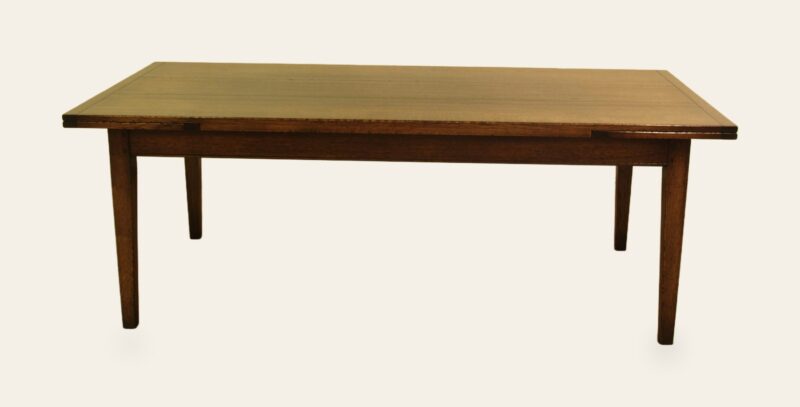
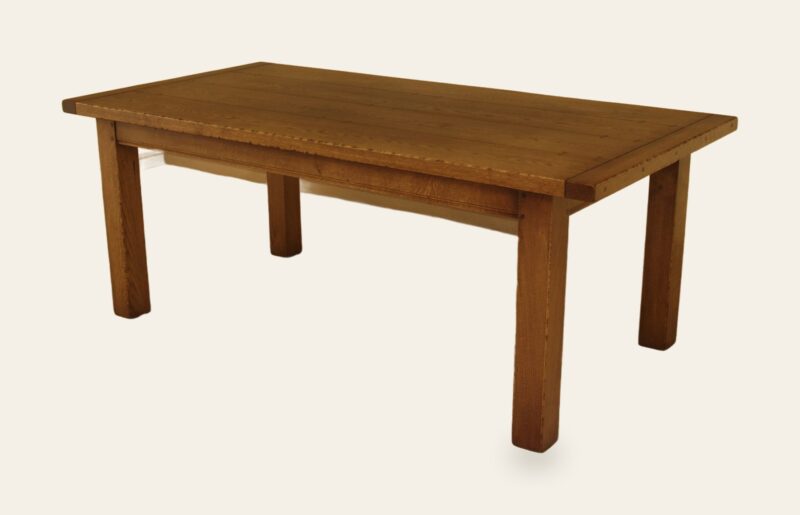
Farmhouse drawleaf. The Pendleton kitchen table with leaves, frequently specified so clients can seat more guests without giving up floor space day to day. See farmhouse tables.
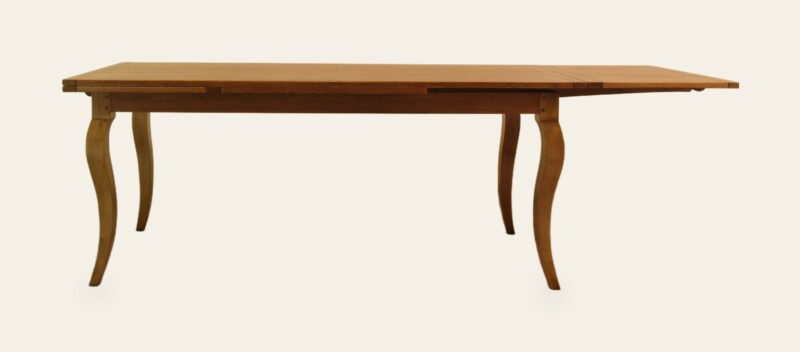
Farmhouse drawleaf with cabriole legs. The S-curved leg dresses the same table up for a dining room rather than a kitchen.
Oakamoor drawleaf. The chunkier, timber-led alternative, with a substantial leg bevelled on its inside edge. See the Oakamoor range.
Turned bulbous drawleaf. A bulbous turned leg — swelling at the waist, gathered above and below — under a drawleaf top.
Round and oval tables extend differently, with a single loose leaf or a slide-and-insert action. See pedestal tables and extending tables.
Sizes
As a guide, on a refectory drawleaf with two 18in leaves:
| Closed width (in) | One leaf out (in) | Both leaves out (in) | Depth (in) |
|---|---|---|---|
| 72 | 90 | 108 | 35 or 39 |
| 84 | 102 | 120 | 35 or 39 |
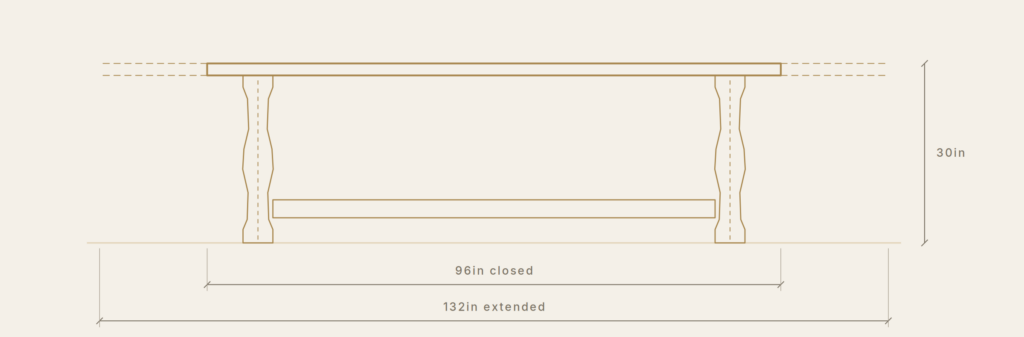
| 96 | 114 | 132 | 35 or 39 |
Standard height is 30in. Allow about 24in of table edge per person, and check the clearance behind the chairs at the extended length — about 36in — before settling on a closed size.
Timbers
Oak, cherry, mahogany and walnut as standard. Oak is the usual choice, and the one the mechanism was designed around.
Specials, on application: character oak with the knots and movement left in; pippy oak in light, medium and heavy grades for tops; oak selected for its medullary ray, within or without the timber; and clean timber with no knots at all.
Finishes: polished, painted, limed, sand-blasted, rub-through paint, natural, or colour matched to a sample. Timber and finish samples are posted out before you commit to anything.
Made to your size
Closed length, extended length, depth, height, leg pattern and top thickness are all yours to set, and leaf length is not fixed at 18in. Common changes: a heavier or lighter top section; legs set inboard so a bench settle fits under; a base from one pattern beneath a top from another.
If the piece is a new design rather than a variation, our designers draw it first. See bespoke and commissioning.
Prices
Quoted individually to size and specification. Tell us the closed length, the depth, the base, the timber and the finish and we will give you a guide price. Special timbers and finishes are priced on application. Standard lead time is normally twelve weeks, and up to sixteen when the workshop is busy. Your date is confirmed when you order.
Clients who commission a drawleaf table often ask who does their panelling or their kitchen. The answer is the next bench along: Reeve & Co Interiors for fitted joinery, Square & True for kitchens.
Every size, timber and finish for our drawleaf tables is priced on the Drawleaf tables order page, where you can choose the options and pay the deposit online.
Against the wall behind it, a server table or sideboard in the same timber gives somewhere to serve from.
Frequently asked questions
What is a drawleaf table?
An extending table whose leaves are stored under the main top rather than separately. Pulling a leaf out draws it along tapered bearers so it rises and finishes level with the top, adding length with nothing to fetch, fit or store.
How long does it take to extend a drawleaf table?
A few seconds, and one person can do it. There is nothing to lift, unbolt or carry, which is the practical reason clients choose the form over a table with a loose leaf.
How much length do the leaves add?
On our refectory tables the standard is two 18in leaves, adding 36in in total, and one can be run out on its own for an intermediate length. Leaf sizes are made to whatever your room requires.
Do the leaves match the top?
Yes. They are cut and matched from the same boards, finished together, and live under the table in the same room, so they weather at the same rate — the main advantage over a leaf kept in a cupboard.