 Skip to content
A lamp table has one job that decides everything: it has to put a glass down at the height of the arm of the chair beside it. Too low and you reach over the arm every time. Too high and it looms.
On this page
A hall table has a different job. It is the first piece of furniture anybody sees in your house, and it lives in the narrowest space in it.
We make both to order, so the height and the depth are decisions rather than whatever the shop had.
Lamp tables
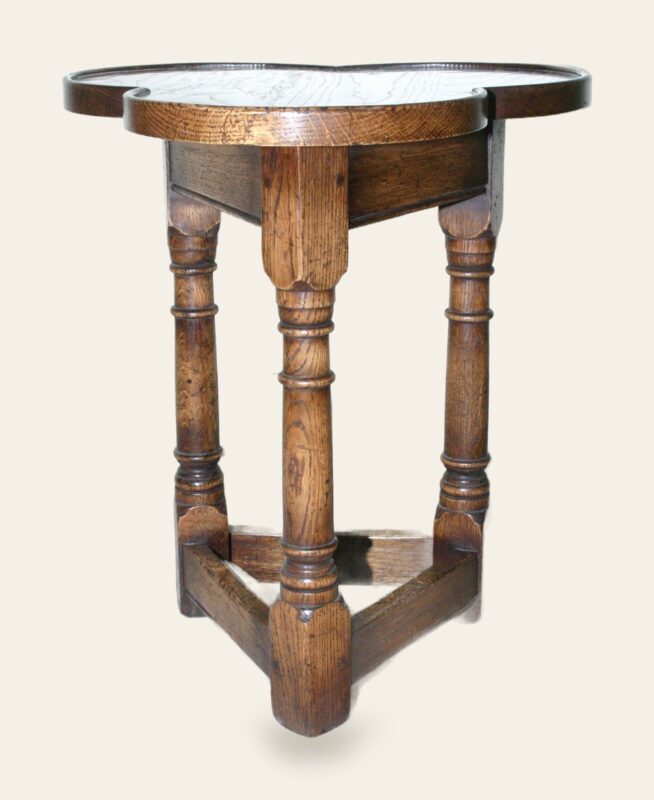
Clover leaf lamp table, small and large. The top cut as a quatrefoil — four lobes meeting at the centre, like a clover, so there are no corners to catch a hip. Made in cherry as well as oak.
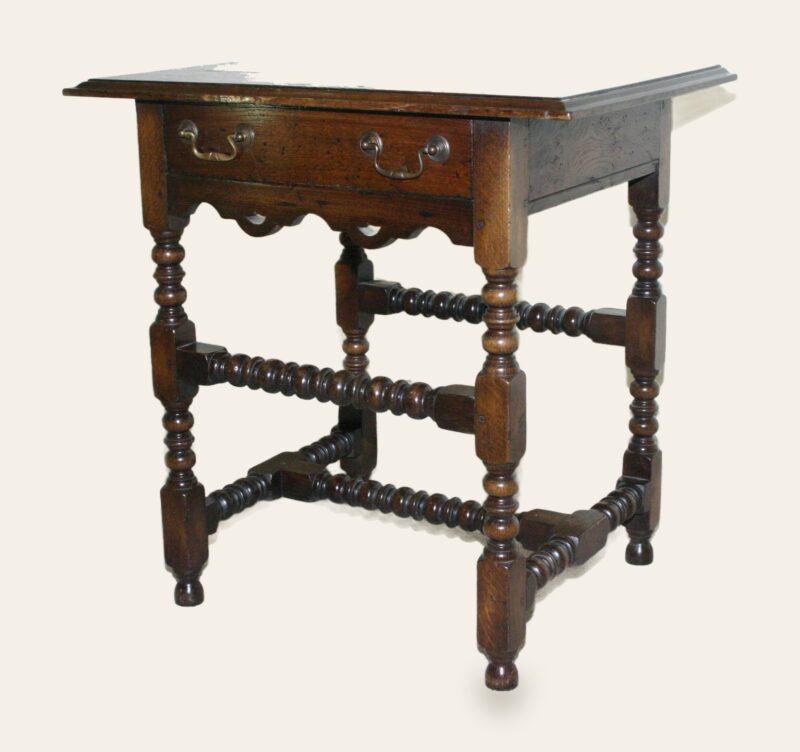
Bobbin side table. Legs turned as a run of bobbins, a repeating series of small beads and hollows. The turning takes light beautifully and reads far lighter than a square leg.
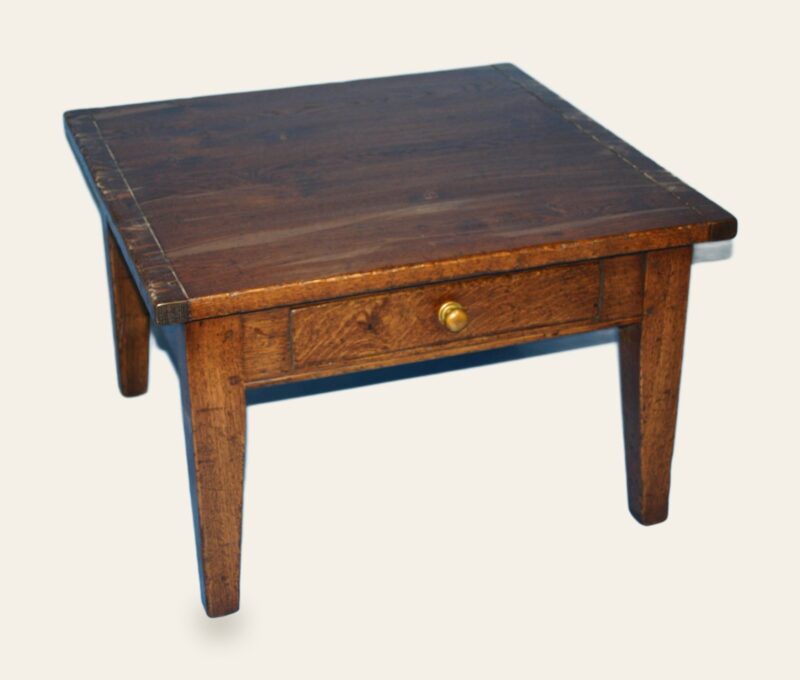
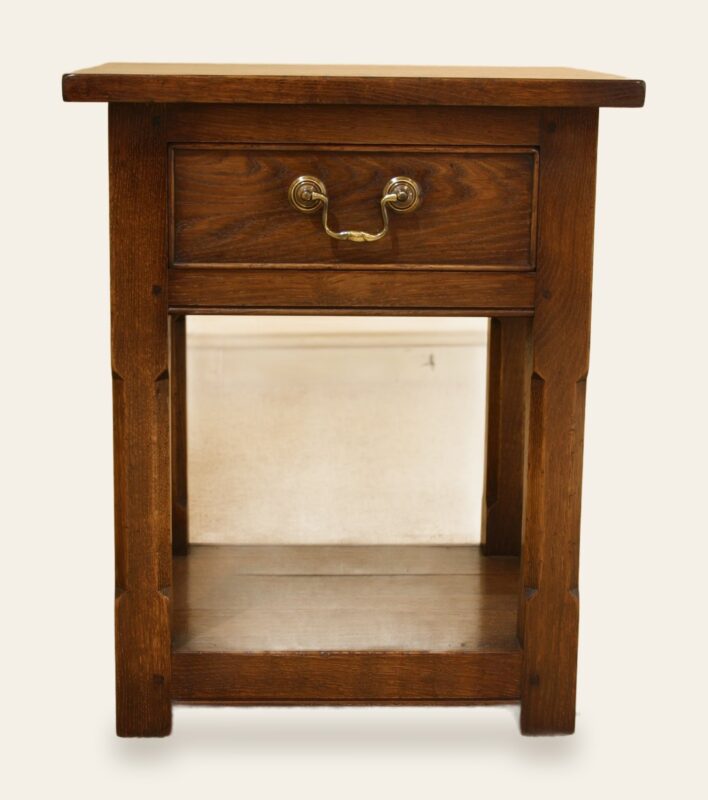
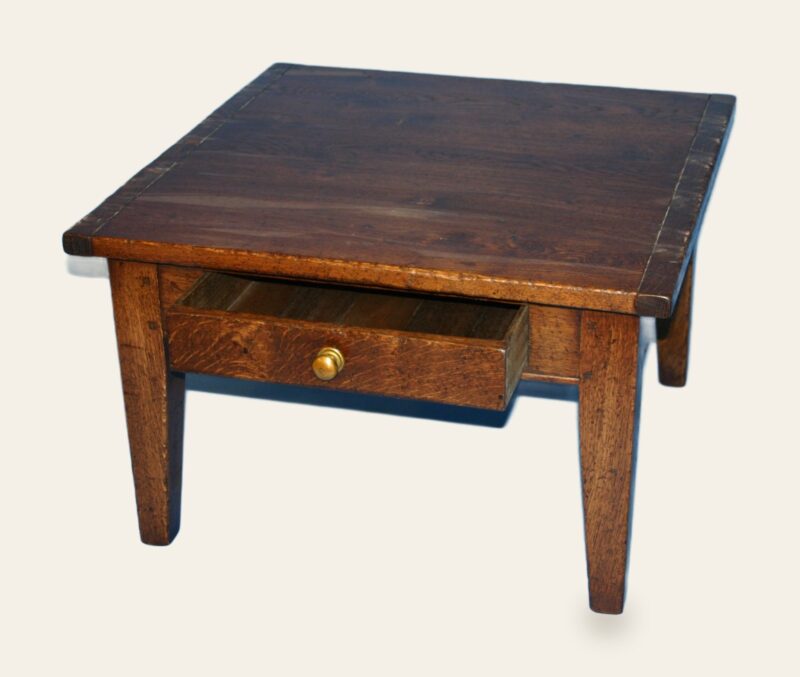
Farmhouse lamp table. The plain country pattern, wide front framing and a single drawer. Made with and without a potboard drawer beneath.
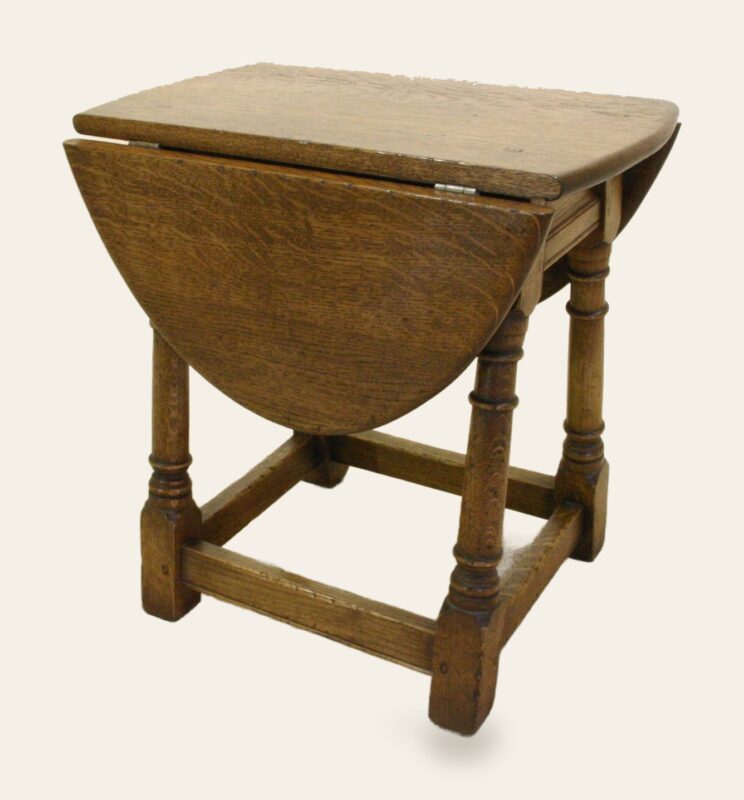
Drop leaf lamp table. A narrow fixed centre with a hinged leaf on one or both sides. Closed it sits tight against a chair; open it takes a tray. Oval or rectangular.
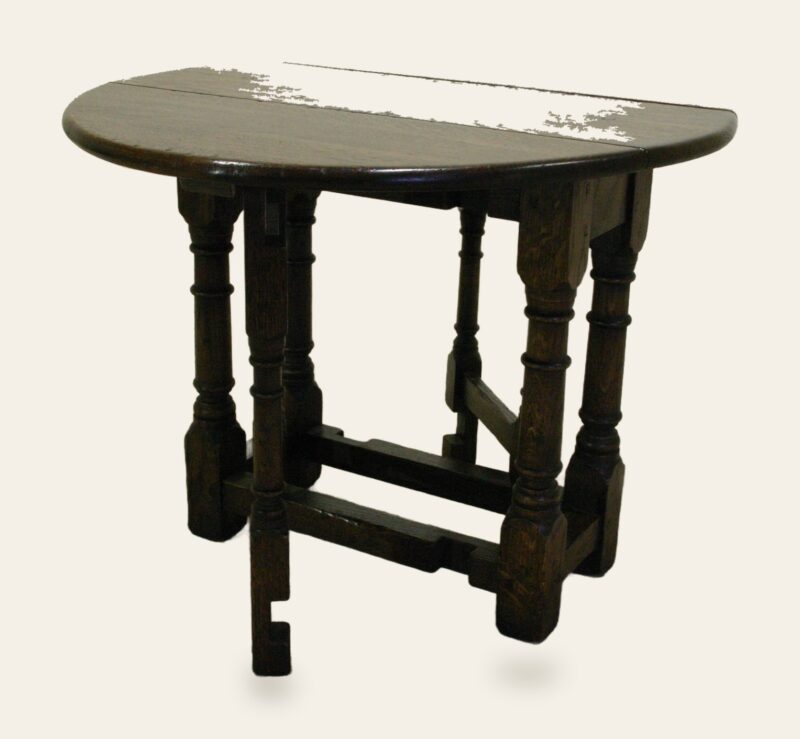
Gateleg lamp table. The same, with the leaves supported by legs that swing out from the frame — the gates. A much larger top from a much smaller table.
Canted corner lamp table with one drawer. Corners cut off at forty-five degrees, which softens the outline and means nobody catches a knee on it.
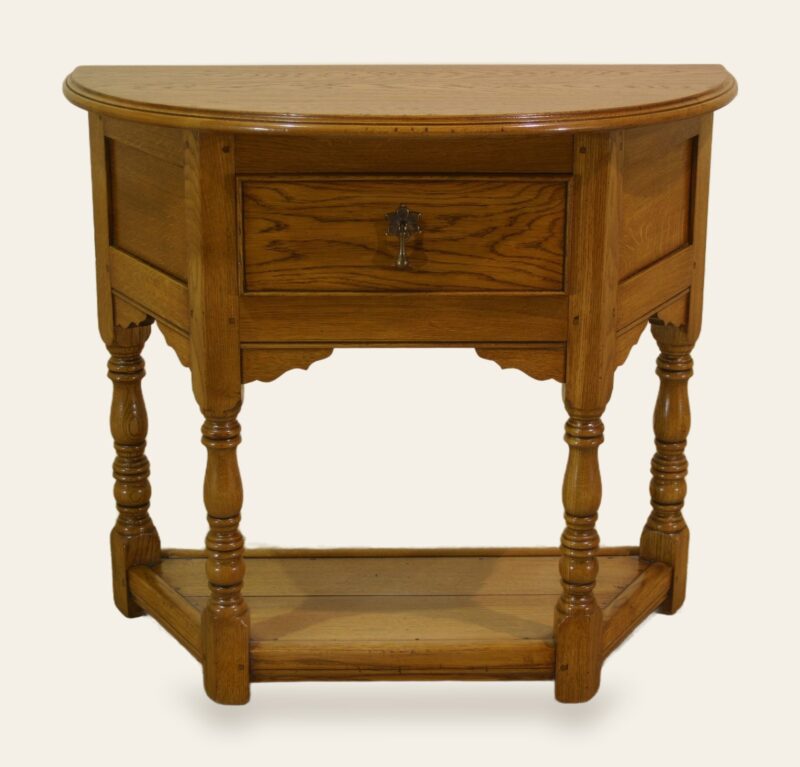
Half round lamp table with one drawer. A semicircular top, flat edge to the wall. It reads as a full round and takes half the depth.
Joint stool and lamp table. The oldest piece of furniture in the English house: four splayed turned legs, stretchers all round, a thick top. Made in matching patterns to our settles and benches.
Round tripod table. A round top on a turned column and three shaped feet, which stand on an uneven floor without rocking.
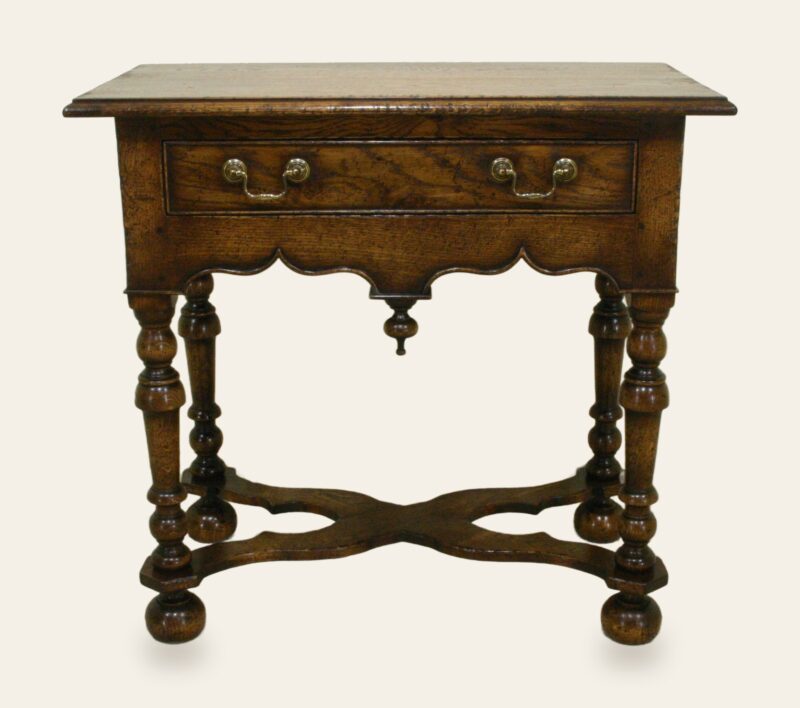
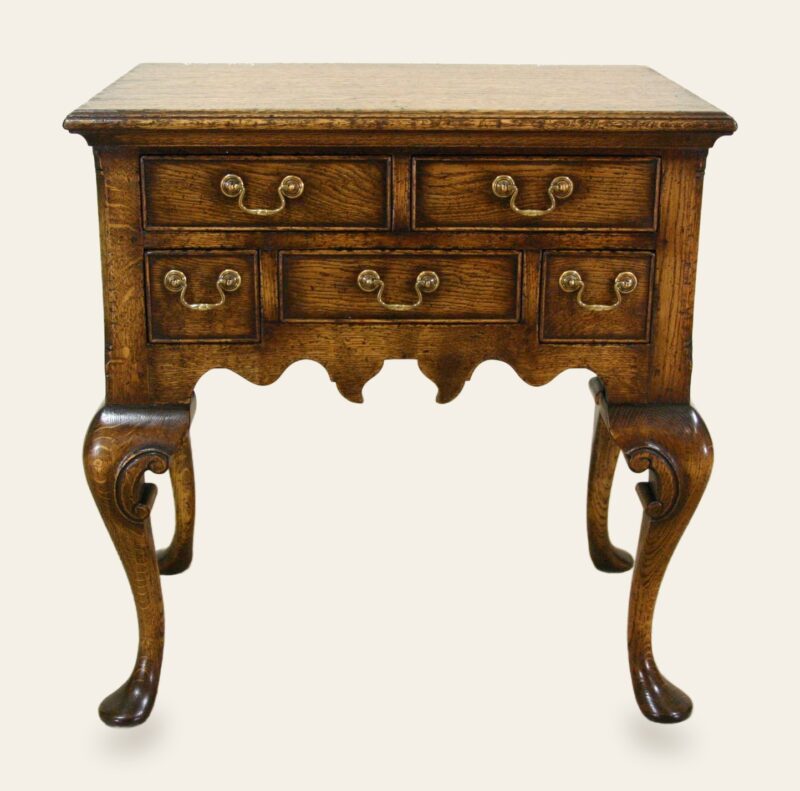
Low boy. A low chest on legs, with a shaped apron and a run of drawers, between a side table and a small chest of drawers. For a hall or bedroom needing storage in the depth of a table.
Hall and side tables
Cross-stretcher hall table. A stretcher running corner to corner beneath, usually with a turned finial where the arms meet. It stiffens a narrow table.
H-stretcher hall table. A stretcher along each side with a bar between them, forming an H in plan. Stronger under length, and the choice for a long hall table.
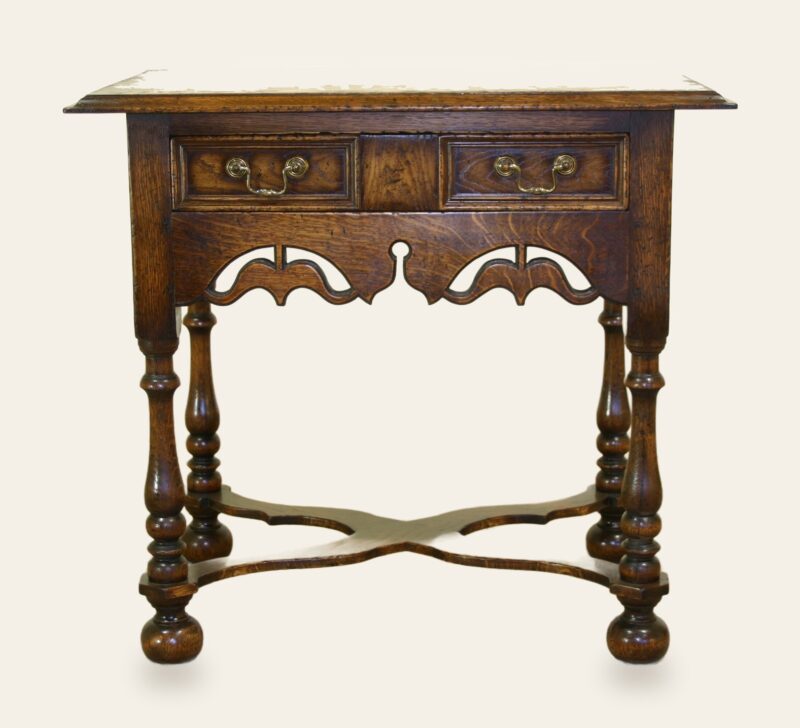
Bun foot hall table with X stretcher. Turned bun feet under an X stretcher, which grounds a table that is otherwise all leg.
Fretted bun foot hall table. The same, with fretwork — pierced decorative timber — in the frieze or stretcher.
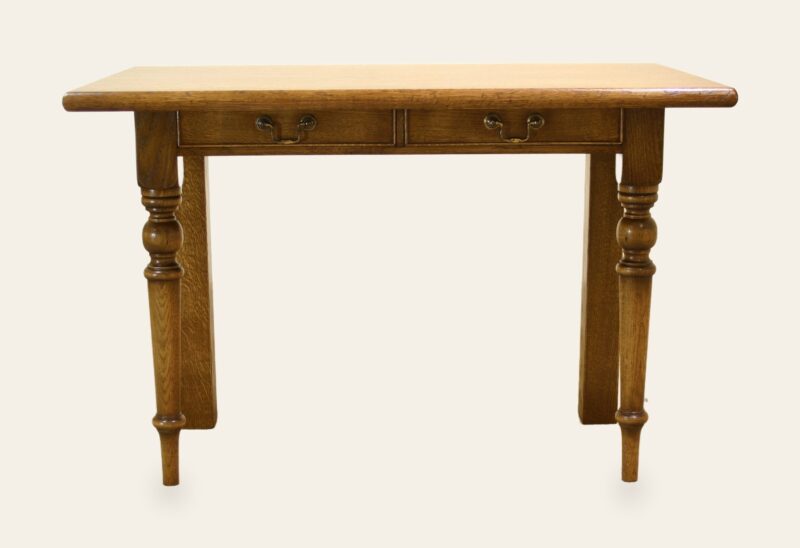
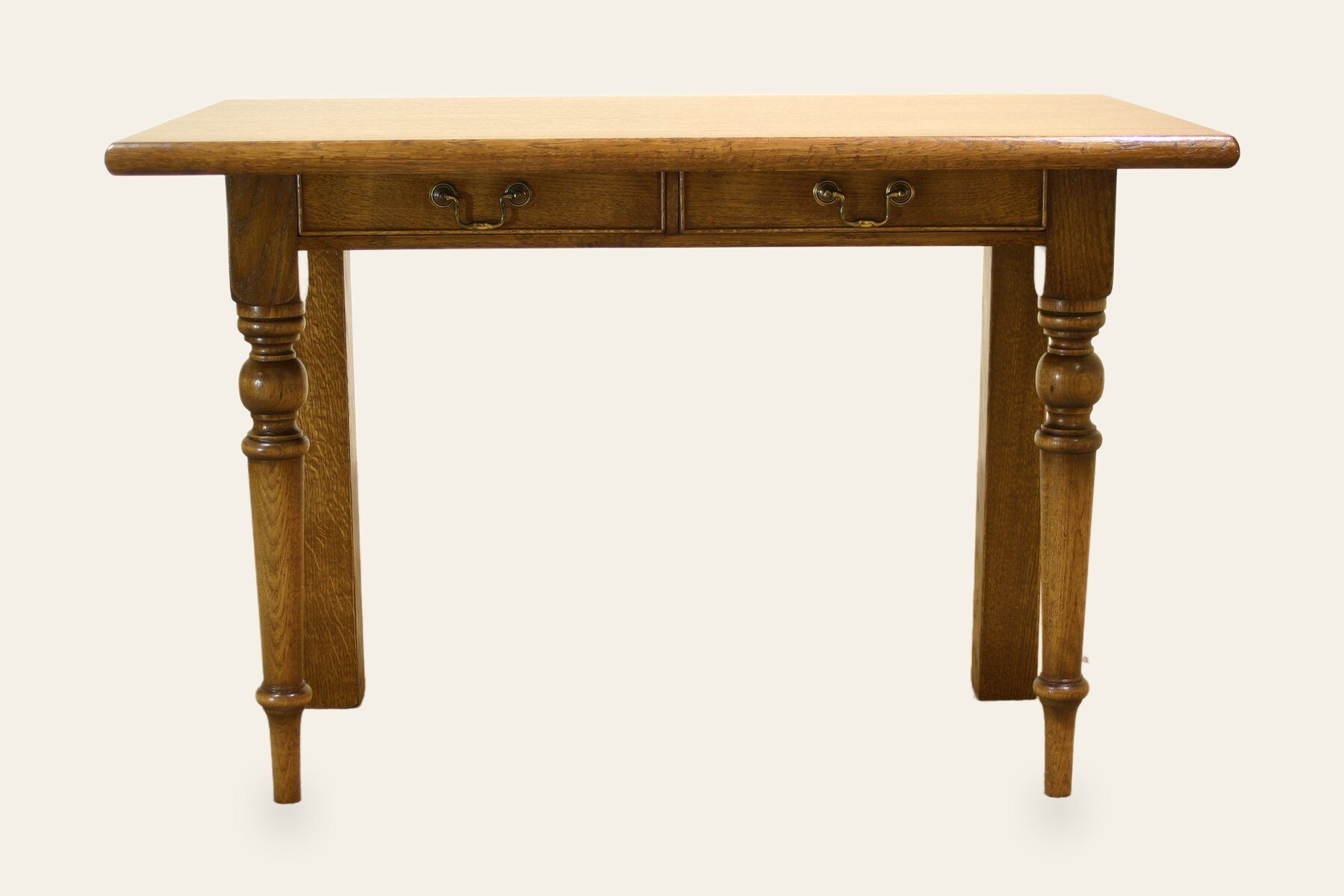
Two-drawer hall table with turned front legs. Turned at the front, square at the back where nobody sees them. Two drawers for keys and post.
Hall table with one drawer. The narrow version, for a corridor where a deeper table would make people turn sideways.
Large side table with turned legs. For a wide hall, a landing or a dining room wall. Related to the servers.
Timbers
Oak, cherry, mahogany and walnut are the standard four, and every table here is made in all of them. Cherry suits the drop leaf and clover leaf patterns and darkens markedly over the first few years; mahogany suits the tripod and low boy.
Specials, on application: character oak; pippy oak in light, medium and heavy grades — on a small top a heavy pippy figure is the whole piece; oak selected for medullary ray; and clean timber with no knots at all.
Finishes: polished, painted, limed, sand-blasted, rub-through paint, natural, or colour matched. We can match furniture that is 100 years old to new reproduction purchases made the year before.
Order timber and finish samples. These pieces sit beside something you already own, so it is the match, not the table, you are choosing.
Standard sizes
12 piecesFarmhouse Lamp table
Width 20″ (51cm)1ft 8in51cm510mmDepth 20″ (51cm)1ft 8in51cm510mmHeight 24″ (61cm)2ft61cm610mm
Oak, cherry, mahogany or walnut
Joint stool / lamp table
Width 19″ (48cm)1ft 7in48cm480mmDepth 11″ (28cm)11″28cm280mmHeight 20″ (51cm)1ft 8in51cm510mm
Oak, cherry, mahogany or walnut
Lamp table with potboard, no drawer
Width 18″ (46cm)1ft 6in46cm460mmDepth 18″ (46cm)1ft 6in46cm460mmHeight 22″ (56cm)1ft 10in56cm560mm
Oak, cherry, mahogany or walnut
Lamp table with potboard, with drawer
Width 18″ (46cm)1ft 6in46cm460mmDepth 18″ (46cm)1ft 6in46cm460mmHeight 22″ (56cm)1ft 10in56cm560mm
Oak, cherry, mahogany or walnut
Clover leaf lamp table
Small
Width 18″ (45cm)1ft 6in45cm450mmDepth 18″ (45cm)1ft 6in45cm450mmHeight 20″ (51cm)1ft 8in51cm510mm
Oak, cherry, mahogany or walnut
Clover leaf lamp table
Large
Width 22″ (56cm)1ft 10in56cm560mmDepth 22″ (56cm)1ft 10in56cm560mmHeight 26″ (66cm)2ft 2in66cm660mm
Oak, cherry, mahogany or walnut
Side (hall) table with cross-stretcher
Width 30″ (76cm)2ft 6in76cm760mmDepth 30″ (76cm)2ft 6in76cm760mmHeight 18″ (46cm)1ft 6in46cm460mm
Oak, cherry, mahogany or walnut
Side (hall) table with H-stretcher
Width 32″ (82cm)2ft 8in82cm820mmDepth 30″ (76cm)2ft 6in76cm760mmHeight 16″ (41cm)1ft 4in41cm410mm
Oak, cherry, mahogany or walnut
Bobbin side (hall) table
Width 30″ (76cm)2ft 6in76cm760mmDepth 30″ (76cm)2ft 6in76cm760mmHeight 18″ (46cm)1ft 6in46cm460mm
Oak, cherry, mahogany or walnut
Rowton caddy-top side table in Cherry
Width 36″ (91cm)3ft91cm910mmDepth 20″ (51cm)1ft 8in51cm510mmHeight 33″ (84cm)2ft 9in84cm840mm
Cherry
Painted side table with pippy oak top
Width 60″ (152cm)5ft152cm1520mmDepth 20″ (51cm)1ft 8in51cm510mmHeight 33″ (84cm)2ft 9in84cm840mm
Hand-painted · oak, cherry, mahogany or walnut beneath
Painted side table with standard oak top
Width 60″ (152cm)5ft152cm1520mmDepth 20″ (51cm)1ft 8in51cm510mmHeight 33″ (84cm)2ft 9in84cm840mm
Hand-painted · oak, cherry, mahogany or walnut beneath
These are the sizes we make as standard. Every piece is made to order in our own workshop, so any size between — or beyond — those listed can be made for you. Heights and depths can be altered to suit a room, and dimensions are nominal.
Made to your size
Small tables are the easiest to alter and the most worth altering, because they are fitted into gaps.
Common changes: height set from the arm of a particular chair; depth reduced so a hall table does not narrow a corridor; a drawer added or deepened; a potboard added; the top shape changed between round, oval, square and canted; leaves added to a fixed top; a pair made to flank a sofa.
If the piece does not exist yet, our designers draw it first. See bespoke and commissioning.
Prices
Quoted individually. Tell us the pattern, the size, the timber and the finish and we will give you a guide price. Special timbers and finishes are on application. Lead time is normally twelve weeks, and up to sixteen when the workshop is busy. Your date is confirmed when you order. A one-off commission usually adds about four weeks.
Every side table we make leaves the same Suffolk workshop as our fitted joinery. Where a project also calls for panelling, a library or a fitted kitchen, that work is done by our sister companies, Reeve & Co Interiors and Square & True.
Every size, timber and finish for our lamp and side tables is priced on the Lamp and side tables order page, where you can choose the options and pay the deposit online.
Frequently asked questions
What height should a lamp table be?
Level with the arm of the chair beside it, or a little above. Measure your chair arm from the floor and send us that figure — it decides whether the table is a pleasure or a nuisance.
What is a clover leaf table?
A lamp table with the top cut as four lobes meeting at the centre, in the shape of a clover leaf. No sharp corners, which suits a route through a room. Made small and large.
Which side table works in a narrow hall?
A half round table with the flat edge to the wall, or a shallow one-drawer hall table. Send the corridor width and we will tell you the deepest that works.
Can you make a pair of matching lamp tables?
Yes, and ordering them together is worth doing, because the pair is then cut from the same boards. Two made a year apart in the same pattern will still differ in figure and colour.