 Skip to content
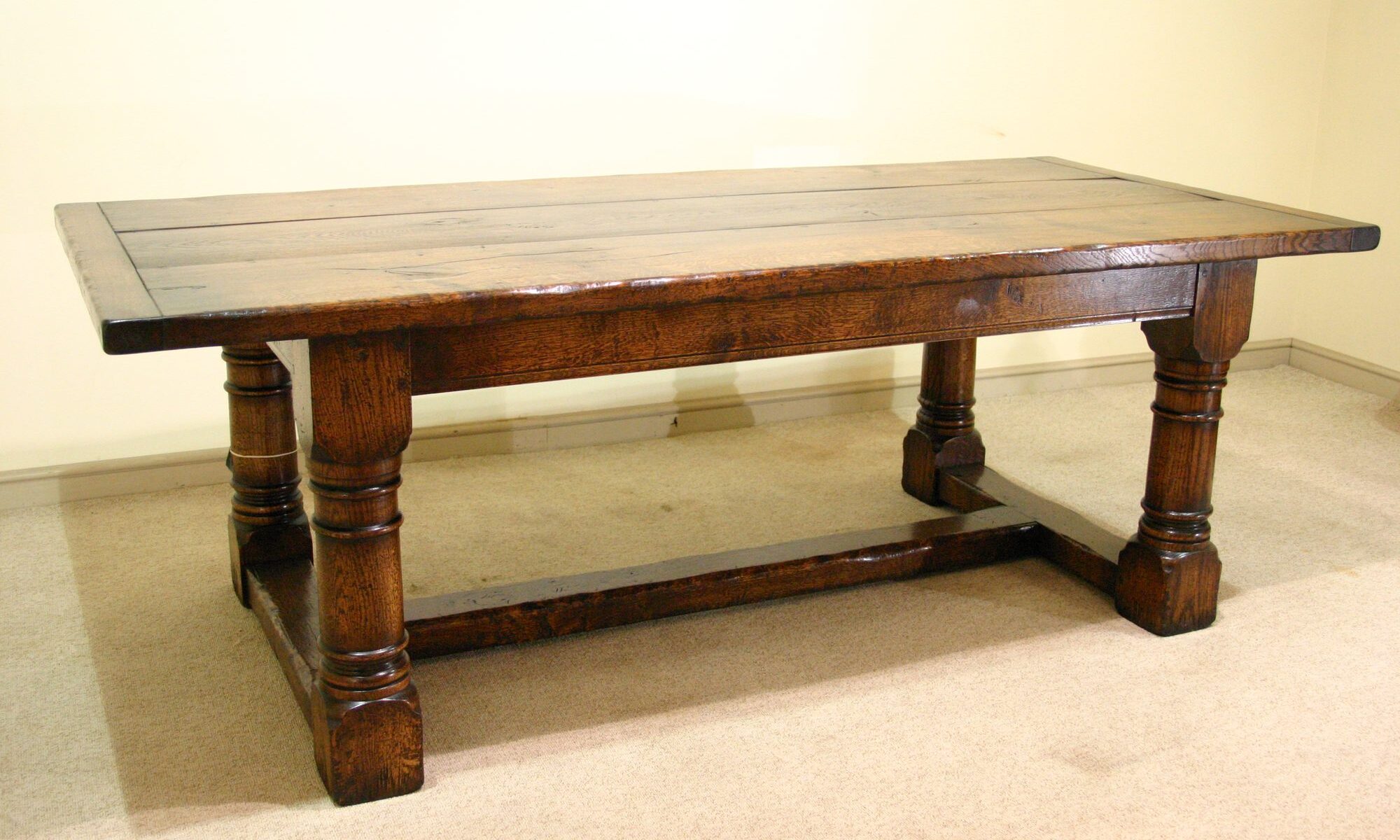
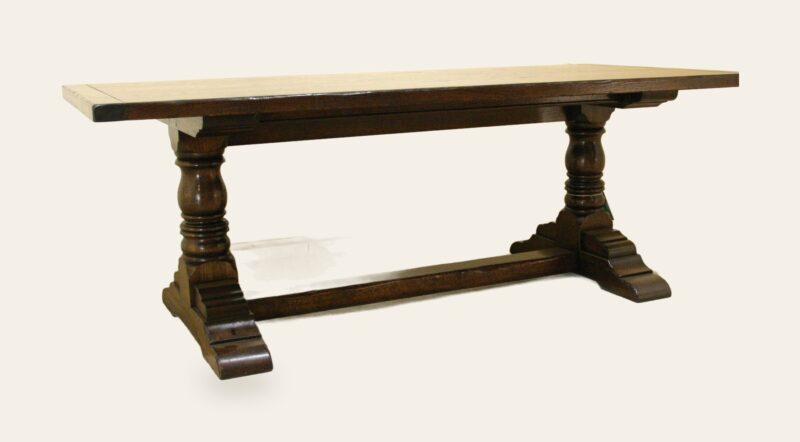
A refectory table is a long table on a stretchered base. The top is made of wide planks; the legs sit at the extreme ends rather than at the corners of a frame; and a stretcher runs low between them to hold the whole thing rigid. The form comes from the monastic refectory — the dining hall — where a table had to be long, strong and clear underneath so that people could sit shoulder to shoulder along both sides.
On this page
That is still what it is good for: ten or twelve people at one table, with no leg landing between two of them. We have made them in this workshop for thirty years, and they remain the piece Bryn Hall is best known for.
What makes it a refectory table
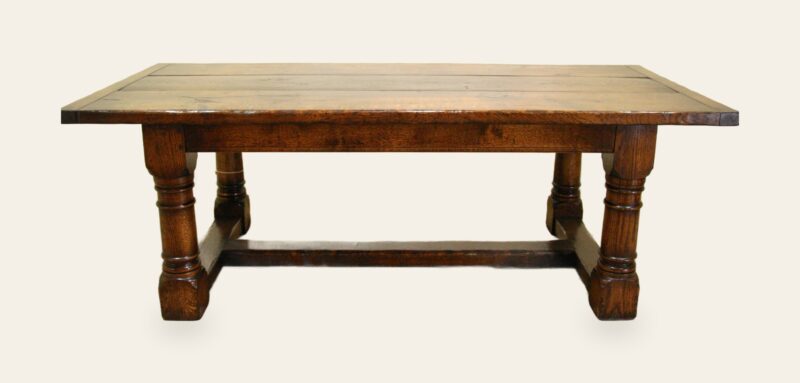
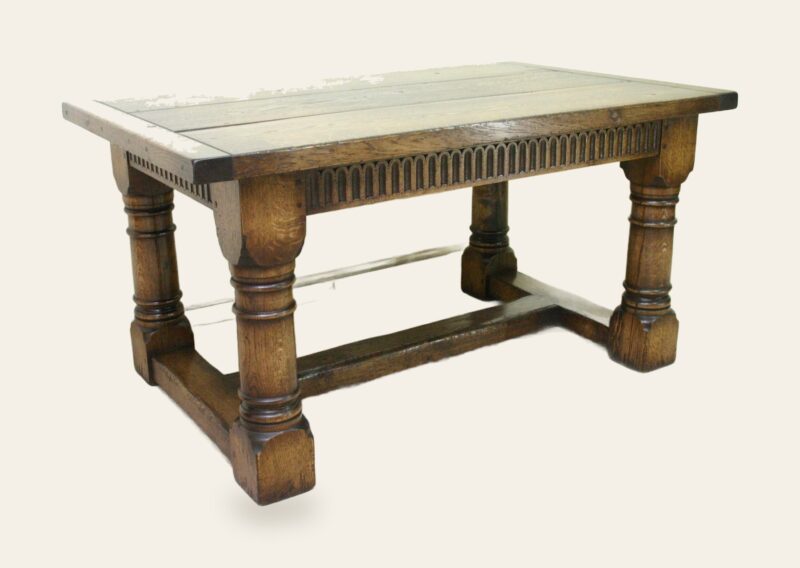
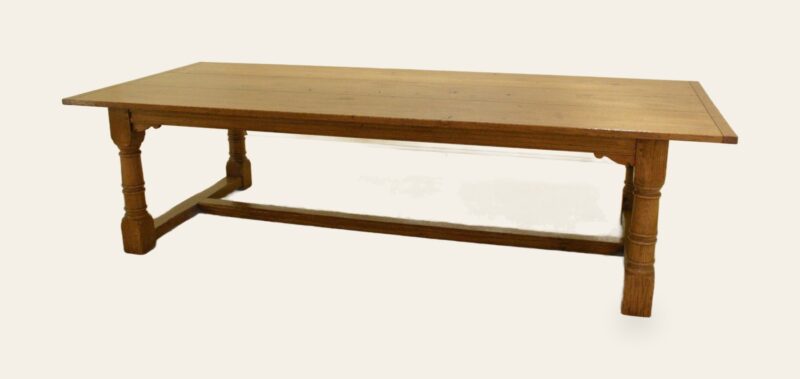
A planked top. Wide boards laid side by side, with the joints showing as lines down the table. Our standard pattern is a four-planked top in a nominal 2in section — thick enough to read as solid from across the room and to take a century of use.
End-standing legs. Set in from the ends and carrying the top on a heavy rail, so nobody sits with a leg between their knees.
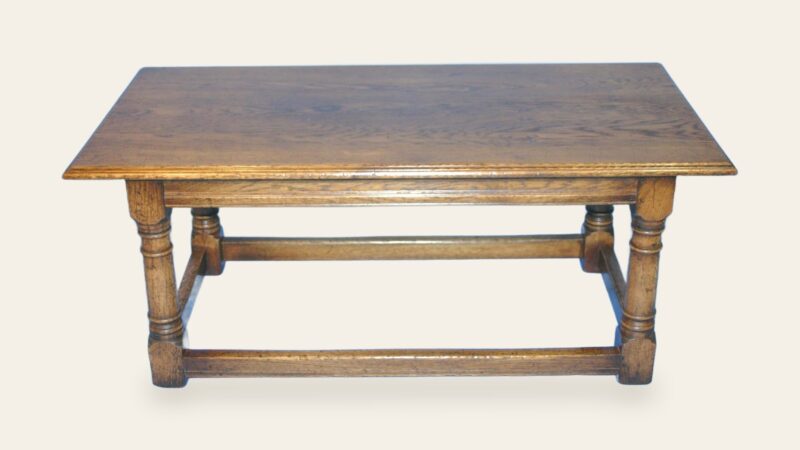
A low stretcher. Traditionally at floor level, tying the two leg assemblies together, which is why a refectory table does not rack when twelve people lean on it. We also build them without a stretcher where you want the feet clear.
The forms we make
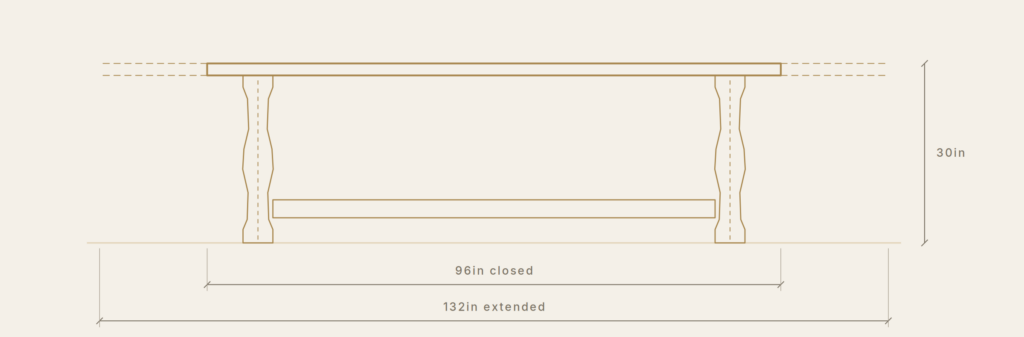
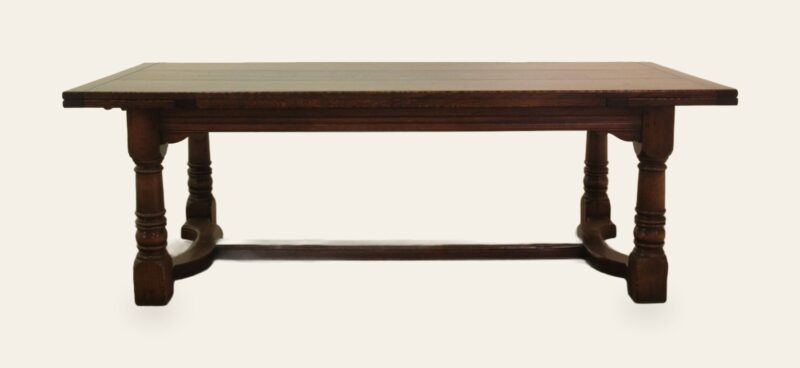
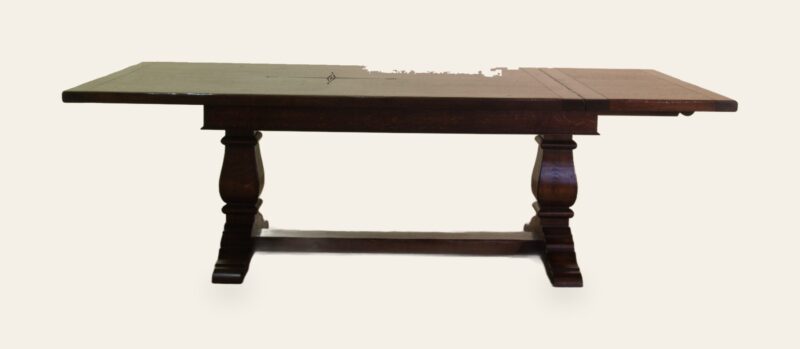
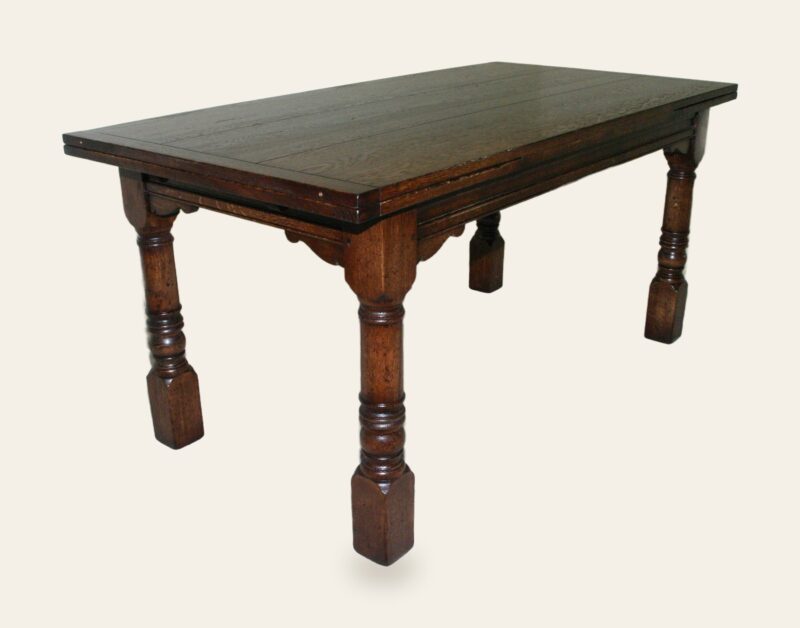
Drawleaf refectory, with two 18in leaves. The most-specified table in the range. The two leaves live under the main top and draw out level at either end, adding three feet in seconds with nothing to store. The mechanism is explained on the drawleaf tables page.
Fixed planked-top refectory. The purest version: a single uninterrupted top in a nominal 2in section, with no moving parts at all.
Drawleaf monks’ refectory. The refectory base and top with the monks’ arrangement, so the table works as both. See monks’ tables.
Fixed planked-top monks’ refectory. The same, without leaves.
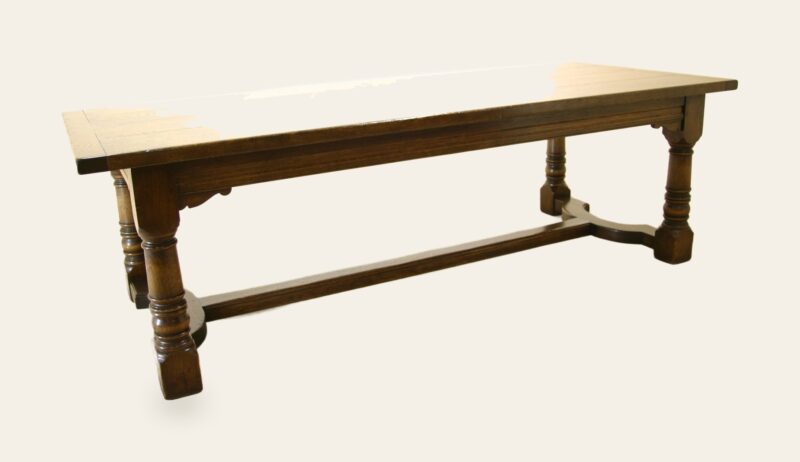
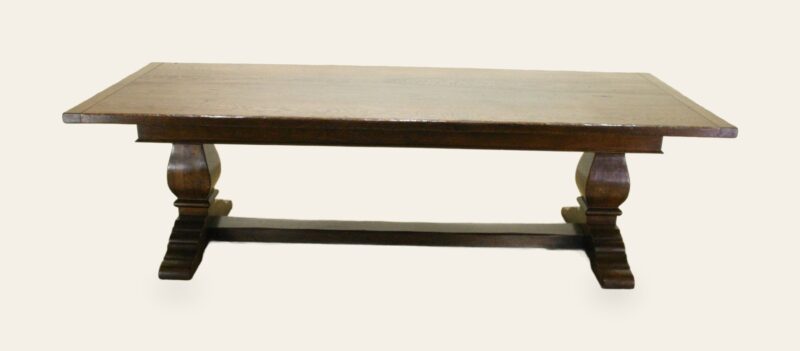
Square-cut baluster leg drawleaf refectory. The baluster turning — the swelling, vase-shaped profile — cut square rather than turned, giving a heavier leg with flat faces that catch the light.
Baluster refectory. The classic turned baluster leg, bulbous at the waist, on a moulded foot. The dressier of the two baluster options.
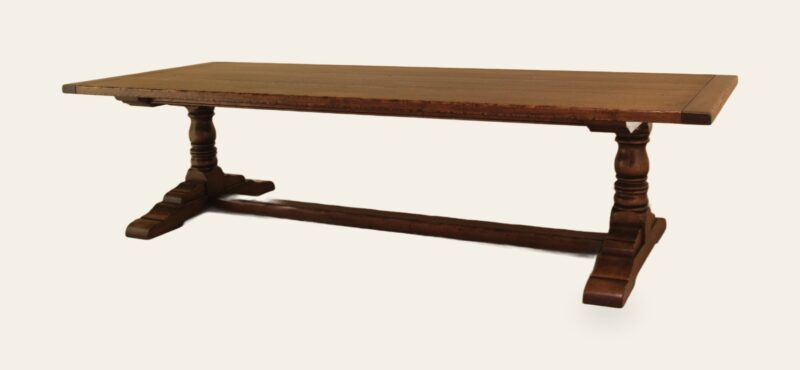
Bandsaw-base refectory. The base cut from the solid rather than turned, giving broad shaped standards at each end instead of legs. Available as a twin pedestal.
Character refectory. Any of the above, made in character oak — knots, shakes and figure deliberately left in, so the table reads as old from the day it arrives.
Sizes we commonly make
These are the widths we build most often. Any size is possible — the table is made from scratch for you.
Drawleaf refectory table
With 2 leaves of 45 cm (18″) each leaf
Width 72, 78, 84, 90, 96, 108, 114 or 120″ (182–305cm)6ft, 6ft 6in, 7ft, 7ft 6in, 8ft, 9ft, 9ft 6in or 10ft182, 198, 213, 228, 244, 275, 290 or 305cm1820, 1980, 2130, 2280, 2440, 2750, 2900 or 3050mmDepth 35 or 39″ (90 or 100cm)2ft 11in or 3ft 3in90 or 100cm900 or 1000mmHeight 30″ (76cm)2ft 6in76cm760mm
Fixed planked top refectory table
With nominal 5cm/2in top
Width 72, 78, 84, 90, 96, 108, 114 or 120″ (183–305cm)6ft, 6ft 6in, 7ft, 7ft 6in, 8ft, 9ft, 9ft 6in or 10ft183, 198, 213, 228, 244, 275, 290 or 305cm1830, 1980, 2130, 2280, 2440, 2750, 2900 or 3050mmDepth 35 or 39″ (90 or 100cm)2ft 11in or 3ft 3in90 or 100cm900 or 1000mmHeight 30″ (76cm)2ft 6in76cm760mm
Square-cut baluster leg drawleaf refectory table
Width 96 or 120″ (244 or 305cm)8ft or 10ft244 or 305cm2440 or 3050mmDepth 39″ (100cm)3ft 3in100cm1000mmHeight 30″ (76cm)2ft 6in76cm760mm
Character refectory table
Width 96 or 120″ (244 or 305cm)8ft or 10ft244 or 305cm2440 or 3050mmDepth 35 or 39″ (90 or 100cm)2ft 11in or 3ft 3in90 or 100cm900 or 1000mmHeight 30″ (76cm)2ft 6in76cm760mm
Made in oak, cherry, mahogany or walnut
These are the sizes we make as standard. Every piece is made to order in our own workshop, so any size between — or beyond — those listed can be made for you. Heights and depths can be altered to suit a room, and dimensions are nominal.
A 35in depth takes place settings on both sides with a narrow centre run; at 39in you have a proper channel for dishes, boards and candlesticks. Two 18in leaves take a 96in table to 132in. Allow about 24in of table edge per person and 36in of clearance behind the chairs.
Timbers
Oak, cherry, mahogany and walnut are the standard four, and every refectory table is made in all of them. Oak is the traditional and much the most common choice.
Specials, quoted on application: character oak, with the knots and movement left in — the most-requested special on this form; pippy oak in light, medium and heavy grades, for tops; oak selected for medullary ray, the silver-grey figure that flashes across quarter-sawn oak, within or without the timber; and clean timber with no knots at all.
Finishes: polished, painted, limed, sand-blasted, rub-through paint or natural, or colour matched to a sample you send us. We can match furniture that is 100 years old to new reproduction purchases made the year before.
Order timber and finish samples. On a table this size, two oak shades are not a small difference.
Made to your size
Every dimension is open. Common changes: a length between the standard widths; a deeper or shallower top; legs moved inboard so a bench settle slides underneath; a base from one pattern under a top from another; a top section heavier or lighter than the nominal 2in standard.
If the piece does not exist yet, our designers draw it before anything is cut. See bespoke and commissioning.
Chairs to go with it
Refectory tables are usually specified with Windsor chairs or ladder backs, a carver at each end, and often a bench settle or long stool where the wall is tight.
Prices
Quoted individually, because no two are the same length. Tell us the width, the depth, the base, the timber and the finish and we will give you a guide price. Special timbers, colour matching and natural finishes are priced on application. Standard lead time is normally twelve weeks, and up to sixteen when the workshop is busy. Your date is confirmed when you order.
We make each refectory table to sit in a room our own joiners have frequently fitted. Reeve & Co Interiors handles the built-in work and Square & True the kitchens, all from the same yard in Mickfield.
Every size, timber and finish for our refectory tables is priced on the Refectory tables order page, where you can choose the options and pay the deposit online.
If you would rather have a clear run of knee room, a double pedestal dining table puts the support under the middle of each half.
For the length to seat a given number, see tables for eight, tables for ten and tables for twelve.
Frequently asked questions
What is a refectory table?
A long dining table with a planked top, legs at the ends rather than the corners, and a low stretcher tying the base together. It comes from the monastic dining hall, where a table had to seat many people along both sides with nothing in the way of their knees.
How many people will an oak refectory table seat?
Allow about 24in of table edge per person. A 72in table seats six to eight, a 96in table eight to ten, and a 120in table twelve or more. A drawleaf version with two 18in leaves adds three feet.
What is the difference between a refectory table and a farmhouse table?
A refectory table has end-standing legs, a low stretcher and usually a heavier planked top. A farmhouse table is a frame table with legs at the corners, often with drawers in the frieze.
Can I have a refectory table that extends?
Yes. The drawleaf refectory carries two 18in leaves under the main top, drawn out level at either end. Nothing is stored elsewhere and the surface stays continuous.